
















Lab Techniques: Freshers Tell Their Stories
Thousands of students step into research laboratories with big dreams of discovering something new. The excitement of innovation, the smell of the lab, and new equipment thrill almost every student. Among all these, the most critical fact a fresher discovers late is the proficiency in lab techniques. Success in labs depends on laboratory skills and one’s ability with the basics.
The theory might look easy, understandable, and perfect in classrooms. But, in real labs, the problem starts when you accidentally spill the reagent or run the machine with the wrong instructions, without a manual. If you are not well with your basics, contamination happens, gels break, and the experiments fail repeatedly.
Freshers who enter the lab without laboratory certifications or laboratory training face many challenges that can ruin the excitement and passion. Their mistakes lead them to lack of opportunities, confidence, motivation, and time. Learning the proper lab techniques is essential for a successful career.
This article brings out the honest and relatable stories, inspired by real experiences that freshers go through. Mastering lab techniques can improve the direction of your career, so start upgrading your lab skills now.
Lesson 1: Theory Doesn’t Equal Technique
You can be a topper and think lab work would be simple because you assume to know the theory behind every protocol, but it doesn’t work that way!
A student with complete confidence began using the pipette, and the confidence crashed the moment she began pipetting. Her first task was to pipette 100 µL. She aspirated incorrectly, introduced bubbles, and delivered almost triple the volume. She couldn’t differentiate between the first stop and the second stop. The experiment collapsed before it even began. She wasn’t scolded, she was guided.
Over the next few weeks, she enrolled in a laboratory certification course and practiced
- Proper handling of pipettes
- Volume measurement and setting
- Avoiding Contamination
- Tip-selection techniques
- Precision and Accuracy
Slowly, she transformed from a nervous beginner to someone her mentor could trust.
Lesson 2: Disappearing DNA Bands Mystery
Molecular Biology and Running Gels seem fascinating. A student with a passion for PCR and Gel electrophoresis had visualised his molecular biology internship as a foundation to something big. But the simplest step, preparing an agarose gel, kept defeating him.
His gels were imperfect:
- It had Air Bubbles
- Wells uneven and broken
- Burnt agarose
- Blurry and smudged DNA bands
Every failed run wasted time, reagents, and sometimes an entire day’s work as he didn’t have any laboratory training.
A senior who had seen his struggles from near finally decided to teach him the art behind the science: accurate weighing, proper heating, careful mixing, avoiding bubbles, and maintaining even thickness. Two days later, his gel runs were perfect, just like he saw in his books and journals.
Lesson 3: Cell Culture Crisis, Contamination Everywhere
Cell culture sounds exciting until contamination hits. A student had seen beautiful images of the cells in textbooks and journals and was thrilled to work with mammalian cells. But she hardly knew how to sterilize the forceps, or to maintain aseptic conditions, and underestimated how delicate and disciplined the workflow needed to be. She felt nervous inside the biosafety cabinet.
Within the first week:
- All the flasks turned cloudy due to contamination
- The Media colour changed
- Contamination Spreads everywhere
Her mentor explained that she unknowingly missed following the basic aseptic protocols: Placed her hands outside the sterile area, forgot to wipe down bottles with alcohol, kept talking while working, and did not flame her instruments properly.
She felt discouraged, but she didn’t quit. She went for training, attended Hands-on Workshops, learned GLP-Aligned Aseptic techniques, and laboratory skills, and soon became the lab’s cell caretaker. Today, with proper laboratory techniques and laboratory certification, she independently manages mammalian cell lines.
Lesson 4: Job Interview Shock
This student completed his Master’s degree with distinction and eagerly applied for positions at biotech companies. The student thought he would be hired based on his grades, but reality proved otherwise.
During interviews, he couldn’t answer the questions recruiters asked, like:
- Can you independently run a PCR?
- Do you know how to prepare buffers and instrument calibration?
- Have you ever worked with HPLC protocol development and documentation?
Every answer began with a NO, and lost multiple opportunities. This made him realise the Gap. Degree-based knowledge wasn’t enough; the companies were looking for candidates with good laboratory skills.
Later, he enrolled to a few laboratory certification courses and he joined Laboratory Training Program and mastered the skills recruiters look for, and cracked this interview in one go!
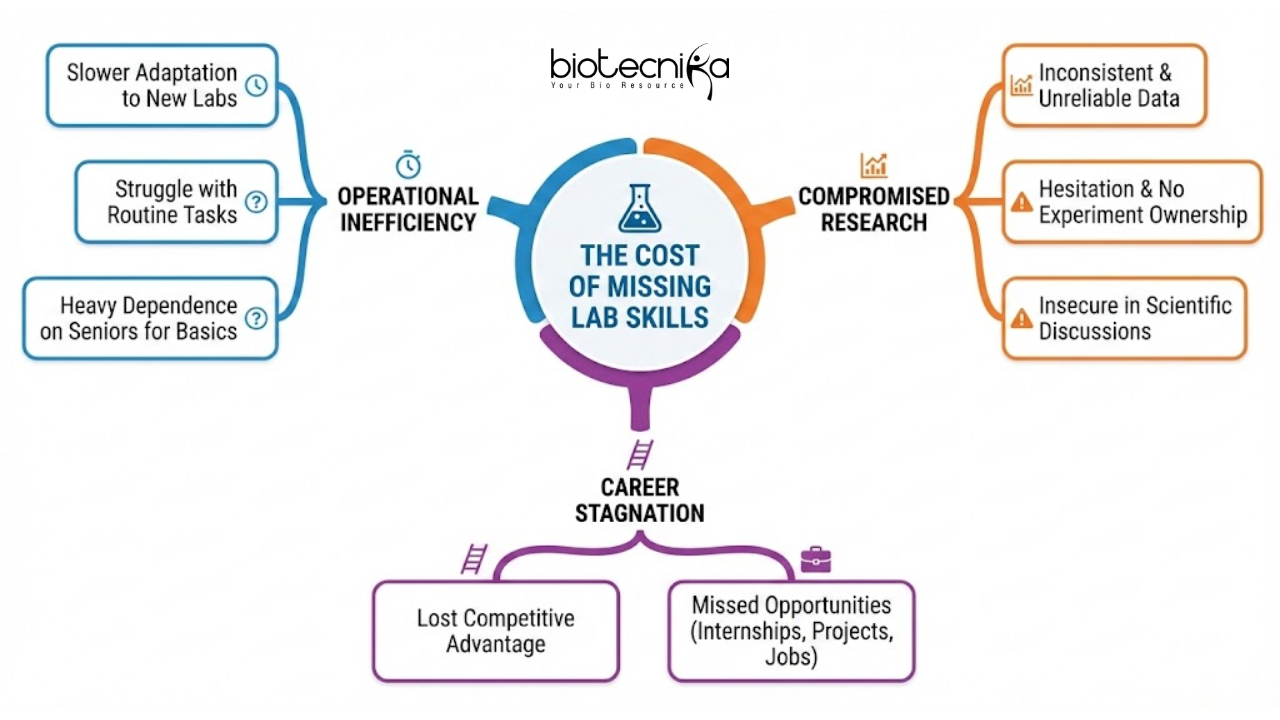
What happens if you don’t learn Lab Techniques?
- Professional Incompetence: Freshers struggle with basic operations, such as proper pipetting, sample handling, and the use of specific equipment, because they lack hands-on training in laboratory skills. This impacts the growth curve in their first job, and results in steep and stressful learning.
- Troubleshooting Difficulties: Without practical experience, freshers often lack the critical thinking and problem-solving abilities needed to troubleshoot when something goes wrong or unexpected results occur. Theory alone rarely prepares the individual, while lab techniques improve decision-making skills in situations that run counter to the plan.
- Safety Hazards: Inexperienced candidates often won’t recognise the potential hazards or follow the safety protocol, and may end up contaminating the cultures. Good Laboratory skills and practices can avoid such experiences and help in the smooth workflow.
- Information Overload and Hesitation: Transitioning from a classroom setting to a professional lab can be challenging. Freshers frequently feel overloaded with new lab techniques and protocols, which can make them reluctant to ask questions or speak up, fearing they’ll be seen as unprepared.
Why Learning Lab Techniques Makes All the Difference
- It saves Time
- It makes you Job-ready
- Failures can be reduced
- It Builds Confidence
- Helps to pursue Research positions
- Accelerates Career Growth
Your Laboratory skills Shape your Journey
In the end, every successful career began exactly as a fresher – uncertain, underconfident, and lacking laboratory skills. What sets professionals apart is not perfection but persistence and a willingness to learn. Lab techniques can’t be mastered overnight; they are built through consistency, curiosity, and the courage to commit mistakes and learn from them. With the proper guidance and training, you can transform uncertainty into expertise that opens the gateways to your dream career. Attend laboratory training workshops and get laboratory certifications that strengthen the skills recruiters look for. Your journey to becoming an independent and skilled researcher starts with one step, and that step is completely in your hands.