










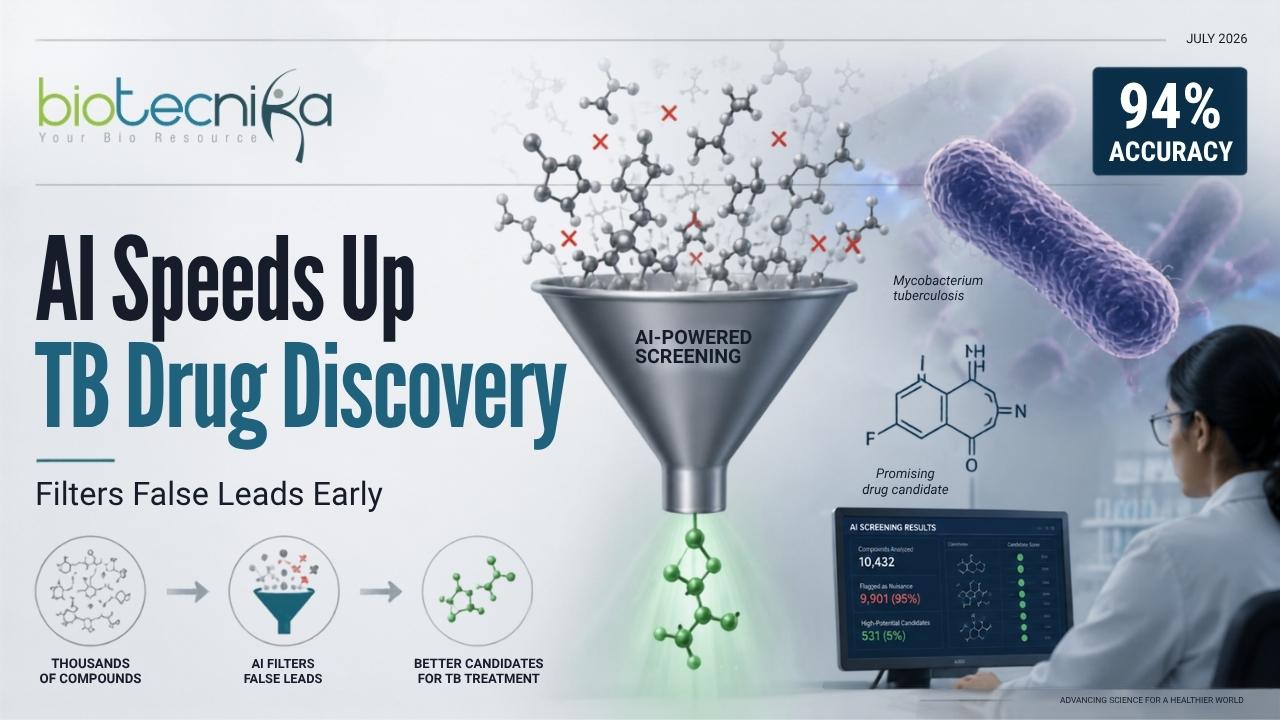
New AI System Speeds Up Tuberculosis Drug Discovery with 94% Accuracy
Tuberculosis (TB) is a notorious disease, and finding new medicines has never been easy. What makes it difficult for scientists is choosing the right drug candidate amongst thousands of molecules. Screening the molecules one by one consumes a lot of time, and many of the promising molecules turn out to be ineffective, though they worked well initially. All these factors not only cost money but time and energy too. With Artificial Intelligence (AI), many of these problems are being solved. To add on to this, the research team at Texas A&M University have now developed an AI system that helps with drug discovery. This system, instead of searching for the drug candidate directly, helps researchers eliminate the misleading drugs, which in turn aids them in focusing on promising candidates.
The study is published in the Journal of Cheminformatics.
Why Tuberculosis Drug Discovery Is Challenging
As mentioned, Tuberculosis is one of the deadliest infectious diseases in the world. It is caused by the bacterium Mycobacterium tuberculosis, infects the lungs and spreads to other organs as well. TB is contagious and spreads via droplets in the air. According to the World Health Organization (WHO), around 10.7 million people developed TB in 2024, and approximately 1.23 million people died from the disease.
What is this a major challenge?
Mycobacterium tuberculosis has a thick protective outer layer that blocks many medicines from damaging its survival. In addition, the organism grows very slowly, due to which experiments can take months to produce results. These factors make drug discovery expensive and time-consuming.
AI Tool Designed to Spot Problematic Compounds
To address this issue, Dr James C. Sacchettini and crew members at Texas A&M University created an AI model called CAGE-Fusion. The system is designed to identify so-called “nuisance molecules” compounds that look effective during laboratory testing but are actually false leads.
The model analyzes compounds and flags four major types of problematic molecules:
- Compounds that clump together and distort test results.
- Molecules that interfere with laboratory assay signals.
- Highly reactive compounds that create misleading outcomes.
- Molecules that interact with many targets instead of the intended one.
By identifying these compounds early, researchers can avoid spending months or even years investigating drug candidates that are unlikely to succeed, which accelerates drug discovery.
Accuracy Reaches 94%
One of the most impressive findings from the study is the model’s performance. When comparing a genuine drug candidate with a nuisance compound, CAGE-Fusion correctly identified the problematic molecule about 94% of the time.
The researchers reported particularly strong performance in detecting highly reactive compounds, which are often responsible for false-positive results during early drug screening. This level of accuracy could significantly improve decision-making in pharmaceutical research and reduce unnecessary costs.
Siddhant Rath, an AgriLife Research scientist in Sacchettini’s lab, says that this model automatically walks through the molecule and pinpoints the exact problematic regions.
Organising Years of Research Data
The team has also integrated the AI model into an open-source platform called DAIKON. The platform helps researchers organise large amounts of drug discovery data collected over many years.
Scientists often struggle to locate information stored across presentations, reports, databases, and laboratory records. DAIKON brings these resources together in one place and allows researchers to search through them more efficiently. The platform is already being used by the Tuberculosis Drug Accelerator (TBDA) consortium, which focuses on developing new treatments for TB.
AI Supports Scientists, Not Replaces Them
The researchers emphasise that AI is not replacing human expertise. Instead, it serves as a powerful assistant that helps scientists decide which paths are worth pursuing and which should be avoided. In drug discovery, knowing what not to study can be just as valuable as identifying a promising candidate. By filtering out false leads and improving access to research data, AI could help accelerate the search for new tuberculosis treatments and bring effective medicines to patients faster.
What this means for Tuberculosis
TB remains a challenging infectious disease, and the need for better treatments continues to grow. AI can’t take over the tasks of producing medicines on its own, but tools like CAGE-Fusion can definitely help the scientists. Ultimately, CAGE-Fusion serves as a decision-support tool that accelerates drug discovery rather than replacing it. By eliminating the less potent candidates, it makes the scientists’ job easier and saves time. In this way, AI-powered drug discovery helps shorten the journey of medicines from the lab to the treatment.