
















Plastic-Eating Fungus Capable of Breaking Down Polyurethane
Plastic, Plastic, Plastic… Plastics everywhere!! Plastic Pollution is one of the major environmental challenges. The extent to which we humans have exploited plastics is unimaginable. For ages, millions of tons of plastic have been ending up in landfills, which can stay intact for decades or even centuries. This is a known problem, but what is the solution? Scientists have been working to find a sustainable route that could minimise this problem, if not remediation. One such finding is the identification of a plastic-eating fungus in the Amazon Rainforest, which survives without oxygen.
A Plastic-Eating Fungus?
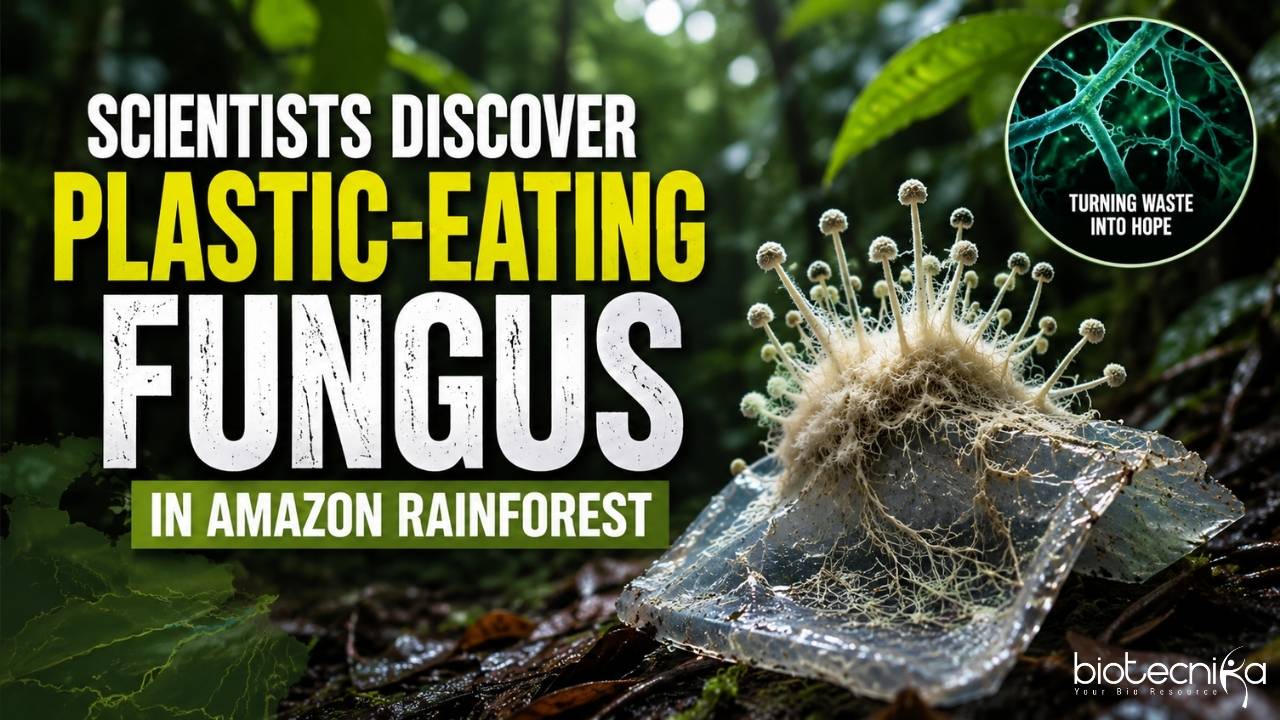
During an expedition in the Ecuadorian Amazon rainforest, the researchers from Yale University discovered the fungus, known as Pestalotiopsis microspora. This fungus, originally isolated as an endophyte from Amazonian plants, has the unusual ability to break down plastic, specifically polyester polyurethane (PUR). PUR is the most common type that is widely used in insulation materials, foams, adhesives, footwear, and automotive components. Once discarded, these materials often become part of the growing plastic waste problem. Currently, the study has demonstrated the efficient degradation of PUR and not all kinds of plastics.
What is the advantage?
On digesting the PUR, the fungus obtains its carbon source. But why carbon? Carbon is one of the essential factors for living organisms to grow. Researchers collected various endophytic (fungus that houses inside plants without harming them) fungal samples and checked for their ability to break down the polymers. Out of the collected samples, Pestalotiopsis microspora delivered a positive result under lab conditions. Later, the study focused on polyester polyurethane.
It has been identified that the plastic-eating fungus has a special enzyme called serine hydrolase, which plays the key role in the digestion of polymers. This enzyme degrades the long-chain polymers to small carbon compounds, which are further utilised by the fungus.
Why the Oxygen-Free Ability Matters
What makes Pestalotiopsis microspora particularly interesting is its ability to function in low-oxygen or oxygen-free conditions. Most organisms involved in decomposition require oxygen to survive and break down waste. But in reality, the plastics are buried deep under the surface, where the oxygen is scarce, and aerobic organisms can’t withstand that environment. The plastic-eating fungus’s ability to function anaerobically fosters hope for in-situ management of waste.
Laboratory studies showed that this fungus can continue degrading polyurethane even under such conditions. This characteristic could make it valuable for future waste-management technologies because much of the world’s plastic waste is buried in landfills where natural decomposition is extremely slow. However, the laboratory conditions have favoured the degradation of polyester polyurethane, yet the effectiveness of the breakdown at the landfill stage needs to be understood.
A Natural Tool Against Plastic Pollution
Scientists believe that the plastic-eating fungus works by producing special enzymes capable of breaking the chemical bonds within polyurethane. Once those bonds are broken, the material becomes easier for the fungus to use as a food source. This natural process has raised hopes that fungi and their enzymes could one day be incorporated into recycling systems or waste-treatment facilities.
Researchers caution that the discovery does not mean plastic pollution has been solved. The fungus is still being studied, and large-scale applications remain under development. More research is needed to determine how efficiently it can process plastic in real-world conditions and whether similar organisms can be used to tackle other types of plastics. At present, there is no evidence that the fungus can rapidly eliminate mixed plastic waste streams commonly found in landfills.
Has the Research Expanded?
Since 2011, scientists have been exploring various organisms and enzymes that have the potential to digest plastic and find a way to eliminate or manage plastic pollution. The discovery of Pestalotiopsis microspora highlights the untapped potential hidden within nature. According to researchers, the Amazon rainforest may contain many more organisms with unique abilities that have yet to be discovered.
Microbes like Cladosporium halotolerans and others have revealed the power to degrade plastics, and they are still being investigated. Hiro Technologies, a Texas-based company, in 2025 grabbed attention by developing degradable nappies. These nappies are integrated with plastic-eating fungi that break down the polymers. This approach is not directly based on Pestalotiopsis microspora, yet sets an example as to how these issues can be tackled.
While practical use of this fungus may still be years away, its ability to consume polyurethane and survive without oxygen offers an exciting glimpse into future approaches for managing plastic waste. In a world struggling with mounting landfill waste, this tiny plastic-eating fungus could eventually become part of a larger strategy to create cleaner and more sustainable waste-management systems.