



















IIT Bombay Cracks a Drug Discovery Puzzle
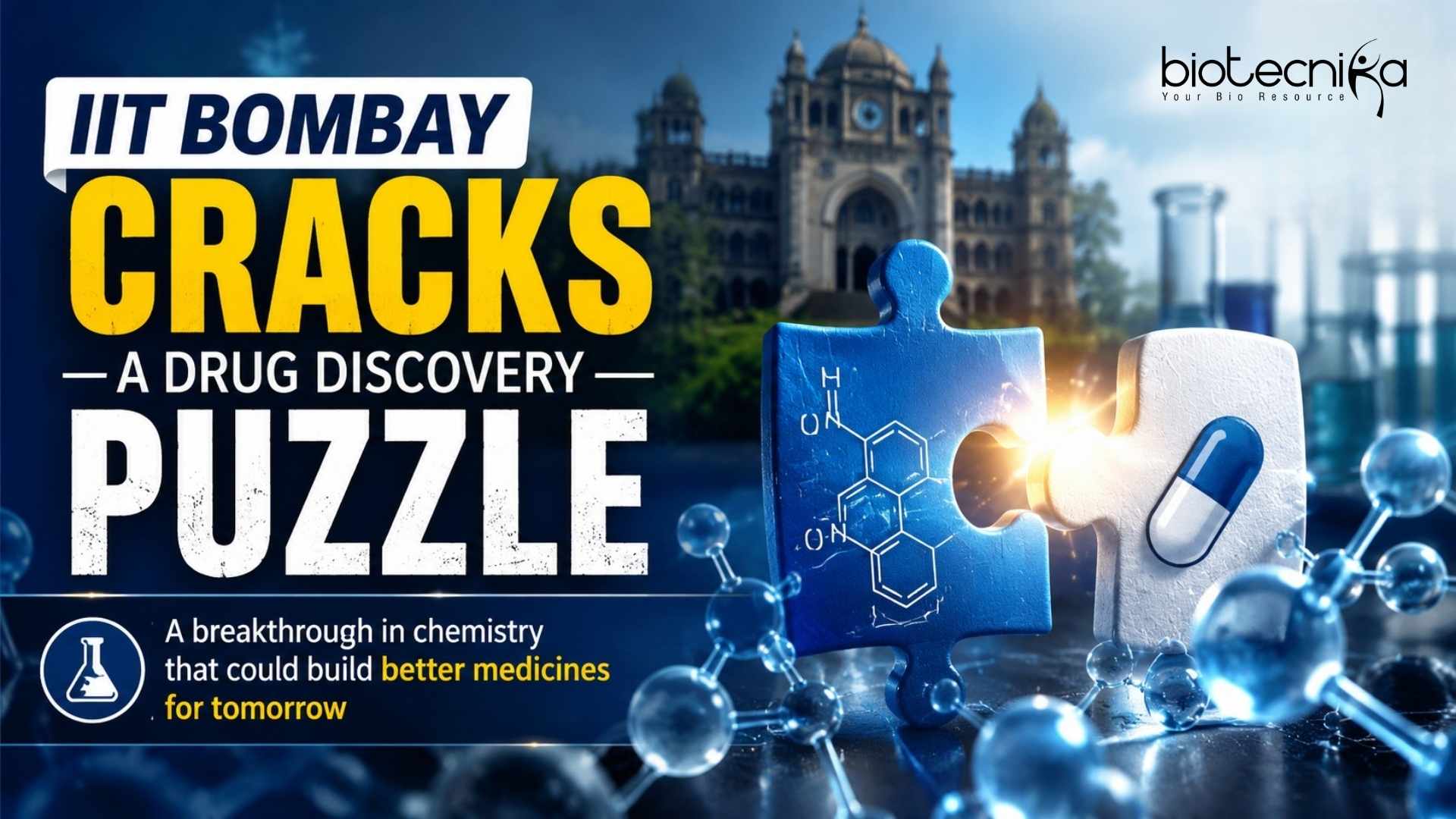
At one of the country’s renowned institutions, IIT Bombay, has cracked a code that could change the drug discovery process. According to their latest publication in the journal Nature, the researchers have spoken about the new chemical method that could change the way scientists make drug molecules.
The team was led by Professor Debabrata Maiti. The team includes Tanay Pal, Md Saimuddin Sk, Animesh Ghosh, and Yazhinimuthu CM from IIT Bombay. Somnath Kar from the Bhabha Atomic Research Centre also collaborated on the study.
Along with his team, he has solved a long-standing problem in synthetic chemistry. This discovery will help in a faster and more efficient way to turn simple Carbon compounds into complex ring-shaped compounds. These compounds will be used in medicines and other high-value products. If adopted on a larger scale, the approach could make drug discovery quicker, reduce costs, and create less chemical waste.
Most of the medicinal compounds have ring-shaped structures. These rings play an important role in how a drug works inside the body. The problem is that the raw materials available in nature are often very different. For example, fatty acids are one of the most common carbon-based compounds found in nature. They have long, straight chains of carbon atoms, instead of rings.
These straight chains cannot be changed into ring-shaped molecules easily. The researchers usually need several chemical reactions to complete the process. Every step needs time, extra chemicals and creates waste. Due to this, the process becomes expensive and less sustainable. The team of researchers from IIT Bombay found a smarter way to solve this problem.
This started with designing a new chemical compound that can identify and react with one specific carbon atom in a long chain. This may sound simple, but it has been one of the biggest problems in synthetic chemistry. Most of the carbon atoms in a straight-chain molecule look almost identical, making it very difficult to target only one location without affecting the others.
By solving this problem, the researchers were able to build ring-shaped molecules in fewer steps and with much better efficiency. The new method also reduces the amount of unwanted by-products, making the overall process cleaner and more environmentally friendly.
Professor Maiti said the biggest strength of the discovery is that it is not limited to making one particular molecule. Instead, it works as a general platform that can convert many different fatty acids into useful bioactive compounds.
This is important because researchers in drug discovery often need to prepare large numbers of molecules before they can identify a promising medicine. A faster way to make these compounds could help researchers test new drug candidates more quickly while lowering research costs.
The method could also support research on natural products used in traditional medicine systems such as Ayurveda. Scientists can now make these compounds in the laboratory instead of depending only on plants, making it easier to study their properties and improve them for future medicines.
To show how well the new process works, the team produced more than 10 biologically and industrially important molecules. These compounds are used not only in medicinal chemistry but also in chemical biology and the perfume and flavour industries.
One of the highlights of the study was the successful laboratory synthesis of muricatacin, a natural compound found in soursop, also known as Laxman phal in India. Muricatacin has attracted scientific interest because of its reported anticancer activity in laboratory studies.
Getting muricatacin directly from the plant is extremely difficult. According to the researchers, around 15 kilograms of plant material produces only about 15 milligrams of the compound, and even then it is mixed with other natural substances. Using their new method, the IIT Bombay team synthesised muricatacin from readily available fatty acids in a much more efficient way. They also prepared modified versions that showed biological activity comparable to the naturally derived compound in their experiments.
This discovery has marked an important milestone in synthetic chemistry. However, there is a lot of work to be done before the technology reaches the public. It has made the process of building complex molecules from simple and widely available materials easier now. The platform can support faster drug discovery and more sustainable chemical manufacturing in the years ahead.