





















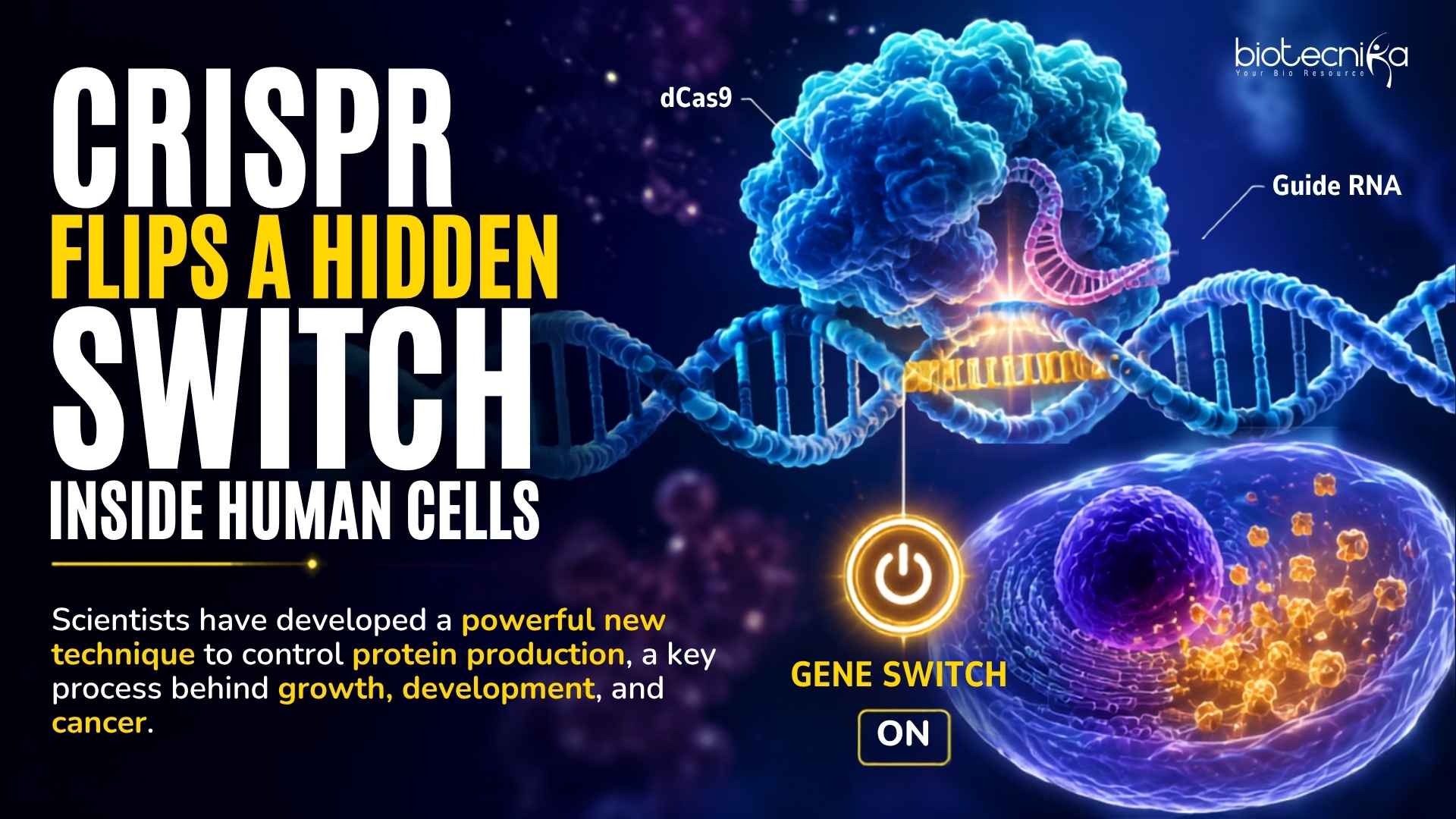
CRISPR Flips a Hidden Switch Inside Human Cells
Scientists have developed a powerful new technique to control protein production, a key process behind growth, development, and cancer.
Researchers have created a novel method using CRISPR which can control the production of proteins in the cells. The research can give scientists more critical insights into cell growth, development and diseases like cancer. This study is led by Professor Stefan H. Stricker from Ludwig Maximilian University (LMU) of Munich’s Biomedical Centre and Helmholtz Institute Munich, with the help of international research teams, which was further published in a Journal named Science.
Proteins are essential for almost every activity inside the body. Cells make these proteins using tiny structures called ribosomes. Ribosomes are built with the help of ribosomal RNA (rRNA). The amount of rRNA inside a cell affects how many proteins it can produce.
Scientists have known for years that different cells contain different amounts of rRNA. They have also found changes in rRNA levels in several diseases. However, it was not clear whether these changes actually caused the disease or simply happened as a result of it.
To answer this question, the researchers created a new CRISPR-based tool called TAPIR, which stands for Targeted Activation of Protein Translation. This method can switch on ribosomal genes and increase the production of ribosomal RNA in a controlled way.
Using TAPIR, the team showed for the first time that increasing rRNA levels directly boosts protein production inside cells. According to Professor Stricker, the study proves that targeted activation of rRNA production significantly increases protein synthesis.
The researchers believe this discovery could be especially useful for studying diseases caused by problems with ribosomes, known as ribosomopathies. One example is Treacher-Collins syndrome, a rare genetic condition that affects the development of facial bones and tissues. In mouse studies, increasing rRNA production helped partly correct some of the disease-related changes.
The team also discovered that the same process is involved in pancreatic cancer. Cancer cells appear to increase rRNA production to keep making proteins quickly, allowing them to grow faster. In mouse models of pancreatic cancer, TAPIR increased rRNA levels and further promoted tumour growth. This finding showed that higher rRNA production is not just a result of cancer but actually plays a direct role in helping tumours grow.
The researchers say these findings highlight the important role of protein production in normal development, cell growth, and cancer. They also see TAPIR as a valuable research platform for studying how protein synthesis affects health and disease.
Although more research is needed before this approach can be used in patients, scientists believe it could one day help treat diseases linked to low ribosome function and lead to new therapies that target cancers with uncontrolled protein production.