
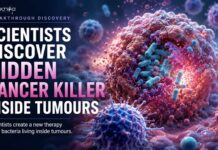














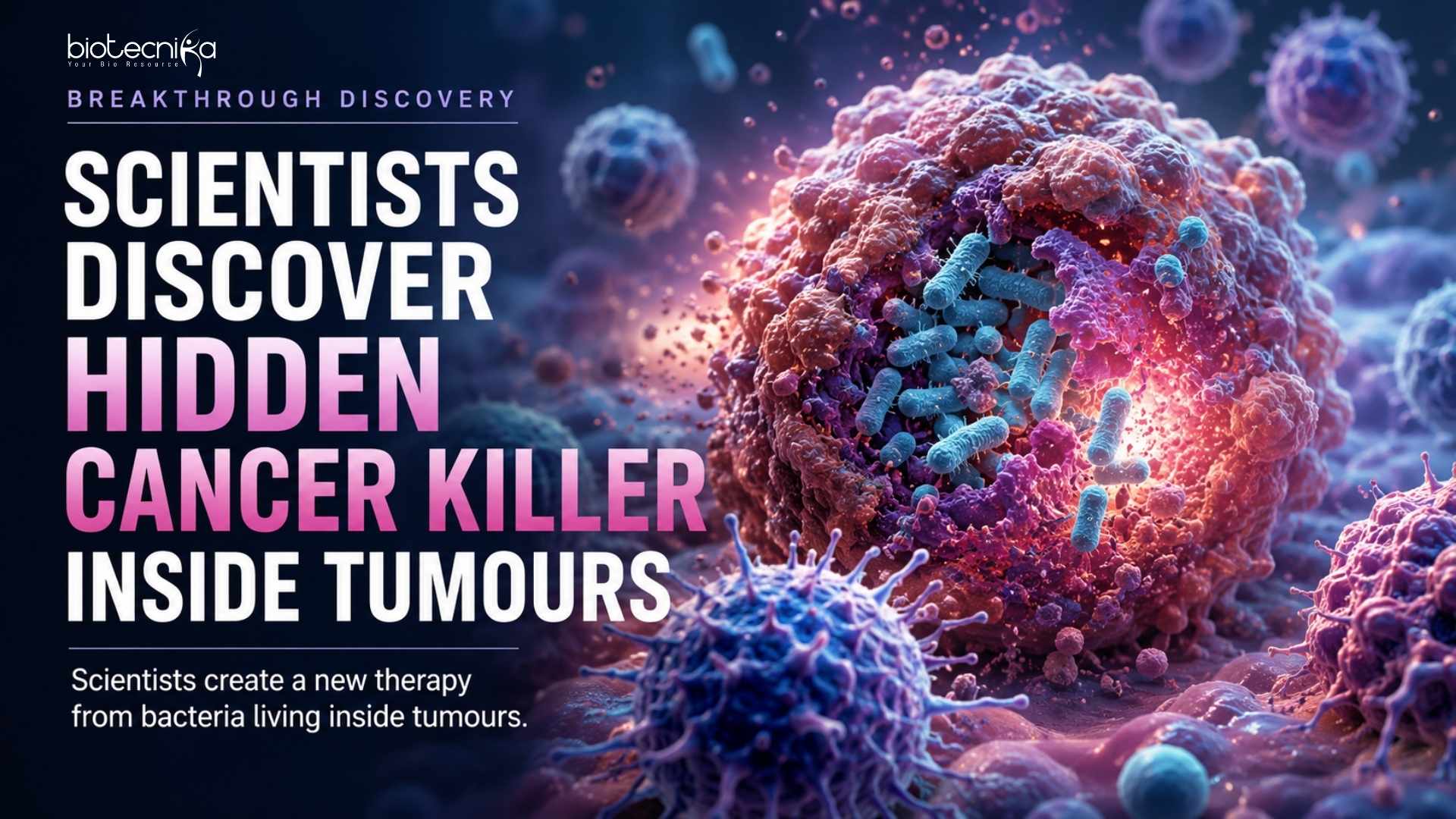
Scientists create a new therapy from bacteria living inside tumours
Doctors and scientists at the University of Illinois Chicago (UIC) have made an unusual discovery. They found that bacteria living inside tumours, the very thing that sounds harmful, could actually help fight cancer.
The team created a new treatment called aurB. It comes from a small piece of a protein found in these tumour bacteria. In early lab and animal tests, aurB showed strong results against prostate cancer, especially when combined with radiation therapy. The study was published in the journal Signal Transduction and Targeted Therapy.
Using Tumour Bacteria to Fight Cancer
For years, scientists have known that tumours are not made up of cancer cells alone. Small groups of bacteria live inside tumours too, in what is called the tumour microenvironment.
Lately, researchers have started wondering if these bacteria could be useful instead of harmful. Could they carry compounds that turn into cancer medicines? The UIC team decided to find out, and their search led them to a protein that could be turned into a cancer-fighting drug.
How the New Treatment Works
The new treatment is built from a tiny peptide called aurB, which was designed from a bacterial protein called auracyanin. Once inside a cancer cell, aurB travels straight to the mitochondria. These are often called the cell’s power plants because they produce the energy a cell needs to survive.
Cancer cells need a lot of energy since they grow and multiply much faster than normal cells. This makes the mitochondria a good target for treatment.
Inside the mitochondria, aurB attaches itself to a protein called ATP synthase. This protein’s job is to make ATP, which is the main fuel that cells run on. By blocking ATP synthase, aurB cuts off the tumour’s energy supply. Without enough fuel, the tumour struggles to keep growing.
“The mitochondria are very important for a cell to survive; they are the energy factories,” said Tohru Yamada, the study’s senior author and an associate professor of surgery and biomedical engineering at UIC. He is also part of the University of Illinois Cancer Center. He explained that many cancer cells change how their mitochondria work because they need to grow so aggressively, which is exactly why targeting the mitochondria makes sense.
How the New Treatment Works
This is not the first bacterial protein Yamada’s lab has worked with. Earlier, they found a different protein, called a cupredoxin, which could also slow tumour growth. Cupredoxins are copper-carrying proteins that help move electrons between other proteins. That earlier discovery led to a peptide drug that was tested in clinical trials in adults and in studies on brain cancer in children.
But that treatment had one big limitation: it depended on a gene called p53. This gene normally helps control cell growth and stops cancer from spreading. The problem is that p53 is damaged or mutated in many cancer patients, and the mutation is different from person to person. So the treatment could work well for one patient and not for another.
“We wanted to have an anti-cancer agent that doesn’t use the p53 function,” Yamada said.
Why Scientists Looked Beyond the p53 Gene
To get around this problem, the researchers looked for a bacterial protein that would work through the mitochondria instead of through p53. They studied tumour samples from breast cancer patients and used DNA sequencing to find out exactly which bacteria were living inside those tumours.
One particular bacterial species stood out. It carried a protein called auracyanin, another cupredoxin that works in a similar way to the one studied earlier. Using this discovery, the researchers built a peptide from auracyanin and named it aurB. Lab tests confirmed that aurB could enter tumour mitochondria and lock onto ATP synthase, blocking the cell’s ability to make energy.
Finding a Better Target
The team tested aurB on cancer cells that did not have working p53 genes, as well as on mouse models of prostate cancer that had stopped responding to hormone therapy.
The results were encouraging. When aurB was paired with radiation therapy, one of the standard treatments doctors already use for prostate cancer, tumour growth slowed down significantly. The tumours shrank far more than they did with radiation alone, and the researchers did not see any major signs of toxicity.
“The combination significantly enhanced the activity of the peptide and the tumour became much smaller,” Yamada said. He added that using a well-established model of prostate cancer that had spread to the tibia bone, the team was able to show a clear reduction in tumour growth before moving toward the next stage of research.
Next Step: Human Clinical Trials
The treatment is still experimental and has not yet been tested in humans. UIC has already patented aurB with help from its Office of Technology Management, and the research team is now looking for the right opportunity to move into human clinical trials.
A Bigger Opportunity for Future Cancer Medicines
Yamada believes this discovery may just be the start. Countless bacterial proteins inside tumours have never even been studied. Any one of them could potentially become the basis for a future cancer drug.
“There are many other bacterial proteins that could be a source of cancer drugs,” Yamada said. “We simply haven’t tried them yet.”
Research Team
The study was led by the UIC team, working closely with collaborators from the College of Medicine and UI Health. Yamada credited the contributions of the Department of Surgery, including Drs. Martin Borhani, Aslam Ejaz, Ajay Rana, Enrico Benedetti and Tapas K. Das Gupta.
Other UIC authors on the study included Dr Samer A. Naffouje, Duy Binh Tran, Konstantin Christov, Albert Green, Ngoc Hai Trieu Phong and Dr Tapas K. Das Gupta from the College of Medicine, along with Weiguo Li from the College of Engineering.
To Sum Up
In this study, scientists turn a potential hazard, bacteria contained in tumours, into a tool that may be used against cancer. The team created the aurB peptide based on a bacterial protein and developed a therapy that prevents the flow of energy to tumours instead of depending on the commonly mutated p53 gene.
Although the therapy is still in its early, preclinical phase, its effectiveness in models of prostate cancer, especially in combination with radiation, shows that this approach is worth trying in humans. Moreover, this research raises a more general question: how many other cancer-fighting agents may be hidden in tumour bacteria?