



















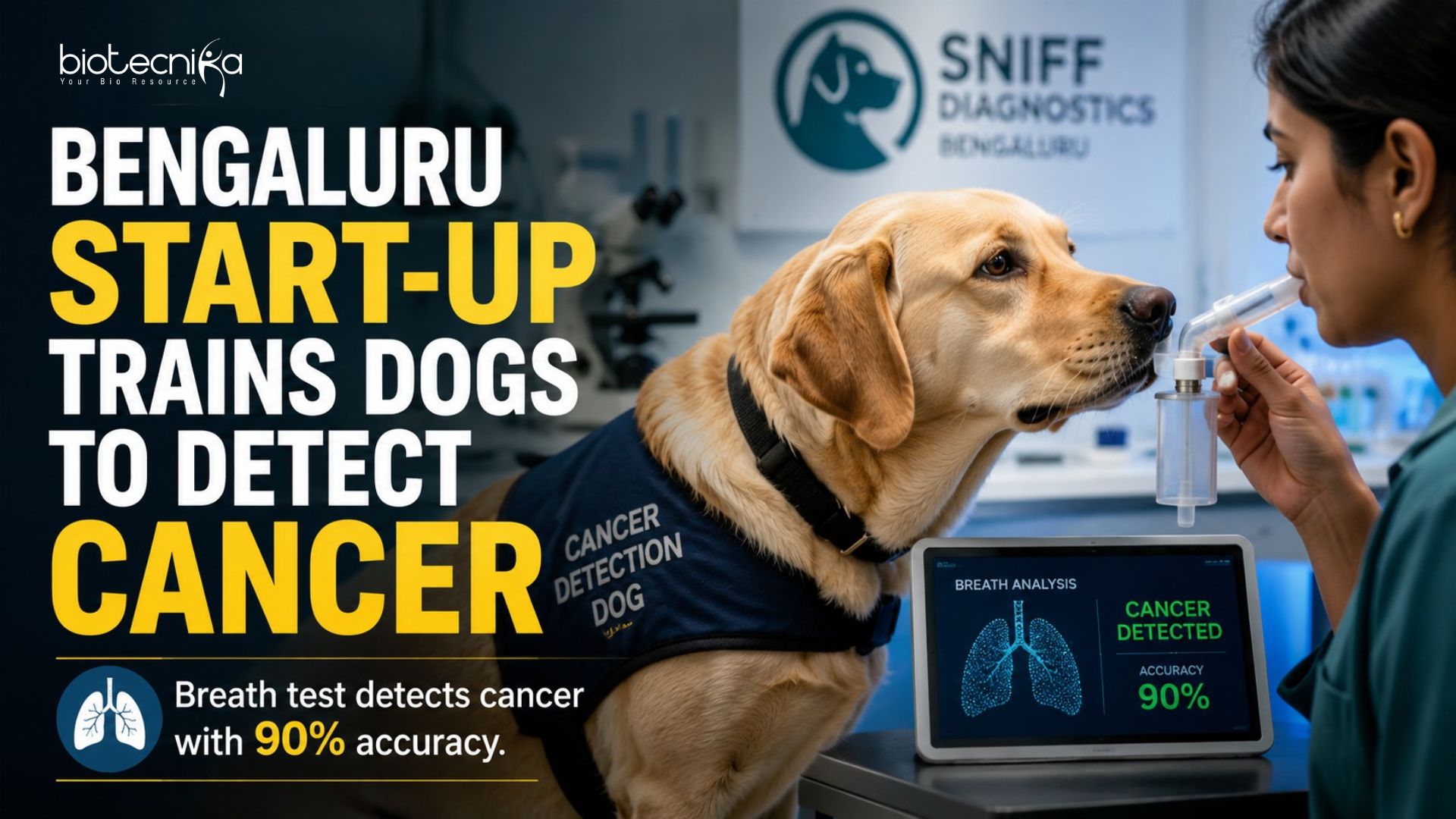
Bengaluru Start-up Trains Dogs to Detect Cancer
Breath test detects cancer with 90% accuracy.
Dognosis, a Bengaluru-based firm, has come up with an innovative technique that makes use of trained dogs to identify cancer. The technology company claims that this will lead to faster, less costly, and more accessible cancer screenings.
Essentially, the firm uses the dogs’ exceptional sense of smell to detect minute chemical changes within an individual, in conjunction with AI, to identify chemical elements known to be indicative of cancer.
The researchers behind Dognosis, and their medical advisors, are optimistic about the early indications, with Dr Swaratika Majumdar asserting, “This is very easy to implement; it’s a non-invasive procedure, and the costs of performing these screenings are significantly lower than current conventional screenings.”
The test has shown 90% sensitivity and 90% specificity, which means it correctly identifies about 90 out of 100 people who have cancer and also correctly rules out cancer in about 90 out of 100 people who do not have it.
To start off the testing process, breath samples are collected by volunteers who wear special masks that allow for capturing volatile organic compounds (VOCs) found in human breath. Once collected, these samples are taken to a lab where professional dogs are utilised to assess the samples using specially designed testing areas under controlled conditions.
According to Akash Kulgod, co-founder and CEO of Dognosis, trained dogs can recognise VOCs that are associated with diseases by using their sense of smell. VOCs are extremely small chemical compounds that are expelled from the cells of living beings. Among those compounds are numerous types of cancer-related chemicals; the ability of dogs to utilise their incredible sense of smell increases the chances of being able to identify these VOCs.
All the dogs’ responses are recorded on sensors and then analysed through an artificial intelligence algorithm, which makes the final results more consistent, scientifically reliable, and accurate. To ensure accuracy, Suba, head of Dognosis’s research and development division, stated that it is essential to maintain the same conditions for testing each time a VOC is being evaluated.
Every sample is tested inside a pressurised chamber. When a dog reacts to a sample, the system records the exact response. This helps convert the dog’s natural behaviour into objective scientific data.
The company has been conducting Phase-2 clinical trials for the past two years. So far, nearly 1,500 participants have been tested, and the screening system has maintained an accuracy rate of around 90%.
Srishti, an office associate at Dognosis, said the method can detect cancer using only a breath sample, making it a non-invasive test. It is also expected to be faster and more affordable than many current screening methods.
He added that the project brings together the natural abilities of dogs with modern technology. India records a large number of cancer cases every year, and many patients are diagnosed only at advanced stages. The company believes that combining trained dogs with advanced detection systems could help improve early cancer diagnosis and make screening more accessible to people across the country.