



















Scientists Discover a Simple Rule Behind Brain Development
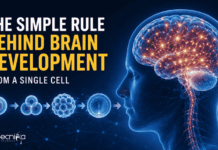
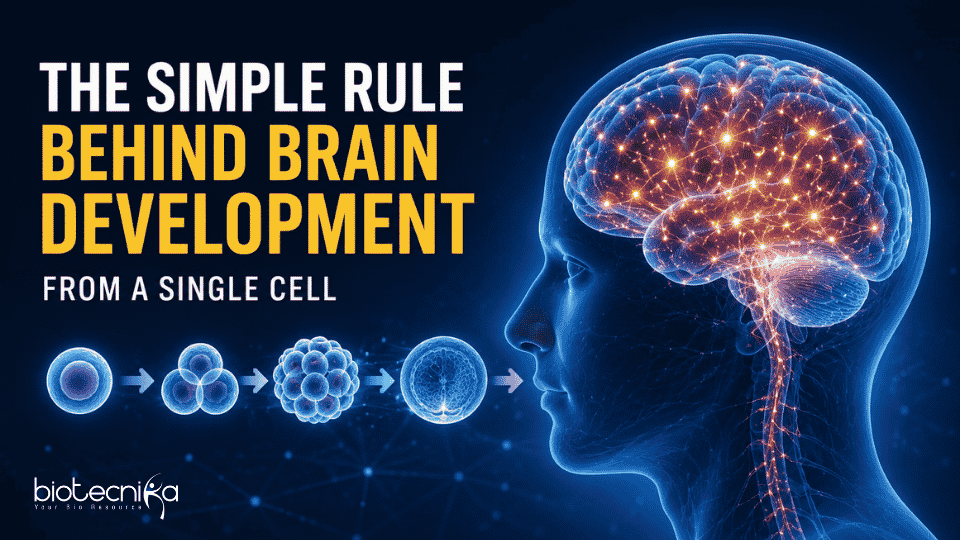
Have you ever thought about how our brains manage to control and coordinate with other systems and with itself? It holds everything together, but how is the brain developed? Compared to other organisms, the human brain is one of the most complex structures in nature. Brain development initiates with a single cell and eventually grows into an organ with about 170 billion cells. But, how does each cell find its way, where exactly to go, and what exactly to do? For ages, Scientists have been working on this question.
Now, researchers from Cold Spring Harbor Laboratory have come up with an explanation for how the brain develops. Surprisingly, the answer seems to be simple. Stan Kerstjens, a postdoc researcher in Professor Anthony Zador’s laboratory, explains how this works. He says this is possible because of the positional information, meaning the cell can only see itself and the surrounding cells. This is like a jigsaw puzzle, where each right piece completes the puzzle.
The study published in Neuron, Kerstjens, along with Zador and other researchers from Harvard University and ETH Zürich, proposed this theory of Brain development. Their study suggests that brain cells use their family history, or cellular lineage, as a guide to find their correct position in the developing brain.
Family Trees May Shape the Brain
For years, we have known that cell communication occurs through chemical signals that pass information from one cell to another. Kerstjens states that this mechanism works well among smaller groups of cells. He adds that this may not be the case for developed organs like the brain, which has billions of cells. During travel, chemical signals may weaken, and for brain cells, it is crucial that they arrive at the correct location.
Every brain cell is created when another cell divides. As this process continues, a large family tree of cells is formed. Scientists found that cells from the same ancestor tend to stay close to one another rather than spread randomly throughout the brain. This creates natural neighborhoods of related cells that help organize the growing brain.
The researchers believe that this simple rule may act like a positional map. Instead of relying only on complex chemical signals, brain cells may also use information about their lineage to determine where they belong. In other words, a cell’s place in the family tree could help decide its place in the brain.
This piece of information unlocks a new way of thinking about brain development. So far, the idea has focused on chemical messengers that guide cells to their roles and locations. The new study suggests that lineage may play a much larger role than previously thought, while cell signals remain important. A cell may not need detailed directions if it simply remains close to its relatives as the brain grows.
To further investigate these findings on brain development, the scientists developed something called “lineage-based model of scalable positional information.” Initially, they used theoretical calculations to check if the idea worked. Later, they tested the model on both individual cells and larger groups of cells to examine gene expression in mouse brains, followed by zebrafish. The outcomes were positive and suggested that the concept operates across the brains of different sizes.
This indicates that both chemical signaling and cellular lineage work together to organize the cells (positional information) in brain development.
AI and Brain Development: Implications
Understanding how brain cells organize themselves is important because developmental errors can contribute to neurological and developmental disorders. By learning the basic rules that shape the brain, researchers may gain new insights into conditions that begin during early brain development.
The findings could also influence fields beyond biology. Scientists say the principles that allow billions of cells to organize themselves into a highly efficient brain may inspire new approaches in artificial intelligence and computer science. If simple rules can create such a complex system in nature, similar ideas might help researchers design smarter and more adaptable technologies.
Although more research is needed, this study provides an important clue about one of neuroscience’s biggest mysteries. It suggests that the secret behind building a brain may not be as complicated as once believed. By staying close to their cellular relatives, brain cells may be following a simple organizational rule that helps transform a single cell into the remarkable human brain.
This discovery gives scientists a fresh understanding of how brain cells work together during development and brings us one step closer to uncovering the blueprint of the human brain.