


















IIT Madras’s ANCHOR: World’s Most Detailed 3D Atlas of the Human Brainstem
For decades, the human brainstem has always been one of the most difficult yet fascinating parts of the brain to study. Till now, the doctors and researchers have seen it through MRI and CT scans. But they were able to see only the broad outlines. The fine details, including hundreds of tiny clusters of nerve cells packed together in small structures, were hidden from the world. But not anymore. The change has begun with the launch of ANCHOR by the researchers at IIT Madras.
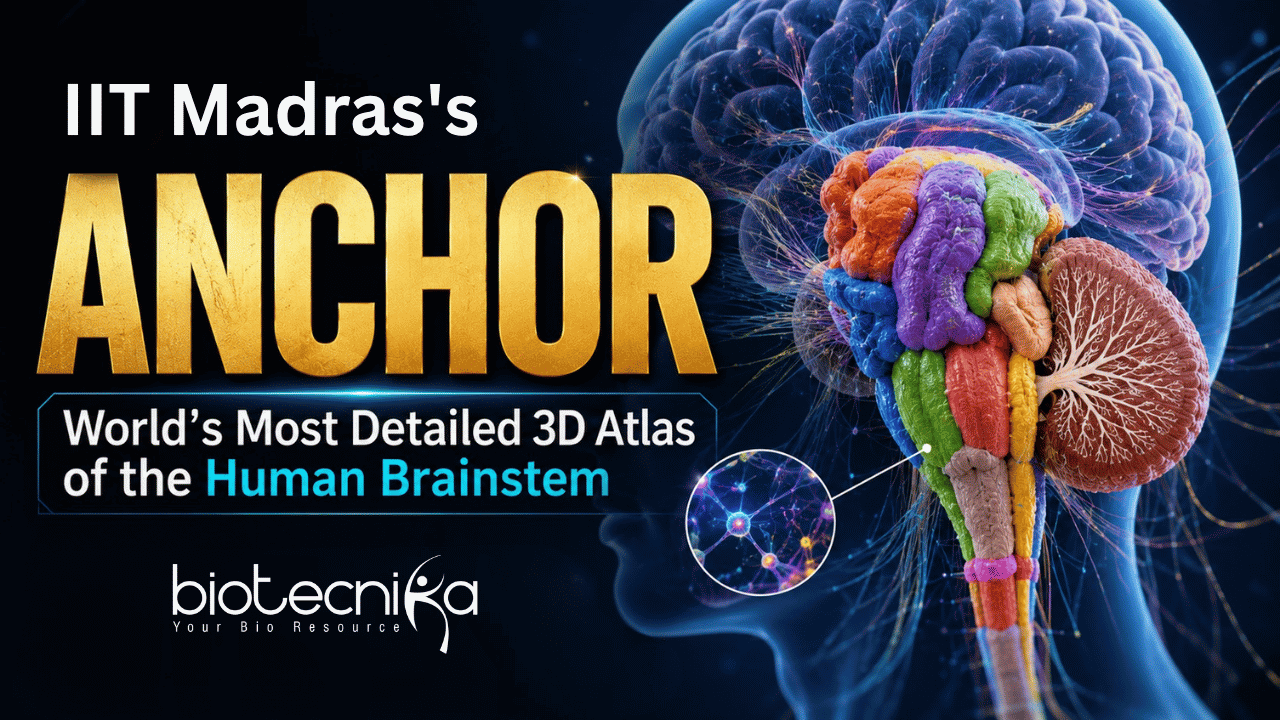
This world’s most detailed 3D atlas of the human brainstem can capture the structures at the cellular resolution. Developed at the Sudha Gopalakrishnan Brain Center (SGBC), the researchers have claimed that this resource has created the most detailed map of the human brainstem ever created.
The atlas was launched earlier this month during the 3rd BRICS Neuroscience Symposium at IIT Madras. Scientists from across BRICS nations and beyond had gathered to exchange ideas on some of the biggest questions in brain research.
ANCHOR stood out because it offers something researchers have lacked for years. That was a detailed cellular-level view of the human brainstem. What makes ANCHOR different is not simply the amount of data it contains. It is the level of detail.
Most of the medical scans show the brainstem at millimeter resolution. But the neuroscientists across the world want to study the structures that are far smaller. According to Prof. Mohanasankar Sivaprakasam, Head of SGBC, the brainstem contains hundreds of nuclei and neural pathways that exist at the micron scale.
“If you want to understand the brainstem today, you mainly look at MRI or CT images,” he said. “Those are useful, but they do not show the fine organization of the brainstem.”
To build ANCHOR, researchers took brainstem samples and cut them into slices just 10 to 20 microns thick. A human hair is several times thicker. Each section then went through a series of laboratory processes before being scanned, digitized, and reconstructed into a three-dimensional model.
The work required hundreds of serial sections, advanced imaging systems, artificial intelligence tools, and high-performance computing infrastructure.
The final result is a collection of detailed maps showing more than 200 brainstem nuclei and fiber tracts.
For neuroscientists, the atlas offers something that has been missing for years: a reliable anatomical reference for one of the brain’s most complex regions.
For clinicians, the implications could be equally important.
The brainstem controls some of the body’s most basic functions, including breathing, heartbeat, sleep cycles, and consciousness. Damage to even a small area can have serious consequences. A more detailed understanding of its anatomy could eventually help improve surgical planning and support research into neurological disorders.
Prof. Sivaprakasam believes the atlas will be valuable not only to scientists but also to the medical community.
“For the first time, we can see how the human brainstem is organized in much greater detail than conventional imaging allows,” he said.
The project is part of a greater effort underway at the Sudha Gopalakrishnan Brain Center. The team is working towards creating cellular-resolution maps of more than 100 human brains across different stages of life and across a range of neurological conditions.
That includes diseases such as dementia, Alzheimer’s disease, and rabies.
According to IIT Madras Director Prof. V. Kamakoti, these studies are helping researchers understand how disease alters the brain’s structure.
“We now have a way to observe what happens to the basic structure of the brain because of disease,” he said. “That is an important step in understanding the human brain.”
The center itself has grown into one of India’s largest neuroscience research initiatives. Supported by Infosys co-founder Kris Gopalakrishnan and Sudha Gopalakrishnan, along with grants from philanthropic organizations and research partners, SGBC today brings together more than 200 researchers, engineers, and technicians working with collaborators around the world.
Importantly, the team has made ANCHOR freely available through its online portal, allowing scientists, clinicians, and students worldwide to explore the data.
Open-access resources are becoming increasingly important in neuroscience, where high-quality human brain data remains scarce. By making the atlas publicly available, the IIT Madras team hopes to accelerate research far beyond its own laboratories.
For now, ANCHOR represents something that neuroscientists rarely get: a new map of largely uncharted territory. And in brain research, better maps often lead to better questions, and eventually, better answers.