

















QA/QC Jobs for Biotechnology Freshers: Salary, Skills & Interview
In the world of science, there are a few hidden and unsung superheroes. One of them is the Quality Control (QC) & Quality Assurance (QA) professionals who work to ensure that every drug that reaches us is safe. But have you ever thought of building a career in QA/QC? Biotech QA/QC jobs are one of the most in-demand and stable career options today.
The biotech and pharmaceutical giants are constantly looking for skilled professionals who can ensure the safety, efficiency and reliability of products.
In this guide, you’ll learn what QA and QC are, the skills employers expect, QA/QC salary trends, career growth opportunities, and the most common interview questions. By the end, you’ll have a clear roadmap to start your QA/QC career with confidence.
What Are QA and QC in Biotechnology?
For every biotech and pharmaceutical manufacturing unit, quality is the foundation. Even a minor mishap can risk product safety, efficiency and regulatory compliance. To prevent these, dedicated Quality Assurance (QA) and Quality Control (QC) departments were established.
If you think these two jobs are the same. Then you have made a mistake. They work closely together but have distinct responsibilities. Let’s understand the difference below.
What is Quality Assurance (QA) in Biotech?
QA is a process-oriented job where the professional makes sure the products are consistently manufactured according to predefined standards. They focus on preventing defects by implementing effective quality management systems.
They make sure that regulatory requirements and standardised procedures are followed at every step of the manufacturing process. This includes establishing documentation systems, validating manufacturing processes, training personnel, and monitoring compliance.
Key Responsibilities of QA Professionals
Quality Assurance professionals typically perform the following tasks:
- Preparing, reviewing, and updating Standard Operating Procedures (SOPs)
- Ensuring compliance with Good Manufacturing Practices (GMP)
- Implementing Good Laboratory Practices (GLP)
- Following Good Documentation Practices (GDP)
- Reviewing Batch Manufacturing Records (BMR)
- Reviewing Batch Packaging Records (BPR)
- Managing deviations, investigations, and risk assessments
- Implementing Corrective and Preventive Actions (CAPA)
- Coordinating change control procedures
- Supporting process validation and equipment qualification
- Conducting internal quality audits
- Preparing for regulatory inspections
- Ensuring data integrity and documentation accuracy
QA professionals act as custodians of the pharmaceutical quality system. Their work helps manufacturers comply with regulatory expectations established by organisations such as the following:
- Central Drugs Standard Control Organisation (CDSCO),
- World Health Organisation (WHO),
- US Food and Drug Administration (US FDA),
- European Medicines Agency (EMA),
- International Council for Harmonisation (ICH).
Why QA Matters?
A strong QA system helps organisations in preventing manufacturing errors, reducing product recalls, and ensure pateint safety. Along with these, they also improve process consistency and build customer confidence.
Since quality cannot simply be tested into a product after manufacturing, QA focuses on building quality into every process from the beginning.
What is Quality Control (QC) in Biotech?
QC is a product-oriented job where the professionals are responsible for verifying that raw materials, in-process samples and finished products meet quality standards. They work primarily in analytical laboratories where they perform scientific testing.
They identify defects, contamination, and deviations before the products reach the consumer. Every pharmaceutical batch must pass the QC test successfully before approval for sale.
Key Responsibilities of QC Professionals
Quality Control professionals are responsible for:
- Testing raw materials before production
- Performing in-process quality checks
- Analysing finished pharmaceutical products
- Conducting stability studies
- Environmental monitoring
- Water quality analysis
- Preparing reagents and standard solutions
- Sample preparation and handling
- Instrument calibration and maintenance
- Recording analytical data accurately
- Investigating out-of-specification (OOS) results
- Following laboratory safety procedures
QC analysts must maintain meticulous documentation because every test result may be reviewed during regulatory inspections.
Common Laboratory Instruments Used in QC
Professionals working in Biotech QA/QC Jobs commonly use:
- pH Meter
- UV-Visible Spectrophotometer
- High-Performance Liquid Chromatography (HPLC)
- Gas Chromatography (GC)
- Fourier Transform Infrared Spectroscopy (FTIR)
- Karl Fischer Titrator
- Dissolution Tester & Disintegration Tester
- Analytical Balance
- Conductivity Meter
- TOC Analyser (in some facilities)
Developing familiarity with these instruments gives Biotechnology Freshers a competitive advantage during recruitment.
QA vs QC – Key Differences
Although QA and QC share the common objective of ensuring product quality, their approaches differ significantly.
| Quality Assurance (QA) | Quality Control (QC) |
| Process-oriented | Product-oriented |
| Prevents defects | Detects defects |
| Focuses on quality systems | Focuses on product testing |
| SOP implementation | Sample analysis |
| Documentation and compliance | Laboratory testing |
| Audits and validation | Instrument operation |
| Process improvement | Product verification |
| Works before and during manufacturing | Works during and after manufacturing |
In simple terms:
- QA ensures the process is correct.
- QC confirms the final product meets quality standards.
Both functions are equally important and work together to maintain product safety and regulatory compliance.
Why Are Biotech QA/QC Jobs in High Demand?
The demand for Biotech QA/QC Jobs has grown consistently over the last decade due to the rapid expansion of India’s pharmaceutical and biotechnology sectors.
India is one of the largest global suppliers of generic medicines and vaccines, exporting pharmaceutical products to more than 200 countries. To access regulated international markets, manufacturers must comply with strict quality standards established by agencies such as the US FDA, WHO, EMA, and CDSCO. As a result, every manufacturing facility requires dedicated QA and QC teams.
Factors Driving Demand
Several industry trends continue to increase the need for quality professionals:
- Expansion of pharmaceutical manufacturing facilities
- Growth in biotechnology research and commercialisation
- Increased production of vaccines and biologics
- Rising demand for biosimilars
- Growth of Contract Development and Manufacturing Organisations (CDMOs)
- Expansion of Contract Research Organisations (CROs)
- Stricter regulatory inspections
- Increasing pharmaceutical exports
- Greater focus on data integrity and quality systems
Because quality functions are legally required, QA and QC remain among the most stable roles in the life sciences sector.
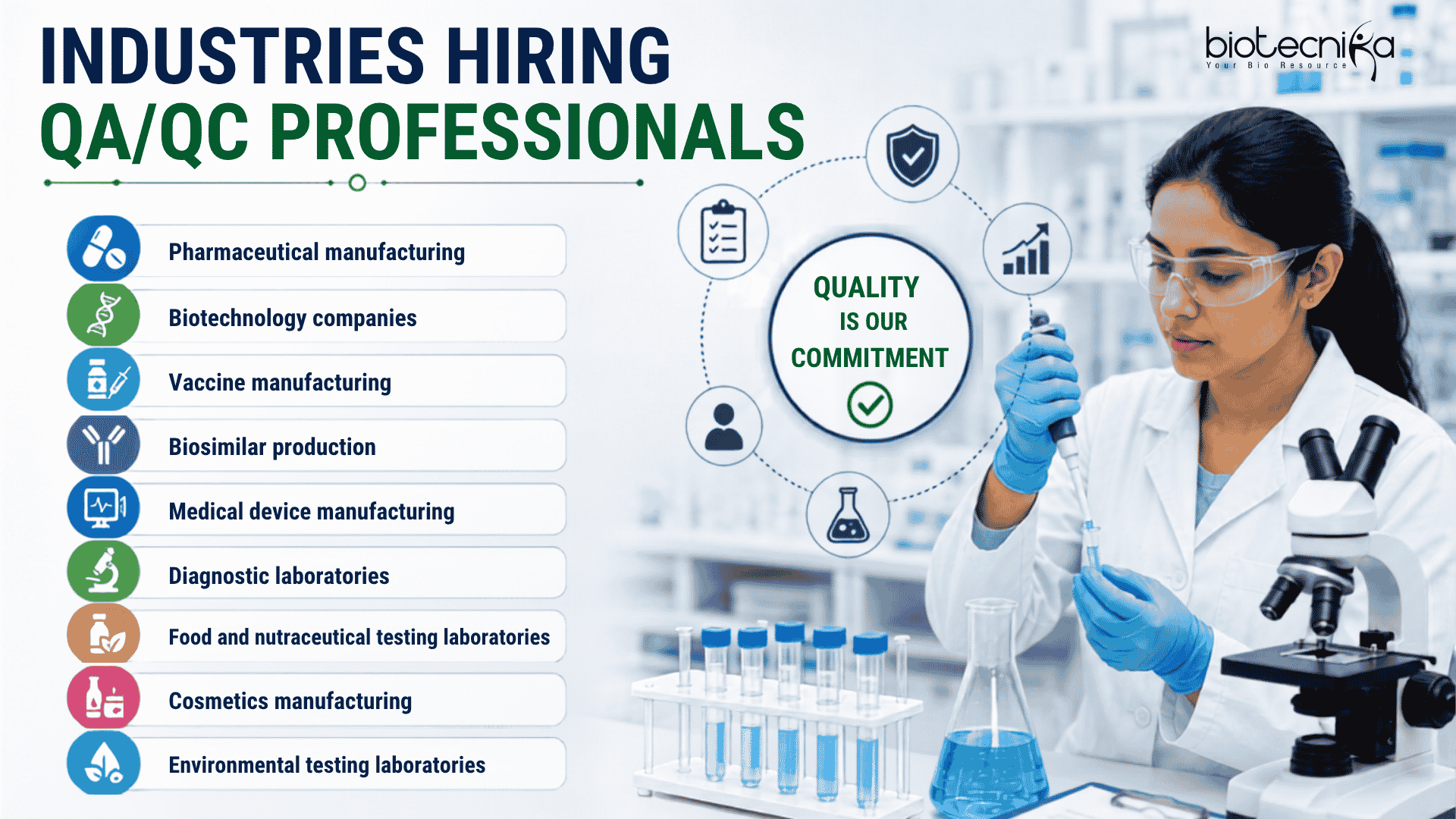
Industries Hiring QA/QC Professionals
Professionals with quality expertise are employed across a wide range of sectors, including:
- Pharmaceutical manufacturing
- Biotechnology companies
- Vaccine manufacturing
- Biosimilar production
- Medical device manufacturing
- Diagnostic laboratories
- Food and nutraceutical testing laboratories
- Cosmetics manufacturing
- Environmental testing laboratories
This diversity makes QA/QC one of the broadest and most resilient Biotechnology Careers available today.
Eligibility for Biotechnology Freshers
Most Biotech QA/QC jobs are open to graduates who have completed a BSc or MSc in biotech, microbiology, biochemistry, chemistry and industrial biotechnology or any related disciplines of Life Sciences.
If you are a final-year student, then you can apply for internships or an apprenticeship in the biotech and pharma companies in the QA/QC department.
Importance of Practical Laboratory Exposure
While your degree gives you entry into these companies, the industry seeks biotechnology freshers who have hands-on experience and are familiar with equipment and processes. You must learn about high-end lab equipment, analytical techniques, and quality documentation to stand out from the rest. With the exposure to GMP-compliant labs, sample preparation, calibration and analytical testing, you will have better chances of securing Biotech QA/QC Jobs.
Essential Biotechnology Skills Required for QA/QC Jobs
To build a successful career in QA/QC, you need to have technical knowledge, regulatory awareness, documentation expertise and interpersonal skills. To ease out your process, here is the list of skills you must have:
QC Technical Skills
Quality Control professionals should develop proficiency in fundamental laboratory techniques and analytical instruments, including:
- pH meter operation and calibration
- UV-Visible Spectroscopy
- Basics of High-Performance Liquid Chromatography (HPLC)
- Fundamentals of Gas Chromatography (GC)
- Karl Fischer titration for moisture determination
- Dissolution testing
- Disintegration testing
- Sample preparation techniques
- Standard solution preparation
- Volumetric analysis
- Instrument calibration
- Routine maintenance and basic troubleshooting
- Good laboratory documentation practices
- Safe handling of chemicals and laboratory reagents
A strong foundation in these Biotechnology Skills enables fresh graduates to perform laboratory testing accurately and efficiently.
QA Skills
Quality Assurance professionals focus on quality systems, documentation, and regulatory compliance. Important competencies include:
- Good Manufacturing Practices (GMP)
- Good Laboratory Practices (GLP)
- Good Documentation Practices (GDP)
- SOP writing and revision
- Batch Manufacturing Record (BMR) review
- Batch Packaging Record (BPR) review
- Corrective and Preventive Action (CAPA)
- Change control procedures
- Process validation basics
- Equipment qualification concepts
- Audit readiness
- Documentation control
- Data integrity (ALCOA+ principles)
- Understanding of ICH and WHO quality guidelines
These regulatory Biotechnology Skills are highly valued because they directly support compliance and inspection readiness.
Soft Skills
Technical expertise alone is not enough. Quality professionals must also demonstrate:
- Attention to detail
- Strong documentation skills
- Analytical thinking
- Problem-solving ability
- Effective communication
- Integrity and ethical conduct
- Time management
- A compliance-focused mindset
Developing these technical and interpersonal Biotechnology Skills prepares fresh graduates for successful careers in the highly regulated biotechnology and pharmaceutical industries.
Biotech QA/QC Salary in India
One of the most common questions among Biotechnology Freshers is, “How much can I earn in a QA/QC role?” While there is no fixed salary because compensation depends on multiple factors, QA/QC remains one of the better-paying entry-level career options in the pharmaceutical and biotechnology industries.
As professionals gain technical expertise, regulatory knowledge, and hands-on experience with laboratory instruments and quality systems, their earning potential increases significantly.
| Career Level | Typical Job Roles | Experience | Approximate QA/QC Salary (India) | Key Factors Influencing Salary |
| Entry-Level | QA Trainee
QC Trainee QC Analyst QA Executive Junior Quality Associate |
0–3 years | Around ₹4 LPA (varies by company, location, qualifications, and skills) | Company size, manufacturing location, educational qualifications, internship experience, practical laboratory exposure, technical and regulatory skills.
Large MNCs, biologics manufacturers, and US FDA/EMA-regulated companies often offer higher salaries. |
| Mid-Level | Senior QC Analyst
Senior QA Executive Validation Executive Documentation Specialist Compliance Executive |
3–8 years | ₹8–15 LPA | Salary depends on expertise in audits, validation, investigations, analytical method validation, regulatory inspections, documentation, and overall responsibilities. |
| Senior-Level | Assistant Manager – QA/QC
Quality Manager Compliance Manager Validation Manager |
8–15 years | ₹15–20 LPA | Compensation varies based on leadership responsibilities, regulatory experience, company size, and expertise.
Professionals in multinational companies may earn higher packages. |
| Leadership Level | Senior Quality Manager
Head of Quality Assurance Quality Head Director – Quality Vice President – Quality |
15+ years | ₹40–48 LPA or higher (company-dependent) | Salary depends on organizational size, business responsibilities, regulatory compliance expertise, strategic leadership, and years of industry experience. |
Factors Affecting QA/QC Salary
Several factors influence earning potential:
- Educational qualification (B.Sc., M.Sc., B.Pharm, M.Pharm)
- Company reputation
- Manufacturing scale
- Geographic location
- Technical expertise
- Knowledge of GMP, GLP, GDP, and ICH guidelines
- Experience with HPLC, GC, validation, and documentation
- Certifications and specialised training
- Communication and leadership skills
Instead of focusing only on starting salary, as a Biotechnology Fresher, you should prioritise gaining practical experience. Along with its continuous development, it will lead to faster salary growth.
Career Growth in QA/QC
One of the strongest advantages of working in quality functions is the clear and structured career progression. Unlike some roles with limited advancement opportunities, QA and QC provide well-defined pathways from trainee positions to senior leadership.
A typical career progression is:
| Position | Typical Experience |
| QA/QC Trainee | 0–1 year |
| QC Analyst / QA Executive | 1–3 years |
| Senior Executive | 3–6 years |
| Assistant Manager | 6–10 years |
| QA/QC Manager | 10–15 years |
| Quality Head | 15+ years |
Opportunities Beyond QA/QC
As professionals gain experience, they may transition into specialized functions such as:
- Regulatory Affairs
- Validation
- Quality Systems
- Compliance Management
- Supplier Quality Assurance
- Internal Auditing
- Qualification and Commissioning
- Pharmacovigilance Quality Systems
- Global Quality Operations
These career paths provide additional opportunities for specialisation, international exposure, and leadership.
For graduates seeking long-term Biotechnology Careers, QA/QC offers exceptional stability because regulatory compliance is a mandatory function in pharmaceutical manufacturing.
Biotech QA/QC Job Interview: Common Questions
Preparing thoroughly for a QA/QC Job Interview significantly improves your chances of securing an offer. Recruiters generally evaluate candidates on three areas:
- Technical knowledge
- Regulatory understanding
- Communication and problem-solving ability
Below are some of the most frequently asked interview questions.
Basic QA/QC Questions
- What is Quality Assurance?
- What is Quality Control?
- Explain the difference between QA and QC.
- Why are QA and QC both necessary?
- What are GMP, GLP, and GDP?
- What is an SOP?
- Why is documentation important?
Regulatory Questions
Interviewers may ask about:
- CAPA (Corrective and Preventive Action)
- Deviation
- Change Control
- Data Integrity
- Validation
- Qualification
- Batch Manufacturing Records (BMR)
- Batch Packaging Records (BPR)
- Audit preparation
Understanding the purpose of these systems is often more important than memorizing definitions.
Laboratory-Based Questions
Candidates applying for QC positions should be prepared to explain:
- Principle of HPLC
- Principle of UV-Visible Spectroscopy
- Principle of Gas Chromatography
- pH and its significance
- Buffer preparation
- Standard solution preparation
- Calibration of laboratory instruments
- Difference between molarity and molality
- Dissolution testing
- Karl Fischer titration
Interviewers may also ask practical questions based on internships or academic laboratory work.
HR Interview Questions
Common HR questions include:
- Tell me about yourself.
- Why do you want to work in QA/QC?
- Why should we hire you?
- Describe a challenge you faced during your laboratory project.
- What are your strengths?
- What are your career goals?
- Are you willing to work in shifts?
- Are you comfortable following strict documentation procedures?
Employers value honesty, professionalism, and a willingness to learn over rehearsed answers.
QA/QC Job Interview Preparation Tips
To perform well in a Biotech QA/QC Job Interview, consider the following:
- Revise core biotechnology and analytical chemistry concepts.
- Understand GMP, GLP, GDP, and data integrity principles.
- Learn the basic working principles of common laboratory instruments.
- Read about recent developments in the pharmaceutical industry.
- Review your internship or project work thoroughly.
- Practice explaining technical concepts clearly.
- Dress professionally and arrive on time.
- Communicate confidently and avoid guessing when unsure.
Preparation demonstrates commitment and helps interviewers assess your potential for success in a regulated environment.
Tips for Biotechnology Freshers to Get QA/QC Jobs Faster
Breaking into the pharmaceutical industry can be competitive, but there are practical steps that can improve your chances of securing Biotech QA/QC Jobs.
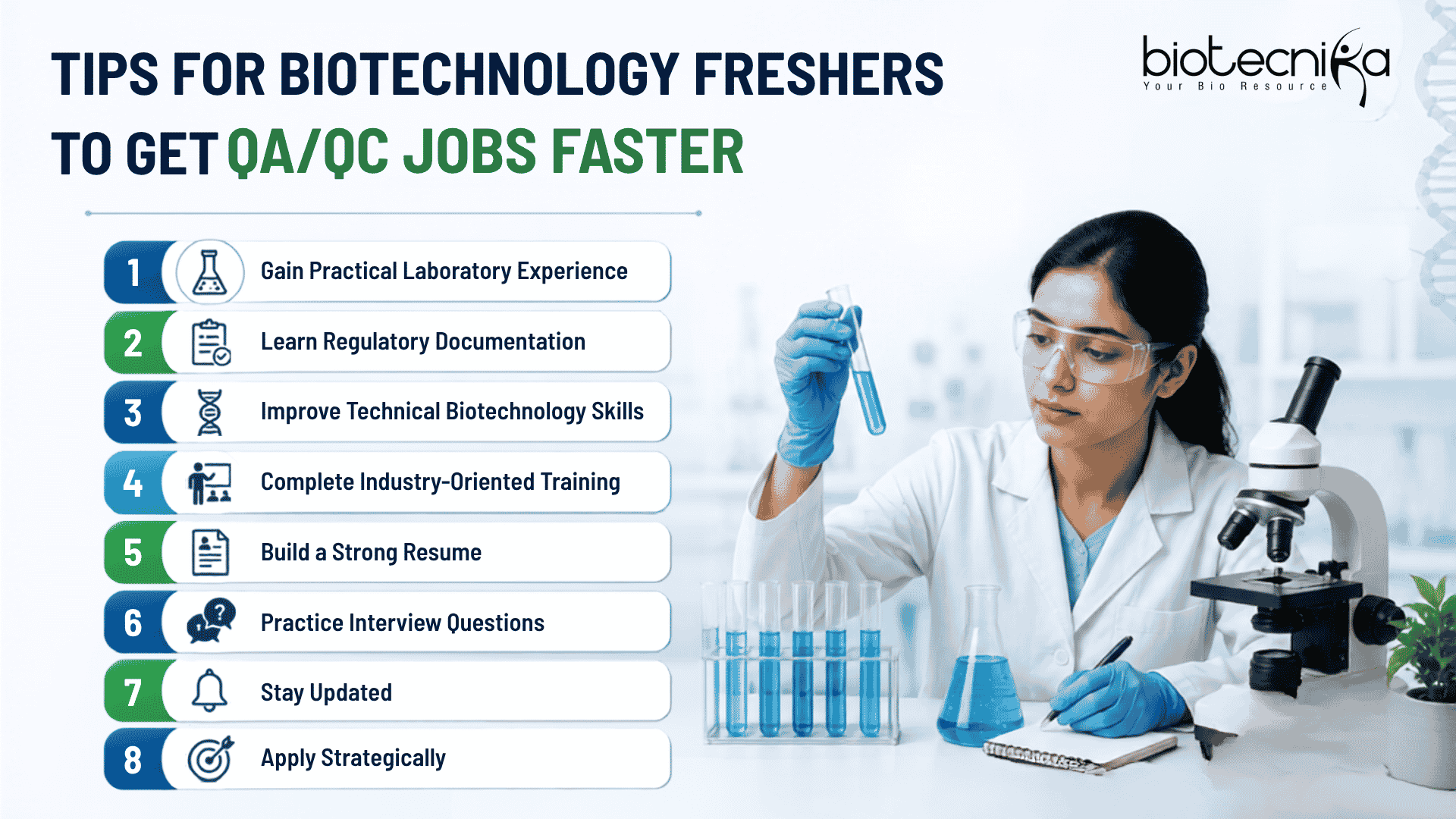
1. Gain Practical Laboratory Experience
Hands-on laboratory training is highly valued. Participate in internships, academic research projects, industrial training, or apprenticeships whenever possible.
2. Learn Regulatory Documentation
Become familiar with:
- SOPs
- GMP documentation
- BMR
- BPR
- CAPA
- Deviation reports
- Change Control
- Data Integrity (ALCOA+)
Documentation skills are essential for both QA and QC roles.
3. Improve Technical Biotechnology Skills
Develop practical knowledge of:
- HPLC
- UV Spectroscopy
- pH Meter
- GC basics
- Dissolution testing
- Calibration
- Sample preparation
These Biotechnology Skills are frequently mentioned in job descriptions.
4. Complete Industry-Oriented Training
Short-term certification programs in pharmaceutical quality systems, analytical instrumentation, GMP, or regulatory affairs can strengthen your resume, especially when they include practical components.
5. Build a Strong Resume
Highlight:
- Laboratory techniques
- Instrument exposure
- Projects
- Internships
- Certifications
- Technical skills
- Regulatory knowledge
Keep the resume concise, well-structured, and tailored to QA/QC roles.
6. Practice Interview Questions
Regularly revise both technical and HR questions. Mock interviews can help improve confidence and communication.
7. Stay Updated
Quality standards continue to evolve. Read regulatory updates from organisations such as WHO, CDSCO, US FDA, and ICH to stay informed about current industry expectations.
8. Apply Strategically
Instead of applying randomly, focus on:
- Pharmaceutical company career pages
- Biotechnology company websites
- Biotechnology-specific job portals
- LinkedIn Jobs
- Campus placement opportunities
- Employee referral programs
Consistent and targeted applications improve the likelihood of receiving interview calls.
Why QA/QC is One of the Best Biotechnology Careers?
Among the many available Biotechnology Careers, QA/QC stands out because of its stability, growth potential, and meaningful contribution to public health.
-
High Industry Demand
Every regulated pharmaceutical manufacturer requires QA and QC departments. This creates continuous demand for qualified professionals regardless of economic conditions.
-
Regulatory Importance
Quality functions are not optional—they are mandated by regulatory authorities. Without QA and QC approval, pharmaceutical products cannot be released to the market.
-
Broad Employment Opportunities
Quality professionals can work in:
- Pharmaceutical companies
- Biotechnology firms
- Vaccine manufacturers
- Medical device companies
- Food and nutraceutical industries
- Diagnostics laboratories
- Contract Research Organisations (CROs)
- Contract Development and Manufacturing Organisations (CDMOs)
-
Strong Career Progression
Professionals can advance from trainee positions to Quality Head or executive leadership through continuous learning and experience.
-
Contribution to Patient Safety
Perhaps the most rewarding aspect of QA/QC is knowing that your work directly supports the production of safe, effective, and reliable healthcare products. By ensuring compliance with quality standards, QA and QC professionals help protect millions of patients every day.
Conclusion
Starting your career can feel challenging, especially when you are competing with many other graduates. But remember that every experienced Biotech QA/QC professional was once a fresher who had to learn the basics and attend their first interview.
The pharmaceutical and biotechnology industries are growing every year, and companies are always looking for people who understand quality, follow procedures carefully, and are eager to learn. You do not need to know everything on day one. What matters most is building strong laboratory skills, understanding quality guidelines, and improving your confidence through regular practice.
Keep learning, gain as much practical experience as you can, and stay updated with industry standards. Every new skill you develop makes you a stronger candidate and brings you one step closer to your first opportunity.
Your journey into QA/QC may begin with an entry-level role, but it can grow into a rewarding career with excellent learning opportunities, career progression, and the chance to make a real difference in patient safety and healthcare. Stay curious, keep improving, and believe in your ability to succeed. The right opportunity could be closer than you think.