

















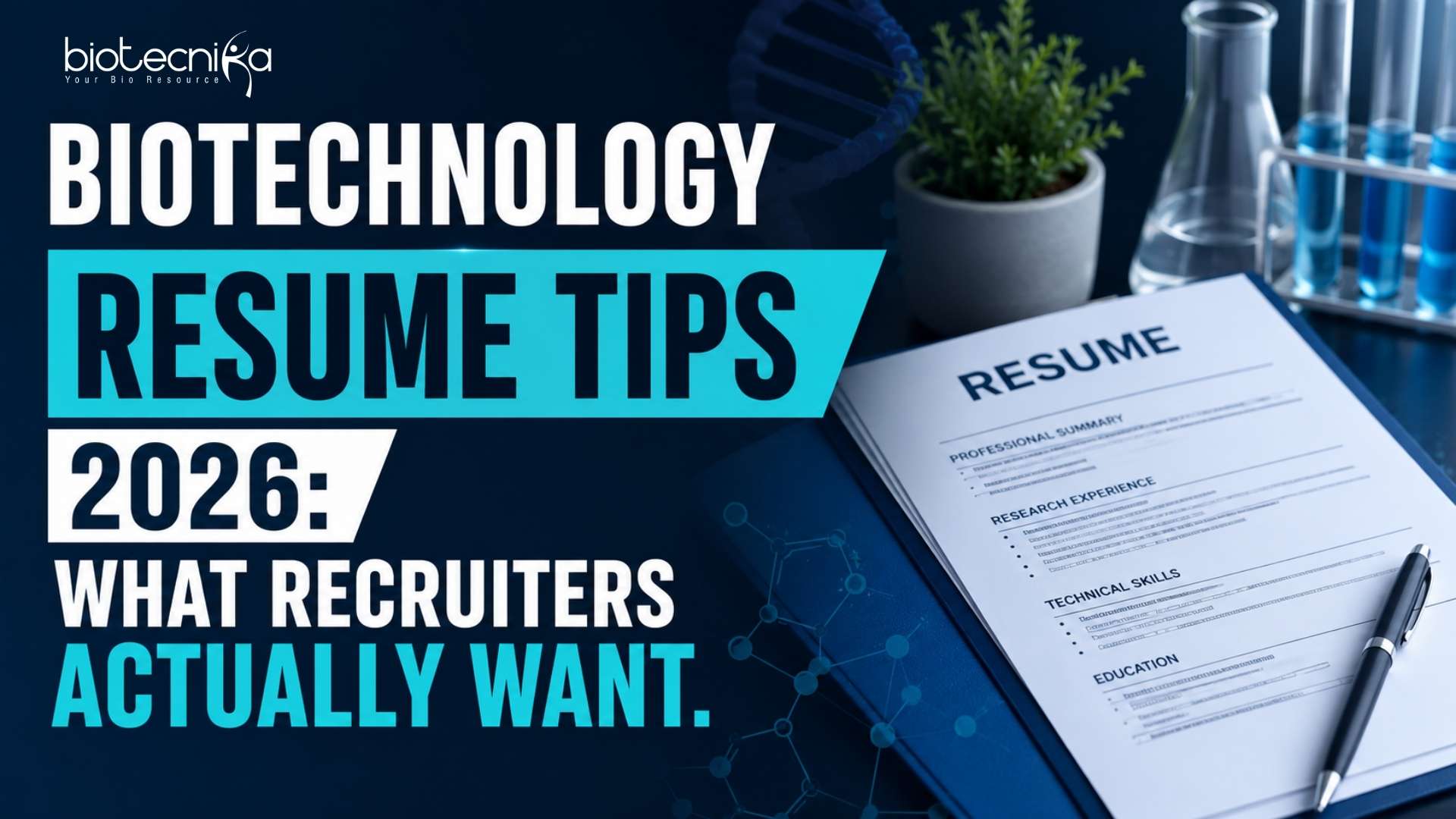
Biotechnology Resume Tips 2026: What Recruiters Actually Want
A Practical Guide to Starting Your Biotechnology Career
While finding my first job in biotechnology as an entry-level candidate was very challenging, one among all students who possessed average or higher academic skills & marks, but still struggled to produce an effective resume that attracts employers. In today’s very competitive job market for biotechnology jobs, your resume is typically the first opportunity to make a strong impression on a prospective employer.
Most recruiters will only spend a few seconds looking at resumes before making a decision regarding whether to move forward with a candidate. For this reason, it is essential to have a well-organized, polished, and ATS-compliant resume.
Biotechnology Freshers can increase their opportunity for obtaining interviews for internships, research positions, pharmaceutical industry job opportunities, quality control job opportunities, clinical research job opportunities, and biotech startup positions by implementing the appropriate Resume Tips presented in this article.
The article provides straightforward and practical Resume Tips that students can use to help create successful Biotechnology Careers.
Why are so many biotech jobs so competitive currently?
Biotechnology is growing at a pace few industries match. From drug discovery and clinical research to AI-powered bioinformatics, genomics, food technology, and biotech startups, the field is expanding in every direction. Contract research organizations (CROs) are hiring. Pharma companies are hiring. And yet, each individual job opening still attracts hundreds of applicants.
That is why your resume matters more than you think. It is not just a document – it is your first pitch. A poorly formatted or carelessly written resume will get filtered out before a human even reads it, often by automated software. A well-crafted one can get you in the room. These are some of the tips that would surely help you to build a resume that would be selection-worthy.
Keep It Short, Clean, and Easy to Read
For freshers, one page is ideal. Two pages are acceptable only if you have solid internships, multiple certifications, or substantial project work. Beyond that, less is more. Recruiters are not looking for your entire college journey; they want to quickly find the relevant parts.
Stick to these formatting basics:
- Fonts like Arial or Calibri, sized between 10 and 12 points
- Standard headings such as Education, Skills, Projects, and Certifications
- Bullet points instead of dense paragraphs
- Adequate spacing between sections – white space is not wasted space
Avoid heavy graphics, too many colors, or creative layouts that distract from the content. Clean always reads as more professional.
Understanding ATS: The First Filter You Need to Pass
Your resume may get passed over by a real person if it doesn’t pass an ATS first. Many businesses use ATS programs to analyze resumes before passing them on to hiring managers and recruiters. ATS will look for specific keywords associated with the job or industry, certain skills, and whether your resume is formatted in a way that they typically accept. In order for your resume to be reviewed by a person, you’ll need to follow some general guidelines:
- Use standard headings – like “Education”, “Skills,” and “Experience.”
- Do not use tables, text boxes, or graphics in your formatting
- Use relevant keywords described in the job posting throughout your resume in an appropriate manner
- Save your resume as a PDF unless the job description specifies an alternative format.
Common keywords within the biotech industry that you should include, where applicable, are: Molecular Biology, Biotechnology, PCR, Cell Culture, Gel Electrophoresis, ELISA, Clinical Trials, Quality Control, Bioinformatics, Data Analysis, Chromatography, and Microbial Techniques.
What Your Resume Should Actually Include
Here is a recommended structure for Biotechnology Freshers, ordered by what recruiters look for first:
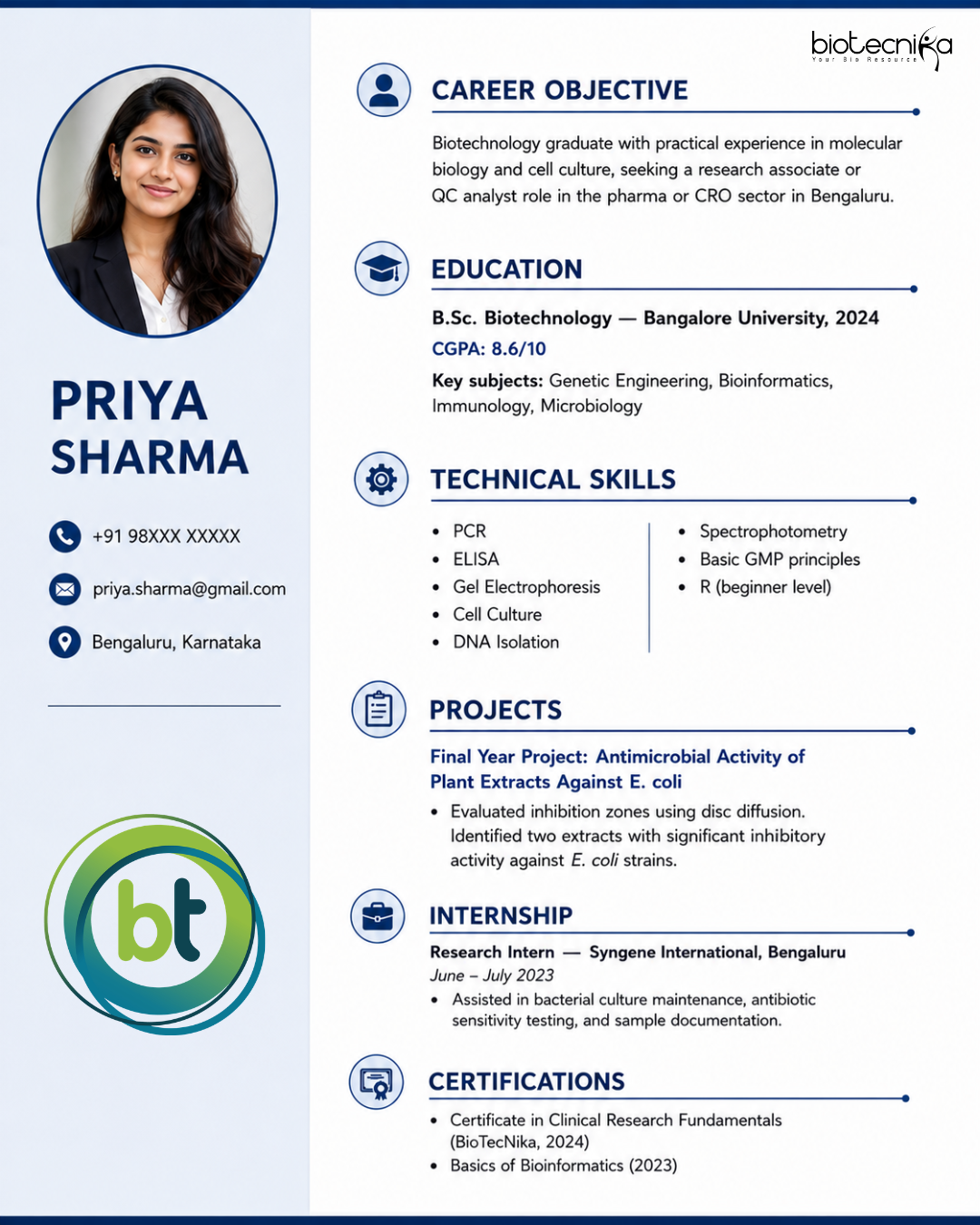
Contact Information
Place your full name, phone number, professional email, city, and, optionally, your LinkedIn profile at the very top. Your email address should look professional — your name or initials are sufficient. An address like [email protected] will undermine an otherwise strong resume.
Career Objective
This is a two- to three-sentence summary of what you bring and what kind of role you are looking for. Write it in your own words; recruiters can immediately spot objectives copied from the internet, and it reflects poorly.
Example: “Biotechnology graduate with hands-on experience in molecular biology and laboratory techniques, seeking an opportunity to contribute to research and development in a dynamic biotechnology organization.”
Education
For freshers, education is your strongest section. Include your degree, university name, year of completion, and CGPA or percentage. Institutions like IIT Delhi, IIT Bombay, VIT Vellore, and SRM Institute often have 85–90% placement rates in biotech-related fields. If your scores are strong, highlight them. If you studied subjects like Genetic Engineering, Bioinformatics, Immunology, or Cell Biology, name them — they show subject relevance to a recruiter who may spend only seconds scanning your degree.
Laboratory and Technical Skills
Indian pharma, QC, and CRO recruiters look specifically for demonstrated lab skills. List only what you have genuinely used — even during college practical sessions is fine. Recruiters will ask technical questions during interviews, and you need to be able to answer them clearly.
Common skills relevant to Indian biotechnology roles include PCR, ELISA, gel electrophoresis, DNA isolation, cell culture, chromatography, spectrophotometry, and microbial techniques. For QC and manufacturing roles, familiarity with GMP and GLP principles is increasingly expected even at the entry level.
In 2026, awareness of AI applications in biology is being noticed by forward-looking employers , particularly in bioinformatics and computational biology roles. India hosted its first AI-biology symposium at IISc Bengaluru in August 2025, and AI featured prominently at BioAsia 2025 in Telangana, signaling that these skills are entering mainstream biotech hiring. You do not need to be an expert. Knowing what tools like AlphaFold (protein structure prediction) do, understanding how omics data is interpreted, or having basic exposure to R or Python for biological data analysis, gives your profile an edge that most freshers currently lack.
Projects and Internships
Even a one-month internship is worth including. Mention the organization, duration, and what you actually did in two to three lines. Your final-year project also belongs here — include the title, objective, techniques used, and results.
Keep these descriptions short and factual. “Worked on bacterial culture techniques and antibiotic sensitivity testing during a one-month internship at [Organization Name]” is enough.
Wherin, nowadays, it is difficult to get an internship or project that is worthy, or that really puts a value or brings up the resume, or catches the attention of the recruiters, one among those names is BioTecNika.
Certifications and Soft Skills
Certifications in areas like clinical research, bioinformatics, molecular biology, or scientific writing are worth including. They show initiative. Top Ed Tech Platforms, such as BioTecNika and biotechnology training institutes, offer useful programs.
Alongside technical skills, mention a few soft skills that are genuinely yours: communication, attention to detail, teamwork, or problem-solving. Do not list every soft skill imaginable. Three or four that you can actually demonstrate are more credible than ten generic ones.
Entry-Level Salaries for Biotech Freshers in India
To better identify targeted roles and realistic salary expectations, it is necessary to review available salary ranges. Entry-level biotechnology salaries in India will vary by position, geographic region, and the educational institution at which help-wanted ads are posted.
According to BioTecNika (2025-2026), the average entry-level salary for biotechnology graduates in India in 2026 will be ₹6.21 LPA. Entry-level salaries for people with a B.Sc. or a B. Tech degree will be paid at an average of ₹3.5-5.5 LPA, whereas entry-level salaries for graduates with specialized skills in any of the following areas will start at an annual salary of almost ₹6 LPA, like Bioinformatics, Genetic Engineering, etc
Entry-level salaries for biotech graduates with skills in bioinformatics will be between ₹25,000 and ₹ 50,000/month. Biopharma manufacturing starting salaries range from ₹4-6 LPA, depending on the position. Quality Control (QC) and pharmaceutical salaries in Bengaluru and Hyderabad are 15-25% higher than the average for those regions.
Additionally, entry-level salaries can double or more for people with laboratory ability, Good Manufacturing Practices (GMP), and/or basic data analysis skills compared to entry-level salaries for those who can only demonstrate knowledge of the theory of laboratory-related sciences.
Tailor Your Resume to Each Position
One of the most frequently overlooked resume tips is also one of the most logical: do not submit the same resume for every position. By making just a few modifications relevant to the job description, you will greatly enhance your opportunity to become one of the chosen few candidates to receive an interview.
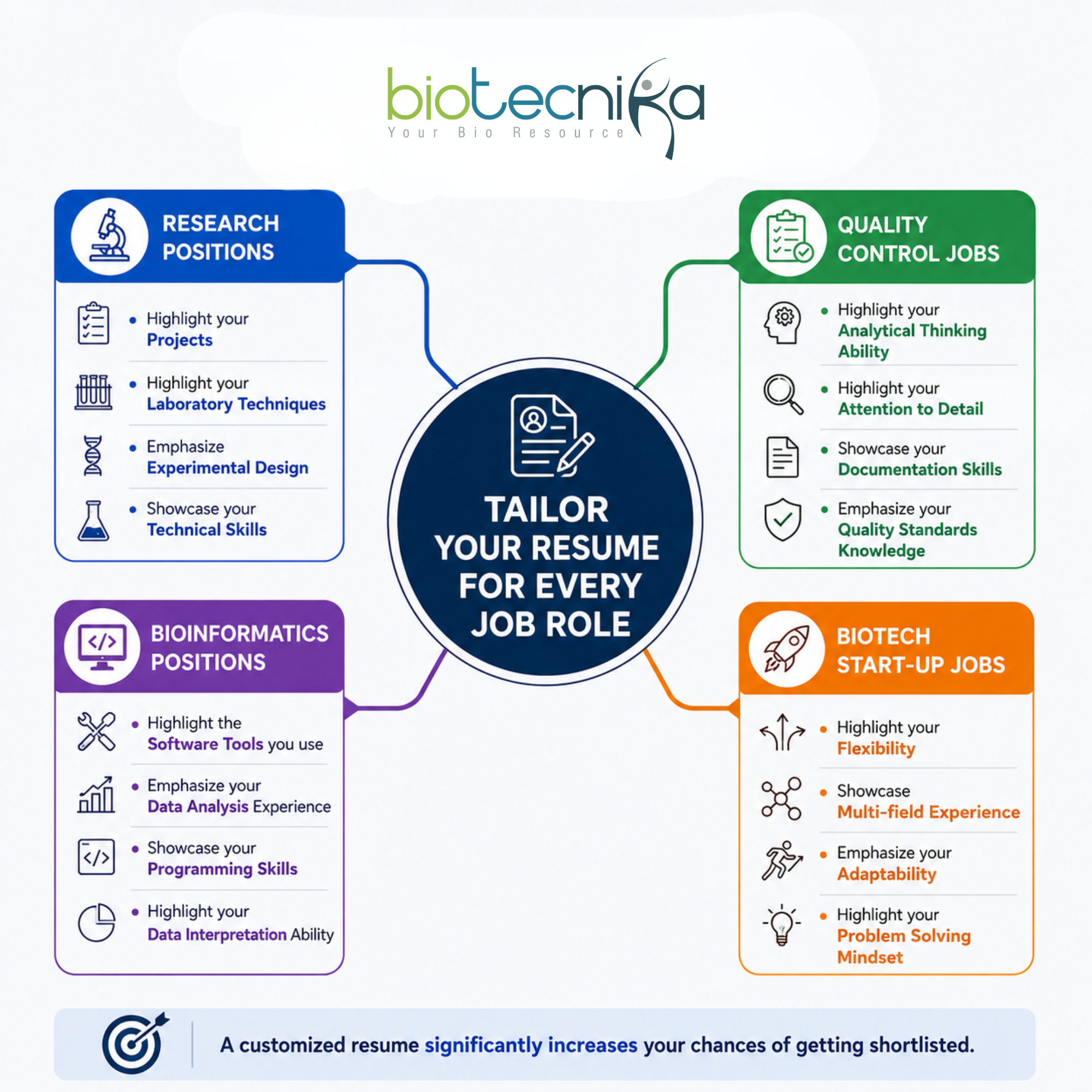
- Research Positions: Highlight your Projects and Laboratory Techniques
- Quality Control Jobs: Highlight your Analytical Thinking Ability and Attention to Detail
- Bioinformatics Positions: Highlight the Software Tools Used and Data Analysis Experience
- Biotech Start-up Jobs: Highlight Your Flexibility and Multiple Field Experiences
How to Optimize LinkedIn: Give a strong base to your resume
Using LinkedIn to search for job candidates has become the norm with recruiters at Indian pharmaceutical companies, CROs, and biotechnology firms. LinkedIn will be necessary for job hunters and recruiters in 2026 because most will no longer send their resume without their LinkedIn profile first.
Recruiters have found that candidates who have complete LinkedIn profiles with appropriate keywords have been the most successful at obtaining jobs. Since the professional environment has socialized many recruiters to utilize LinkedIn in order to evaluate potential employees, recruiters will prefer candidates with complete LinkedIn profiles over candidates whose profiles are incomplete or lack relevant keywords.
The LinkedIn profile for Freshers should be simple:
- Clear and professional image (not a cropped image with someone else or a personal photograph)
- A headline should be eye-catching and convey professionalism, determination, or your future goals, not just your degree.
- The summary should be a continuation of the resume objective, in your words, with the same content.
- Include your skills, projects, internships, and certifications in your resume.
- Among the many keywords for biotechnology on LinkedIn, include some that fit you and will increase the chances of being found by recruiters.
- If you are actively seeking employment, make your “open to work” status visible to recruiters.
Both your LinkedIn profile and resume must tell the same story. If recruiters find inconsistencies with your work history or the skills you’ve provided on your resume and LinkedIn profile, it will create doubt in the recruiter’s mind, and they will not consider you an applicant.
Using AI Tools to Polish Your Resume:
AI tools can be practically integrated into the resume-building process. While an AI tool won’t build the entire resume for you, it helps in identifying errors, refining your writing, and determining how well your resume aligns with a specific job posting prior to submission.
Practical uses of tools:
Grammarly – a check on grammar, tone, and clarity prior to submission
ChatGPT – rephrasing sentences or providing an initial objective statement, and assessing whether project descriptions are intelligible to a person outside your field.
Resume Scanners – imitate ATS screening to provide you with a percentage match of your resume with a job posting based on keywords.
NOTE: Use the tools to enhance your writing, but do not substitute them. The recruiters at reputed Indian Biotech and Pharmaceutical companies are astute evaluators. A resume written purely by an AI that does not represent you sounds excessively formal or generic, and is going to create the same question as the use of a downloaded template.
Mistakes That Cost Freshers Their Interviews
Experienced recruiters know red flags when they see them. The most common ones that cost applicants the interview without a phone call are:
- Typographical errors / Grammatical mistakes – Proofread, proofread, and proofread again.
- False internship/publication claims – these are quick to check and are difficult to bounce back from
- Objectives copied word-for-word from the web
- Stating skills that cannot be verbally justified or illustrated
- Including religious, marital status, and family information, unless necessary
- Inappropriate file name, e.g., resumefinal123.pdf
- Save your CV as a PDF. Use a name like FirstNameLastNameResume.pdf.
It seems like a trivial detail, but it signals that you know how to be professional.
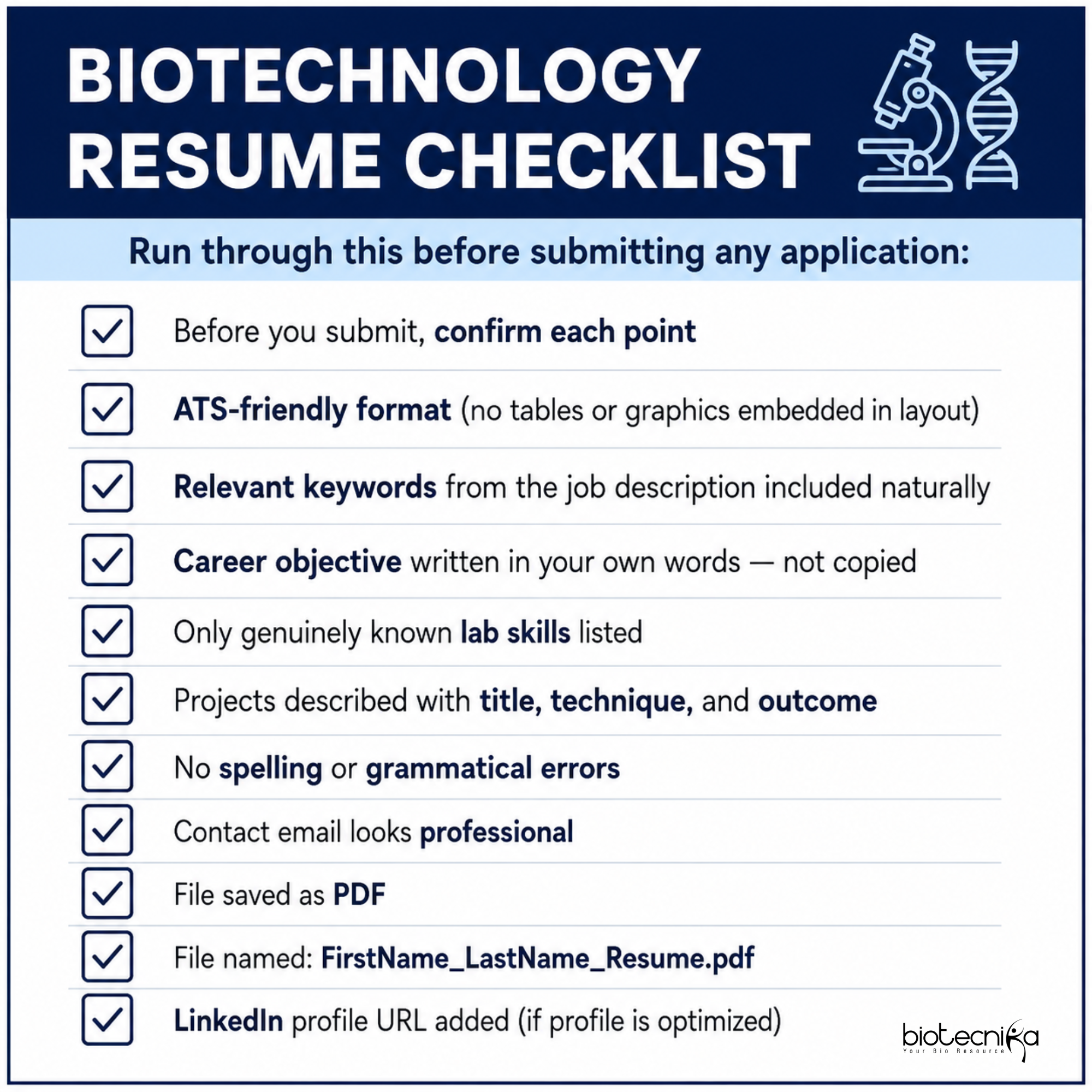
Biotechnology Resume Checklist
Run through this before submitting any application:
Before you submit, confirm each point
Final Thoughts
You do not need years of experience to write a strong resume. What you need is clarity about what you have learned, what you have done, and what you are looking for. Present your education honestly, list your lab skills accurately, describe your projects in plain language, and keep the layout clean.
Growth is occurring in the biotechnology (bio-science) industry all over the country, but especially in areas like Genomics (Hyderabad), pharma (Pune), and the CROs (Bangalore). There are expected to be plenty of opportunities in this segment of the job market until 2030 (millions of job openings). The competition for entry-level positions is stiff, so you need to make your resume memorable and easy to read so that the employer chooses your application.