



















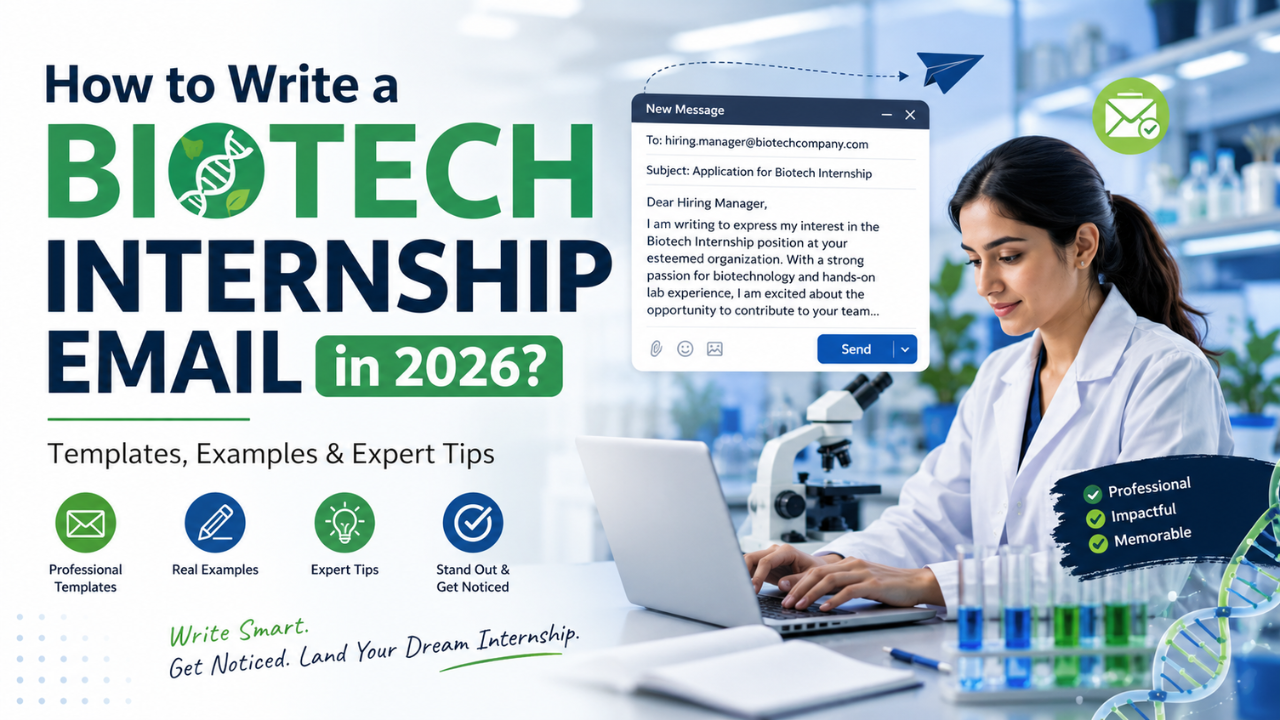
How to Write a Biotech Internship Email in 2026? Templates, Examples & Expert Tips
Looking for a Biotechnology Internship? Your Email Could Be the Reason You Get Selected. Most biotech students in India think getting an internship is all about marks, skills, and college reputation. But the real question is: What’s the reality? In many cases, the first filter is not your CGPA. It’s not even your lab skills. It’s your Biotech Internship Email.
Yes, a simple internship email can determine whether a professor opens your CV or ignores it. One mail will get you a chance to enter a CSIR lab, your dream biotech company, or startup.
Every year, thousands of biotech and life science students like you apply for very limited internship seats. Only a strong, clear, and personalized email can make you stand out from the rest.
Today, the Indian biotech industry is growing faster. With this growth, competition for the biotech internship is also increasing. That means your approach has to be smarter, and not just stronger.
This is where the Biotech Internship Email Templates for the Biotech students become important. With these, you can learn how to write effective internship emails. We will look at the ATS-friendly resume strategies that will improve your chances of getting noticed by the right people at the right time.
So, let’s begin our journey of finding the right internship email template.
How Do You Write an Internship Email for Biotechnology Students?
Well, since middle school, we were taught letter writing and emails. We have written them many times. But were they always in the right format?
A successful biotechnology internship email should include:
- A clear subject line.
- A professional greeting.
- A short introduction.
- Relevant laboratory skills.
- Internship duration and availability.
- A request for consideration.
- A professional closing.
- An attached CV or resume.
Most importantly, your Biotech Internship Email should be between 150 and 250 words. Make sure that you don’t use the same email for every professor, scientist, and company you contact.
Why Biotechnology Internships Matter More Than Ever?
In today’s fast-moving world, just a biotechnology degree is not enough. It will provide you with theoretical knowledge. But employers and research supervisors often look for practical skills and experience in candidates.
With the biotechnology internship, you can gain lab techniques, research experience, and an understanding of the industry workflow. You can build professional connections and strengthen your higher education applications. The internship will improve your job prospects.
Many MSc admissions committees, PhD supervisors, and recruiters prefer candidates who have completed a biotechnology internship or a life science internship.
Benefits of a Biotechnology Internship
| Benefit | Impact on Career |
| Laboratory Experience | Improves practical skills |
| Research Exposure | Helps with publications and projects |
| Industry Knowledge | Makes students job-ready |
| Networking | Builds professional connections |
| Stronger Resume | Improves interview chances |
| Recommendation Letters | Useful for higher studies |
Why Personalized Internship Emails Get More Responses?
Many students send the same email to 100 professors and wonder why nobody replies. Professors and industry professionals can easily identify generic emails. You have to make a personalized biotechnology internship application that shows:
- Genuine interest
- Professionalism
- Research effort
- Strong communication skills
Many research internship opportunities in India are never publicly advertised. Scientists often select students who directly contact them with a thoughtful and relevant Biotech Internship Email.
Essential Elements of a Biotechnology Internship Email
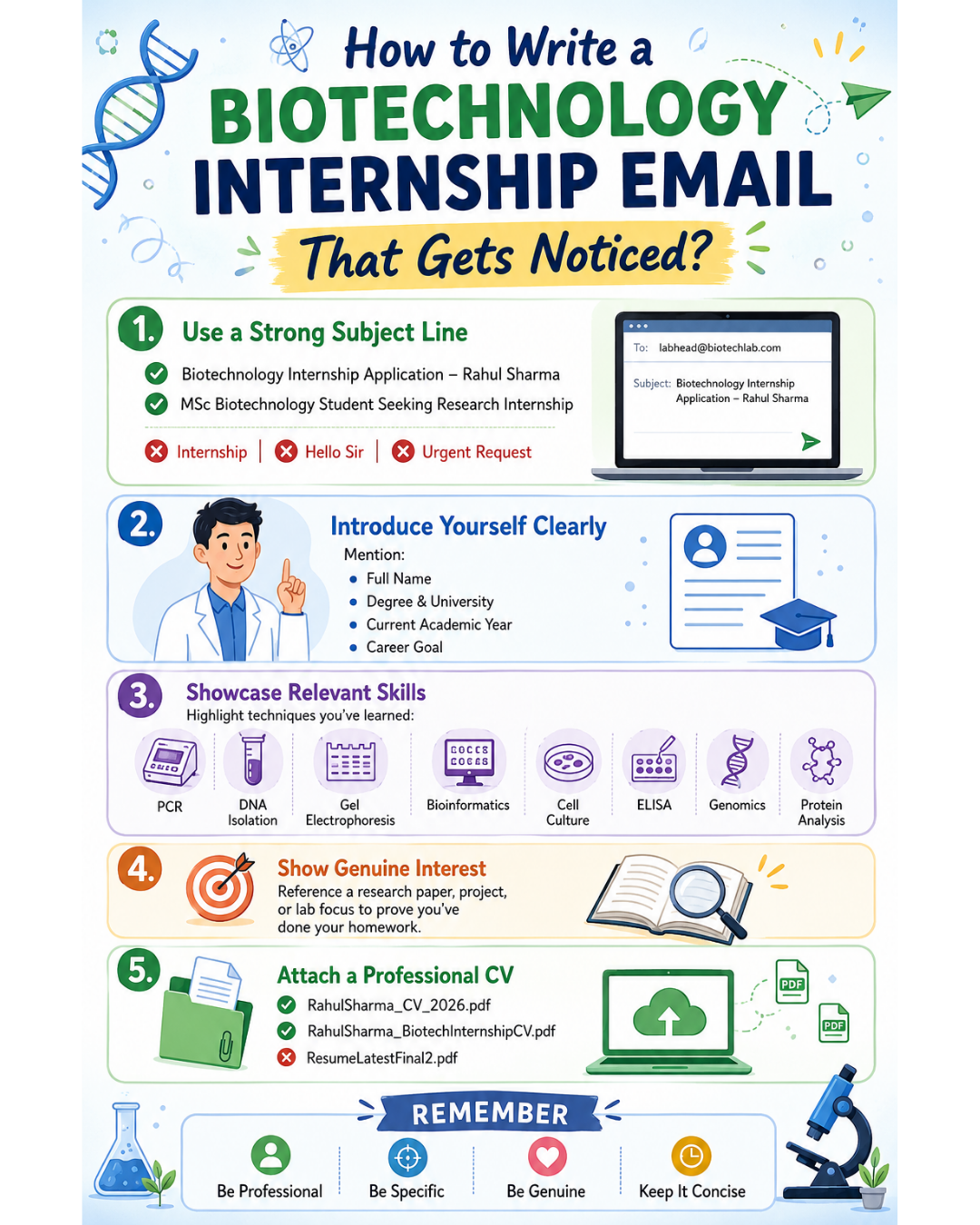
1. Use a Professional Subject Line
Your subject line should clearly explain why you are contacting the recipient. For your ease, here are Sample Internship Email Subject Lines That Get Opened
- Application for Biotechnology Internship – Rahul Sharma
- MSc Biotechnology Student Seeking Research Internship
- Summer Internship Biotechnology Application
- Biotechnology Internship India – Final Year Student
- Request for Research Internship in Molecular Biology
You should avoid subject lines like:
- Internship
- Help Needed
- Hello Sir
- Urgent Request
2. Introduce Yourself Clearly
You can start your Biotech Internship Email by introducing yourself. Always start with your full name, degree program, college or university name, and then the current academic year.
Example:
“I am currently pursuing an MSc in Biotechnology at XYZ University and am interested in gaining hands-on research experience in molecular biology.”
3. Highlight Relevant Skills
Don’t forget to mention your skillset. It does not have to be advanced skills. Show skills that are relevant. For example, talk about your PCR, DNA isolation, Gel electrophoresis, bioinformatics, and more skills that you have learned in college. Below is the list of more skills that will grab the attention of scientists:
- Cell Culture
- ELISA
- Microbiology
- Genomics
- Protein Analysis
4. Explain Your Interest
Mention a research paper, project, or area of work that interests you. This demonstrates that you have done your homework.
5. Attach a Professional Resume
Good examples:
- RahulSharma_CV_2026.pdf
- RahulSharma_BiotechInternshipCV.pdf
Avoid:
- ResumeLatestFinal2.pdf
- NewResumeUpdated.pdf
Internship Email Template for Research Laboratories
Subject: Application for Biotechnology Internship Opportunity
Dear Professor,
I hope you are doing well.
My name is [Your Name], and I am currently pursuing [Degree Name] at [University Name]. I have a strong interest in molecular biology and biotechnology research.
I recently read about your work in [Research Area] and found it highly inspiring. I would be grateful for an opportunity to work under your guidance and gain practical research experience.
I have experience in laboratory techniques such as PCR, DNA extraction, gel electrophoresis, and microbiological methods. I am eager to contribute to ongoing projects and learn advanced research methodologies.
I have attached my CV for your consideration.
Thank you for your time and consideration.
Sincerely,
[Your Name]
Biotechnology Internship Email Template for Companies
Subject: Biotechnology Internship Application – [Your Name]
Dear Hiring Manager,
I am currently pursuing a [Degree] in Biotechnology from [University Name] and would like to apply for a biotechnology internship opportunity within your organization.
My academic training has provided me with experience in microbiology, molecular biology, biotechnology techniques, and data analysis. I am eager to gain industry exposure and understand biotechnology product development and quality processes.
I would greatly appreciate consideration for any available internship opportunities.
Please find my attached resume for review.
Thank you for your time.
Kind regards,
[Your Name]
Follow-Up Regarding Biotechnology Internship Application
Dear Professor/Hiring Manager,
I hope you are doing well.
I recently submitted my application for a biotechnology internship and wanted to follow up regarding any updates. I remain highly interested in the opportunity to learn from your team and contribute to ongoing projects.
I understand you may be receiving many applications and appreciate your time and consideration.
Thank you for your attention. I look forward to hearing from you.
Kind regards,
[Your Name]
How to Find Professors for Biotechnology Internships?
One of the most common questions students ask is: “Where can I find professors to email?”
University Websites
Visit the faculty pages of:
- IITs
- IISERs
- Central Universities
- State Universities
- Medical Research Institutes
Research Institutes
Explore laboratories associated with:
- CSIR
- ICMR
- DBT-funded institutes
- DRDO
- BARC
Research Papers
Many scientific publications include the corresponding author’s email address. If you are interested in genomics, microbiology, immunology, cancer biology, or bioinformatics, research papers can help you identify potential mentors.
Many scientists and biotechnology professionals maintain active LinkedIn profiles.
How Many Professors Should You Contact?
A practical target is:
| Internship Goal | Recommended Applications |
| Summer Internship | 20–30 |
| Research Internship | 30–50 |
| Competitive National Labs | 40–60 |
Consistency is often more important than sending one perfect application.
Biotechnology Internship Application Timeline
| Internship Period | Best Time to Apply |
| Summer Internship (May–July) | December–February |
| Winter Internship (December–January) | August–October |
| Research Internship at National Labs | 3–6 months in advance |
| Industry Internships | 2–4 months in advance |
Applying early often gives students access to more opportunities and higher response rates.
ATS-Friendly Resume Tips for Biotechnology Internship Applications
Many biotechnology companies and CROs now use Applicant Tracking Systems (ATS) to screen resumes. If your resume is not ATS-friendly, it may never reach a recruiter.
ATS Resume Optimization Checklist
| ATS Tip | Why It Matters |
| Use keywords from the internship description | Improves the matching score |
| Save as PDF | Preserves formatting |
| Use standard headings | ATS can read them easily |
| Avoid graphics and icons | Some systems cannot parse them |
| Include laboratory skills | Improves relevance |
| Customize each application | Increases visibility |
Important Biotechnology Keywords
Include relevant keywords such as:
- Biotechnology
- Molecular Biology
- Microbiology
- PCR
- Cell Culture
- Bioinformatics
- Genomics
- ELISA
- Biotechnology Research
- Life Science Research
Cold Email Strategy for Biotechnology Internships
A cold email for internship applications means contacting someone even when no internship has been advertised. This approach works surprisingly well in research.
Cold Email Best Practices
- Personalize every email.
- Mention the recipient’s work.
- Keep the message concise.
- Attach your CV.
- Follow up professionally.
Internship Email vs Generic Email
| Factor | Professional Internship Email | Generic Email |
| Personalization | High | Low |
| Response Rate | Higher | Lower |
| Professional Impression | Strong | Weak |
| Research Mentioned | Yes | No |
| Internship Goals Explained | Yes | Usually No |
| Chance of Reply | Better | Lower |
Best Places to Apply for a Biotechnology Internship in India
Once your email is ready, the next challenge is identifying the right organizations and laboratories to contact.
Government Research Organizations
- CSIR Laboratories
- ICMR Institutes
- DRDO Laboratories
- BARC Research Centers
National Biotechnology Institutes
- National Institute of Immunology (NII)
- National Center for Cell Science (NCCS)
- Institute of Genomics and Integrative Biology (IGIB)
Biotechnology Companies
- Biopharmaceutical companies
- Vaccine manufacturers
- Genomics companies
- Diagnostics companies
CRO Companies
- Clinical research organizations
- Drug development companies
- Contract testing laboratories
These organizations regularly offer biotechnology internship opportunities in India for students.
How Biotechnology Internships Support Long-Term Career Growth?
A biotechnology internship is not just a short-term learning experience. The skills, research exposure, and professional connections you gain can influence your future career path. Whether your goal is research, industry, government service, or higher studies, internship experience can strengthen your profile and improve your opportunities.
Research Scientist Careers
Scientists work in organizations such as CSIR, ICMR, DRDO, and BARC.
Typical responsibilities include:
- Experimental research
- Scientific publications
- Product development
- Data analysis
Early-career scientist positions often begin at government pay levels comparable to Level-10 positions.
Biotechnology Officer Careers
These professionals work in government departments and biotechnology programs.
Responsibilities include:
- Project monitoring
- Policy implementation
- Program management
Food Safety Careers
Food Safety Officers work in:
- Regulatory agencies
- Food testing laboratories
- Quality assurance departments
Technical Officer Careers
Technical Officers support laboratory operations and scientific research. Practical internship experience often improves employability in these roles.
What Should You Do If You Receive No Response?
Not receiving a reply does not mean rejection. Many scientists receive hundreds of emails every month. Follow these steps:
- Wait 7 to 10 days.
- Send a polite follow-up email.
- Apply to additional laboratories.
- Improve your CV.
- Continue networking on LinkedIn.
- Attend workshops and conferences.
Many successful students receive internship offers only after contacting multiple organizations.
Common Mistakes Biotechnology Students Should Avoid
Before sending your biotechnology internship application, avoid these common mistakes:
| Mistake | What to Do Instead |
| Sending Generic Emails | Personalize every email by mentioning the professor’s research area or the company’s work. |
| Writing Long Emails | Keep your internship email clear, concise, and within 150–250 words. |
| Using Informal Greetings | Avoid “Hey” or “Hi Buddy”. Use “Dear Professor”, “Dear Sir/Madam”, or “Dear Hiring Manager”. |
| Ignoring Grammar Errors | Proofread your email before sending. |
| Forgetting Attachments | Always double-check that your CV or resume is attached. |
Quick Checklist Before Sending
- Professional subject line
- Personalized email
- Attached CV/resume
- Grammar checked
- Professional greeting
- Contact details included
Final Thoughts
Securing a biotechnology internship is rarely about sending one perfect email. Most successful students apply consistently, personalize every application, and follow up professionally.
Start by preparing an ATS-friendly CV, creating a list of 20 to 30 laboratories or companies, and using the Biotech Internship Email templates provided in this guide. Focus on building relevant skills, highlighting your research interests, and demonstrating genuine enthusiasm for learning.
Remember, Recruiters and principal investigators often spend less than a minute reviewing internship applications. A concise email combined with a targeted CV usually performs better than lengthy messages.
Every biotechnology internship application you send increases your chances of gaining valuable laboratory experience, building professional connections, and moving closer to a successful future in biotechnology careers, research careers, and life science careers.
The students who start early, stay consistent, and communicate professionally are often the ones who secure the best opportunities.
Frequently Asked Questions
What is the best biotechnology internship email subject line?
A clear subject line such as “Application for Biotechnology Internship – Your Name” is usually effective.
How long should an internship email be?
Keep it between 150 and 250 words.
Should I attach my resume?
Yes. Always attach an updated CV or resume.
Can first-year biotechnology students apply for internships?
Yes. Many laboratories and organizations offer training opportunities for early-year students.
How many internship emails should I send?
Students commonly send 20 to 50 applications before receiving positive responses.
What is the best time to apply for biotechnology internships?
For the summer Biotech Internship, applications should ideally be submitted three to six months in advance.