






















R&D Careers in Biotechnology: Academics vs Industry
Riya is a biotechnology student who has always enjoyed performing experiments while studying how science plays a key role in helping to solve real-world issues. However, like many students in their last year of university, she is feeling confused about which path to take after graduation: either academic research or entering into an industry position. Some of her fellow students want to pursue their doctorate degrees and continue with research, while others are focusing on securing high-paying jobs in the private sector. Riya is unsure whether the paths to freedom of research or accommodating higher salaries would provide her with a brighter future. If you are going through this as well, we have prepared an article comparing academic and industrial-based furthering of your education and R&D Careers in Biotechnology, so you can make your decision easily.
What are R&D Careers in Biotechnology?
R&D (Research and Development) careers in biotechnology involve working on new ideas, experiments, and innovations in areas like healthcare, agriculture, pharmaceuticals, and genetics. People in these roles try to discover new drugs, improve crops, develop vaccines, or solve scientific problems.
You can pursue research careers mainly in two paths:
- Academics (universities and research institutes)
- Industry (biotech companies, pharma companies, startups)
R&D Careers in Academia
What You Do
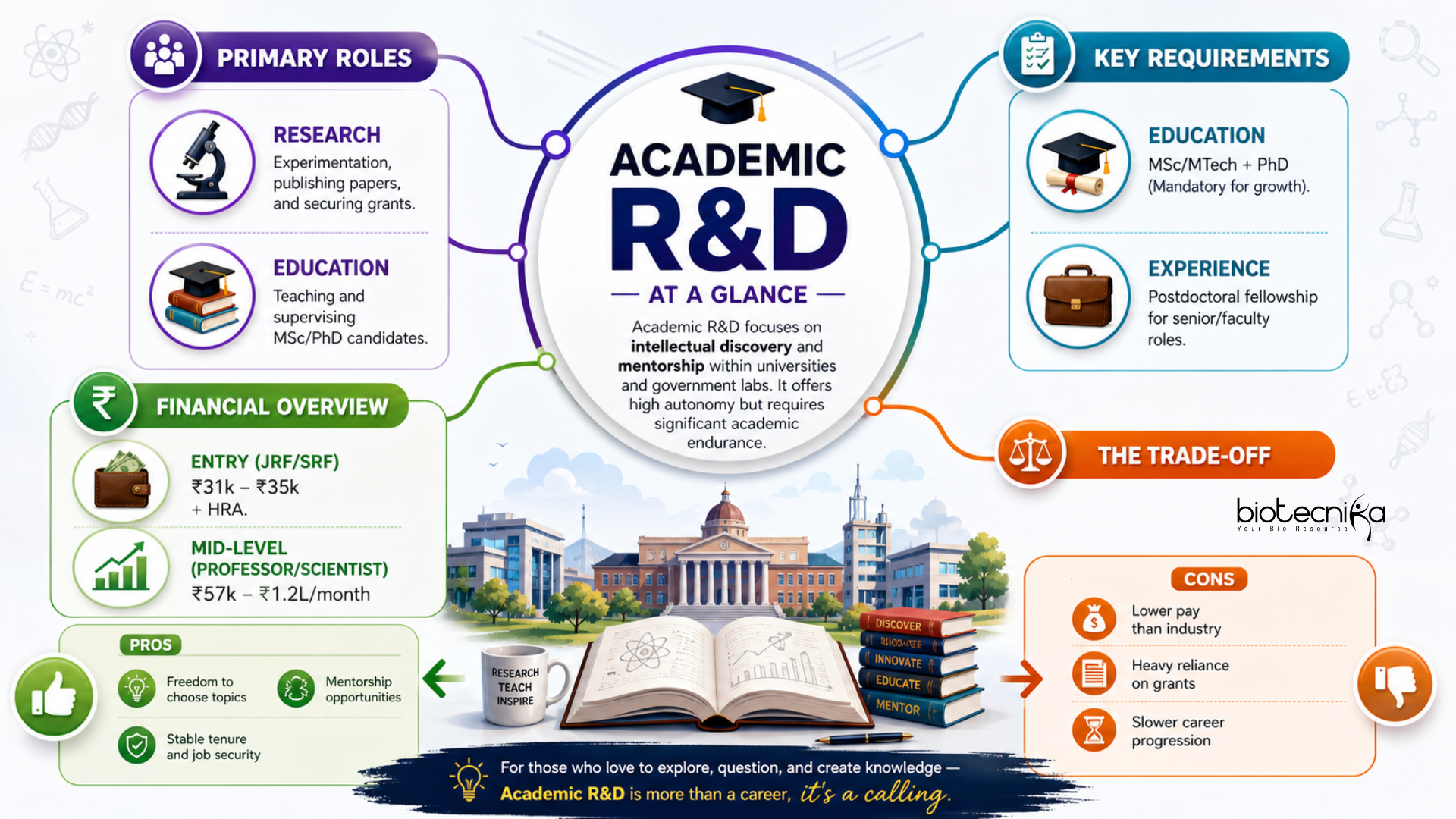
In academic research, you usually work in universities, colleges, or government-funded labs. Your main work includes:
- Conducting experiments and publishing research papers
- Teaching students (in some roles)
- Writing research proposals to get funding
- Guiding students like MSc or PhD scholars
Work Environment
Academic work is more flexible. You often have the freedom to choose your research topic and explore your ideas deeply. However, progress can be slow because funding and approvals take time.
Qualifications Needed
To build a career in academics, you usually need:
- MSc or MTech in Biotechnology or related field
- PhD (very important for higher positions)
- Postdoctoral experience (often required for top roles)
Salary in Academia
Salaries in academic R&D careers are usually lower than in industry, especially at the beginning.
- Junior Research Fellow (JRF): ₹31,000 + HRA
- Senior Research Fellow (SRF): ₹35,000 + HRA
- Assistant Professor: ₹57,000 – ₹70,000 per month
- Scientist roles: ₹60,000 – ₹1,20,000 per month
Pros of Academic Careers
- Freedom to choose research topics
- Opportunity to teach and guide students
- Less pressure compared to industry deadlines
- Chance to contribute to scientific knowledge
Cons of Academic Careers
- Salary gap compared to the industry
- Funding challenges
- Slow career growth in some cases
- Job positions can be limited
R&D Careers in Industry
What You Do
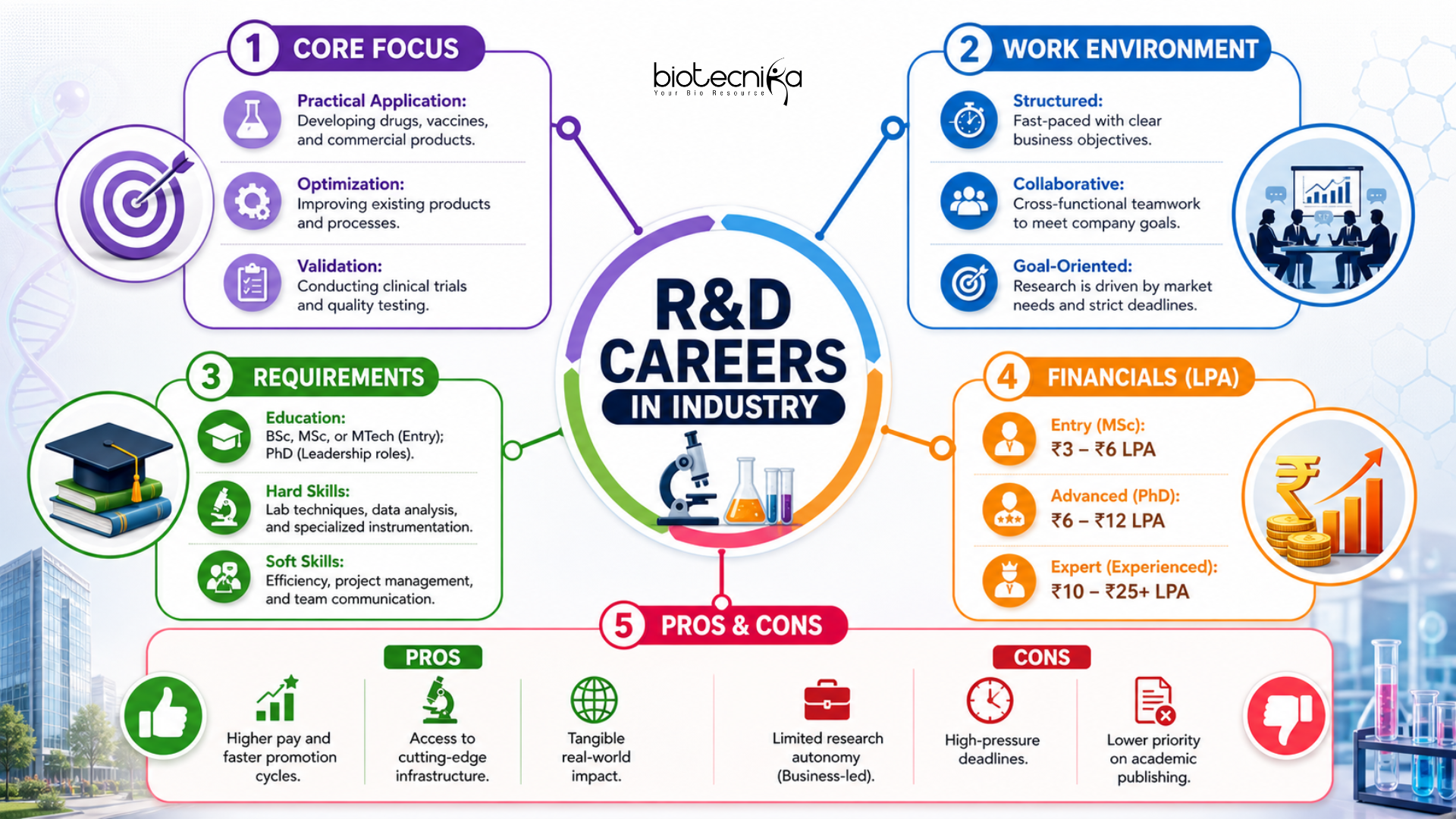
In the industry, you work in biotech companies, pharmaceutical companies, or startups. Your work focuses on practical applications of research.
Your responsibilities may include:
- Developing new drugs, vaccines, or products
- Improving existing products
- Conducting trials and testing
- Working in teams to meet company goals
Work Environment
Industry jobs are more structured and fast-paced. You work on projects with deadlines and clear goals. Unlike academics, your research is usually guided by business needs.
Qualifications Needed
For industry R&D roles, you can start with:
- BSc / MSc / MTech in Biotechnology
- A PhD is helpful for higher roles, but not always required
- Skills in lab techniques, data analysis, and tools
Salary in Industry
The industry offers higher salaries compared to academic research careers.
- Entry-level (MSc): ₹3 – ₹6 LPA
- PhD holders: ₹6 – ₹12 LPA
- Experienced professionals: ₹10 – ₹25 LPA or more
Pros of Industry Careers
- Higher salary and better financial growth
- Faster career progression
- Exposure to real-world applications
- Better infrastructure and funding
Cons of Industry Careers
- Less freedom in choosing research topics
- High pressure and strict deadlines
- Work depends on company goals
- Less focus on publishing research
Salary Gap: Academics vs Industry
One of the biggest differences in R&D careers in biotechnology is the salary gap.
- Academic careers offer a stable but lower income, especially in the early stages
- Industry careers offer higher salaries and faster financial growth
This salary gap is one of the main reasons many students prefer industry jobs after completing their degree.
However, academics can also offer good salaries at senior levels, but it takes more time to reach that level.
Key Differences Between Academics and Industry
| Factor | Academics | Industry |
| Focus | Knowledge & discovery | Product development |
| Salary | Lower initially | Higher |
| Freedom | High | Limited |
| Work Speed | Slow | Fast |
| Job Stability | Moderate | Depends on the company |
| Growth | Slow but steady | Faster |
Which One Should You Choose?
Choosing between R&D careers in academics and industry depends on your interests and goals.
Choose Academics if:
- You love teaching and guiding students
- You enjoy deep research and discovery
- You want freedom in your work
- You are okay with slower financial growth
Choose Industry if:
- You want a high-paying job
- You like working on real-world products
- You prefer structured work and fast results
- You want quicker career growth
Can You Switch Between Them?
Yes, it is possible to switch between academic and industry research careers, but it may not always be easy.
- Moving from academics to industry is common, especially after a PhD
- Moving from industry to academics usually requires strong research publications and sometimes a PhD
So, it’s better to plan your career path early.
Concluding Thoughts
There are multiple career paths available in R&D (research and development) biotechnology. You can choose between two options: if you prefer freedom of knowledge or if you are motivated by a more financial or practical application of your work.
If you prefer to work within an academic environment and enjoy both researching and teaching others in your field, academia is certainly the best direction for you; however, if you’re more interested in the financial aspects and would like to see the practical application of your research, then you will enjoy working in an industry position.
Consider your personal likes and dislikes as well as how much you value your strengths, future goals, and career path. This will allow you to create the foundation for a fulfilling career in biotechnology.