






Astronauts Advancing Life-Saving Cancer Research Beyond Earth
Can you picture yourself having a Friday that consists of being several hundred kilometers above Earth, repairing space suits, researching cancer cures, and having your eyes and heart checked, all in the same day? That was the week’s end for the ISS crew. All of the astronauts had worked on DNA-sized materials that could be used to develop future cancer treatments, while others continued to do health tests and repair the ISS for future experiments on how living in space affects people.
NASA astronaut Jessica Meir started her day working on the Cold Atom Lab inside the Destiny laboratory module. The special science facility cools atoms to temperatures close to absolute zero so scientists can study how they behave. Meir checked water hoses that remove heat from the system and inspected fiber optic cables that help cool and observe atoms with great precision. Researchers hope these experiments will improve our understanding of gravity, atomic physics, and dark matter.
Later, Meir joined fellow NASA astronaut Jack Hathaway inside the Quest airlock for spacesuit maintenance work. Hathaway installed three fully charged spacesuit batteries into a storage compartment and checked the surrounding equipment to make sure everything was properly arranged. Meir replaced connectors on a pistol grip tool that astronauts use during spacewalks for repair and assembly tasks.
NASA astronaut Chris Williams focused mainly on unloading supplies from the Cygnus XL cargo spacecraft, which arrived at the station on April 13. He also worked inside the Columbus laboratory module, fixing the vibration isolation system on a European exercise device to ensure it was functioning correctly.
Meanwhile, ESA astronaut Sophie Adenot carried out an important cancer research experiment inside the Kibo laboratory module’s Life Science Glovebox. She created tiny engineered materials designed to behave like DNA. These nanoparticle structures carry cancer-fighting drugs and are designed to target harmful cells while reducing side effects. Scientists believe the weightless conditions in space help these particles form more stable structures, which could lead to better cancer treatments in the future.
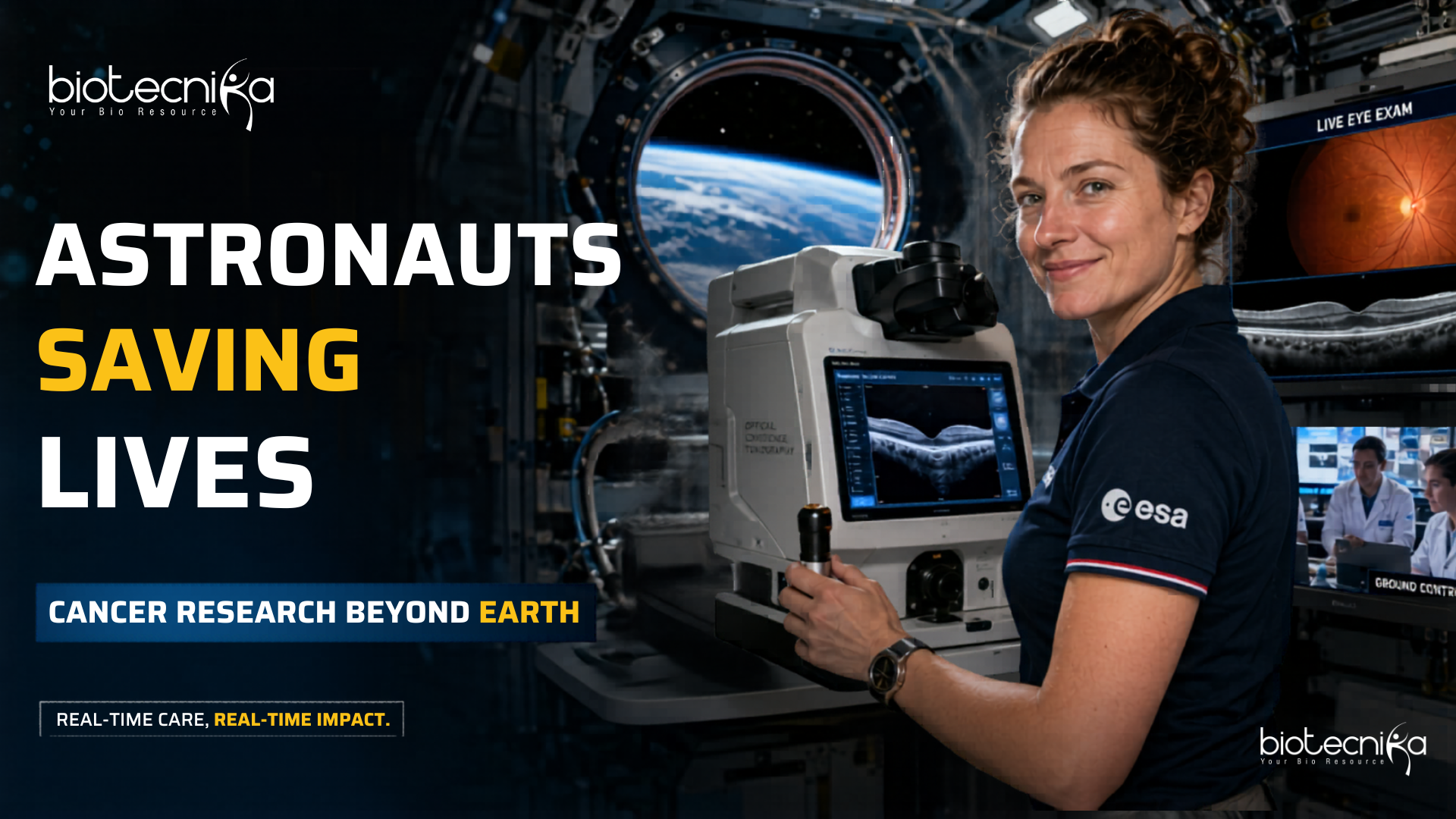
Before finishing their workday, the astronauts conducted medical assessments as well. Meir received an ophthalmologic evaluation; Adenot utilized an imaging device to view Meir’s retina, lens, and cornea. Williams had sensors affixed to monitor his pulse; Hathaway employed an ultrasound device to survey Williams’ chest and evaluate his heart. Medical personnel based on Earth viewed the tests in real-time via video so they could learn about the effects of long-term space flight on astronaut health.
Cosmonauts Nikolay Kud-Sverchkov and Nikolay Mikaev from Russia were completing psychological computer tests to gather data for research on how people adapt mentally to long-duration missions in space. In addition, Andrey Fedyaev, another flight engineer from Roscosmos, repaired various pieces of equipment related to fluid cleaning and recycling systems on the International Space Station.