



















Quantum Computing Takes a Big Step Toward Faster Drug Discovery
Imagine trying to understand how tiny molecules in your body behave; it’s incredibly complex and usually takes a lot of time. Now, scientists are starting to use quantum computers to do this faster and more accurately. This could completely change how new medicines are discovered in the future. Reading this article further will take you more into the evolution of quantum computing.
Quantum Computers Successfully Model Complex Enzymes
Quantum computing is on the verge of having an impact on pharmaceutical drug discovery and development, with a recently conducted investigation where researchers utilized quantum computers to help model the behavior of protein molecules, which play a key role in comprehending how medications interact with individuals’ bodies.
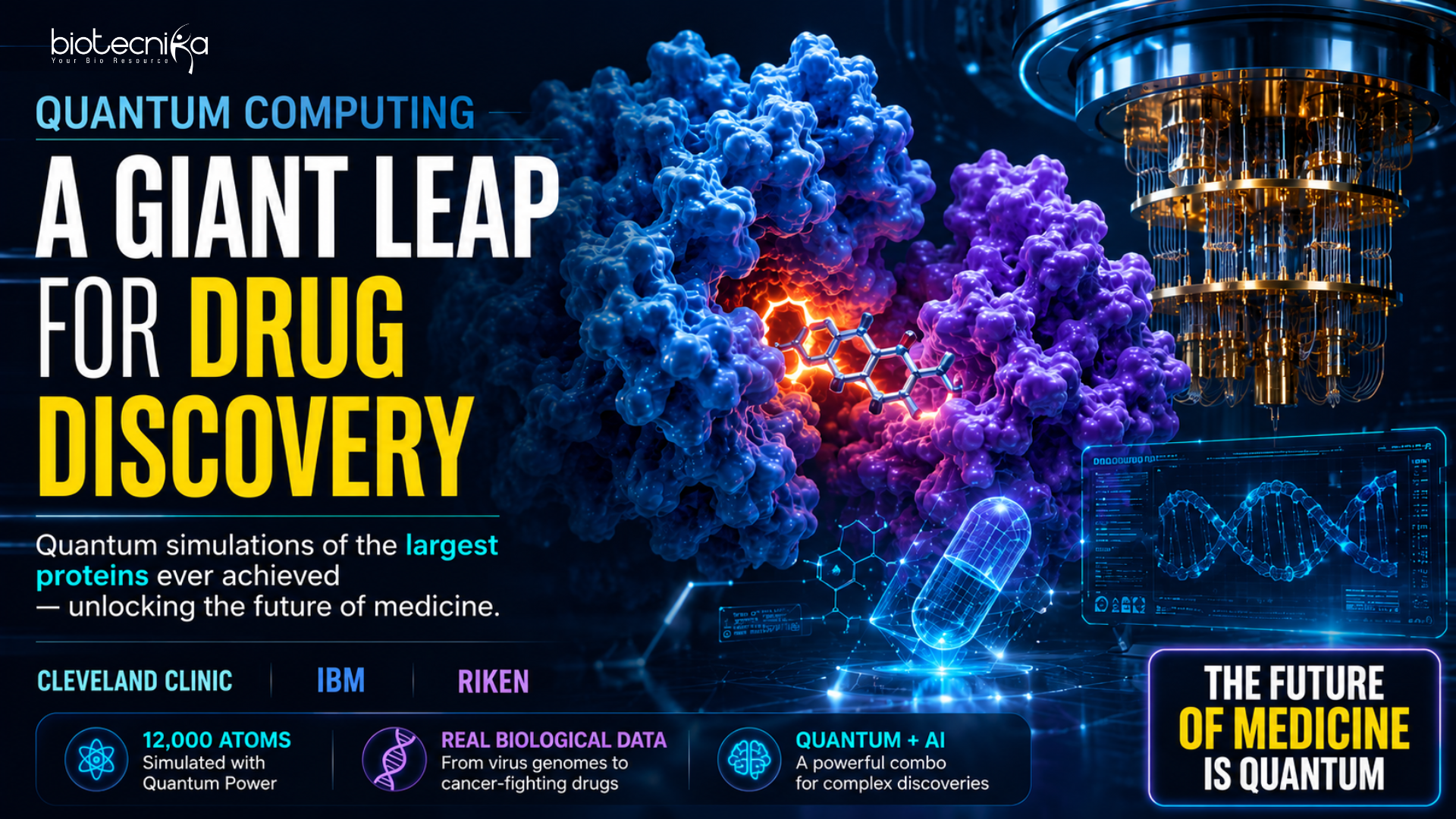
The project was a collaboration between the Cleveland Clinic, IBM in the US, and the Riken Center for Computational Science. Together, they successfully simulated how two enzymes interact with possible drug compounds. Each of these enzymes contained around 12,000 atoms, making them the largest biological molecules ever modeled using quantum computing.
Kenneth Merz, who led the study at the Cleveland Clinic, said this work is an important step forward. It shows that quantum computing is starting to become useful for real problems in drug discovery. The findings were shared as a preprint paper.
Quantum computing is especially suitable for chemistry because the behavior of atoms and molecules follows the rules of quantum mechanics. However, progress has been slow due to technical challenges like limited computing power and errors in quantum systems.
Major Collaborations Drive Innovation in Drug Discovery
The field recently got a boost from the Wellcome Leap, an initiative funded by the Wellcome Trust. It ran a $50 million “Quantum for Bio” challenge to explore how quantum computers can help solve biological problems. Six teams showed that combining quantum systems with traditional computers can lead to useful results.
The top project, which won a $2 million prize, was led by Algorithmiq along with the Cleveland Clinic and IBM. The team studied how a light-activated drug used in cancer treatment works. This drug, used in photodynamic therapy, becomes active when exposed to light and can destroy tumor cells. The researchers showed that quantum methods could simulate this process better than classical computing alone. They also used machine learning to test more variations of the molecule and found that quantum methods become more useful as molecular complexity increases.
Another project involved the Wellcome Sanger Institute and the University of Oxford. Scientists encoded the genome of the hepatitis D virus onto an IBM quantum computer. This was a major step, as it showed that real biological data can be adapted for quantum systems. Although the virus genome is small (about 1,700 units), the team hopes to eventually scale this approach to study the much larger human genome and compare DNA across individuals.
Most teams in the challenge used IBM’s superconducting quantum hardware, which offers better speed, affordability, and more usable qubits compared to other systems.
From Research to Reality: The Future of Quantum in Healthcare
Experts say this work helps clarify where quantum computing can truly add value and what still needs improvement. Interest in this field is growing quickly, with companies like Qubit Pharmaceuticals starting new collaborations to develop quantum tools for drug discovery.
Even though quantum computing has not yet shown a clear advantage in everyday real-world use, researchers believe it is only a matter of time. IBM expects that by the early 2030s, quantum technology will be ready for large-scale use in chemistry and life sciences.