
















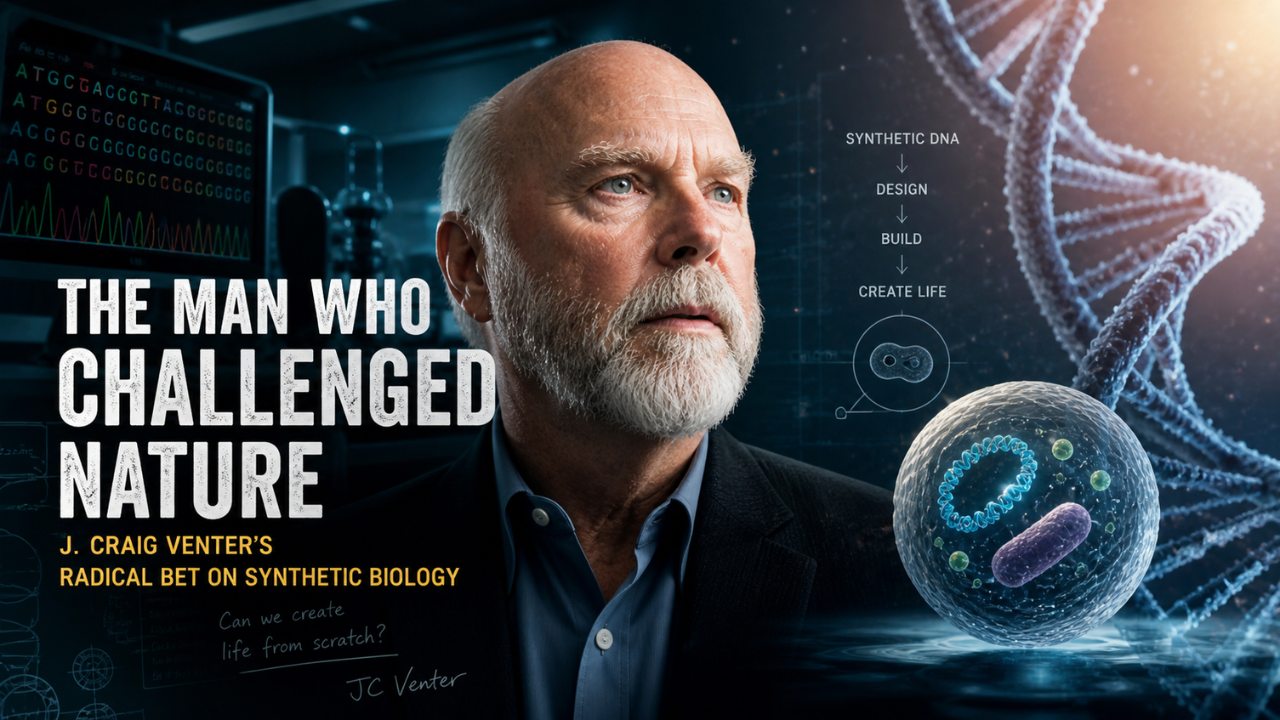
The Man Who Challenged Nature: J. Craig Venter’s Radical Bet on Synthetic Biology
What if we could write genetic codes just like computer code? This one question has turned the impossible into possible in 2010, with Synthetic biology. With the groundbreaking breakthrough, J. Craig Venter and his team caught the attention of the scientific community. Their work of creating a synthetic cell controlled by a genome was built on a computer.
This is not just another successful lab experiment. It changed the way we think about life itself. Now, after Venter’s death on April 29, 2026, the field is taking stock. The excitement is still there, but so is a more grounded question. How far have we actually come?
The answer is not as simple as it looks. In the last century, the field of biological science focused on understanding life at its most basic level. With the discovery of the DNA structure and later the Human Genome Project, the boundaries of science were pushed beyond its limits. These efforts of the scientific community have given us a detailed understanding and map of human genes. This helped us in building the modern field of genomics.
Venter was the pioneer of the field of synthetic biology. These contributions to the field have pushed the research faster and harder. But he was not like any other scientist. His ability to see the world differently has brought a new perspective. He always asked, “If we can read DNA, why not write it?”
This question today sits at the core of Synthetic biology. The idea is simple to explain, even if it is hard to execute. Instead of only studying cells, scientists try to design them. They use tools from Genetic engineering to program organisms to do useful things. In some ways, it borrows thinking from engineering, where systems are built with a purpose in mind.
The 2010 experiment was a proof of concept. It showed that a genome could be built piece by piece and then used to run a cell. Still, even that landmark result had its limits. The cell itself was not created from nothing. It needed an existing biological structure to work. That detail often gets lost in the headlines, but scientists remember it well.
Since then, progress has been real, though not always headline-grabbing. One of the clearest wins is in drug production. Scientists have engineered microbes to produce artemisinin, a key malaria treatment. What once depended on plant extraction can now be done in controlled systems. It is a quiet success story for Biotechnology.
There are similar efforts in other areas. Labs around the world are working on microbes that can produce fuels or clean up pollutants. Some are even exploring how engineered organisms could help capture carbon. These ideas show how wide the field has spread.
And yet, talk to researchers in the field, and you will hear a more cautious tone.
The early vision treated cells almost like machines. The hope was that you could swap parts in and out and get predictable results. Real biology does not work that way. Cells are complicated. Genes interact in ways that are hard to map, and even harder to control. A design that works perfectly in a lab can behave very differently outside it.
This gap shows up clearly in areas like biofuels. The science is solid in theory, but expanding it has been a bit challenging. Some of them are increasing costs, declining yields, and unstable systems. These are not small problems, and they have slowed progress.
These challenges may be easy to overcome. But the reality is far more complicated. Despite advancements in genomics and genetic engineering, researchers are still not able to build a living organism completely with the help of non-living parts. This remains one of the biggest challenges that is yet to be solved in the near future. Venter’s work brought us closer to, but not all the way to, all the way there.
At the same time, the field has started to face tougher questions. One of them is Biosecurity. The same tools that allow scientists to design helpful organisms could also be misused. This dual-use nature has become a serious concern as the technology becomes easier to access.
DNA synthesis is no longer limited to a handful of advanced labs. It is becoming more common and more affordable. That is good for innovation, but it also raises the stakes. Oversight systems are trying to keep up, but many experts say there are still gaps.
Then there is the environment. Releasing engineered organisms into the wild is not a simple decision. Even well-designed systems can have unexpected effects. They might interact with natural species or disrupt existing ecosystems. These risks are still being studied, and they add another layer of caution.
What Venter leaves behind is not just a set of experiments, but a shift in thinking. He helped move biology from observation to design. That shift is still playing out.
Today, Synthetic biology sits in an in-between space. It has delivered useful tools, especially in medicine and industry. But it has not yet reached the point where life can be designed as easily as software. The analogy still holds some value, but it is far from complete.
If anything, the field has grown more realistic. Scientists now talk less about rewriting life overnight and more about careful, step-by-step progress. New tools, including artificial intelligence, are helping move things forward. But they are not magic solutions.
In the end, the story of synthetic biology is still unfolding. Venter asked whether life could be written, and the field is still working on the answer.