








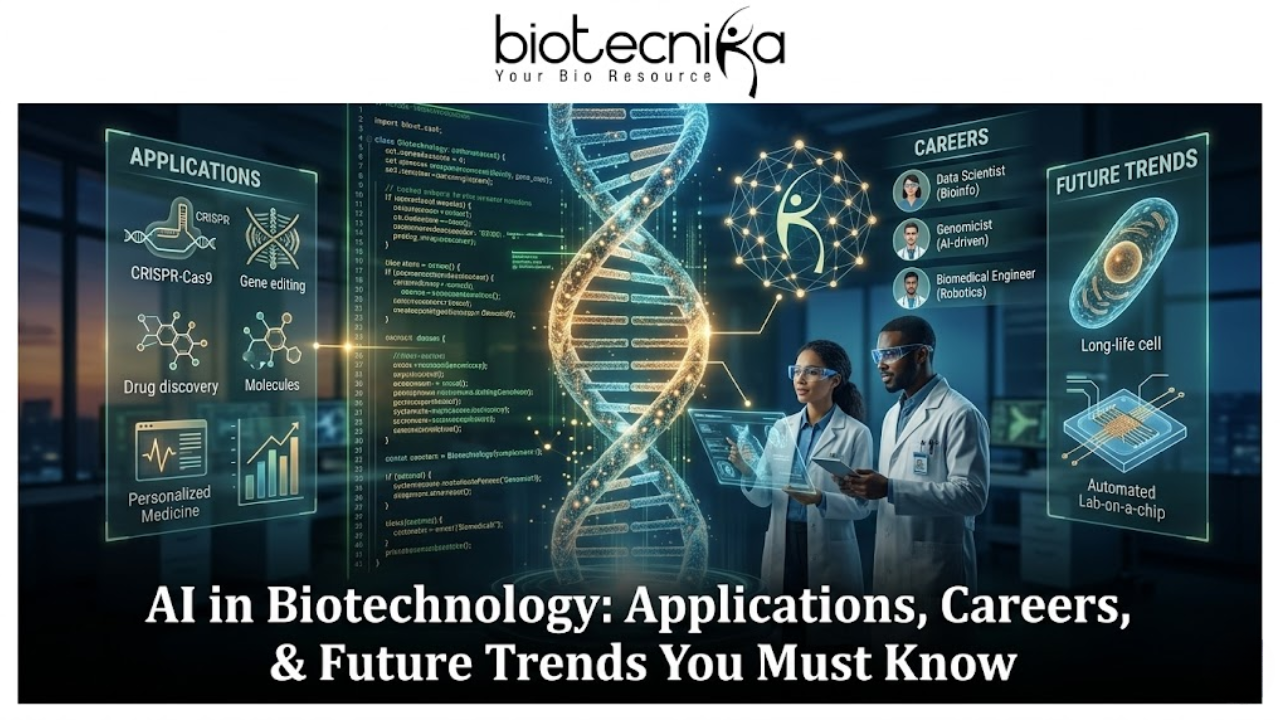
AI in Biotechnology: Applications, Careers, & Future Trends You Must Know
Dhriti, a biotech student, was staring at the laptop screen filled with rows of genetic data. She had spent months trying to figure out how a single mutation can cause a serious disease. Her project looked simple on paper, but not in reality. The data was too large, the patterns were unclear, and the time was running out. That’s when her professor explained her role of AI in Biotechnology. Like every other biotech student, even she thought coding and algorithms were meant for computer science students. But she gave it a try. She used AI-based tools for her research.
Within minutes, the system began analyzing the same dataset she had struggled with for weeks. It highlighted patterns, predicted possible gene interactions, and even suggested potential drug targets. What seemed impossible before suddenly felt achievable. That moment changed everything for her. Dhriti realized that the future of biotechnology was not just in microscopes and lab experiments, but also in data, algorithms, and intelligent systems.
Today, stories like Dhriti’s are becoming common across India and around the world. AI in Biotechnology is transforming how students learn, how researchers work, and how healthcare solutions are developed. From drug discovery to personalized medicine, AI and machine learning are opening doors that were once closed.
For students and professionals in life sciences, this is more than just a trend. It is a shift that is redefining careers, research, and the future of healthcare itself.
Evolution of AI
Before you start your journey with AI, let’s learn a bit about its history. The journey of artificial intelligence started more than 70 years ago. Early computing systems were developed during World War II to decode messages. In the 1950s, scientists created the first pattern recognition systems. These systems could identify simple patterns in data.
Over time, AI evolved into more advanced forms:
- Machine learning allowed systems to learn from data
- Deep learning improved pattern recognition using neural networks
- Generative AI now creates text, images, and even molecular structures
AI works by learning from data. It studies patterns in past information and uses them to make decisions. For example, in hiring, an AI system can analyze past employee data to find patterns and suggest suitable candidates. But this also shows a challenge. If the training data has bias, the AI system may repeat it.
Experts explain that AI has two key features:
- Adaptivity, which means it learns and improves over time
- Autonomy, which means it can make decisions without constant human input
This evolution has made AI a powerful tool in biotechnology and pharma.
Understanding AI and Machine Learning
As we know today, Artificial intelligence is a broad field. It includes several technologies that work together. You must remember some of these key components of AI:
- Machine Learning: Learns patterns from data
- Deep Learning: Uses neural networks for complex tasks
- Natural Language Processing: Understands human language
- Generative AI: Creates new content such as molecules or drug compounds
Got confused a bit, well let me explain to you clearly. The relationship between AI and machine learning is simple. Machine learning is a part of AI. It focuses on learning from data, while AI covers the overall system that makes decisions.
In biotechnology, AI depends heavily on large datasets. This is where bioinformatics plays a key role. Bioinformatics combines biology, computer science, and data analysis to understand complex biological data like DNA sequences.
Applications of AI in Biotech
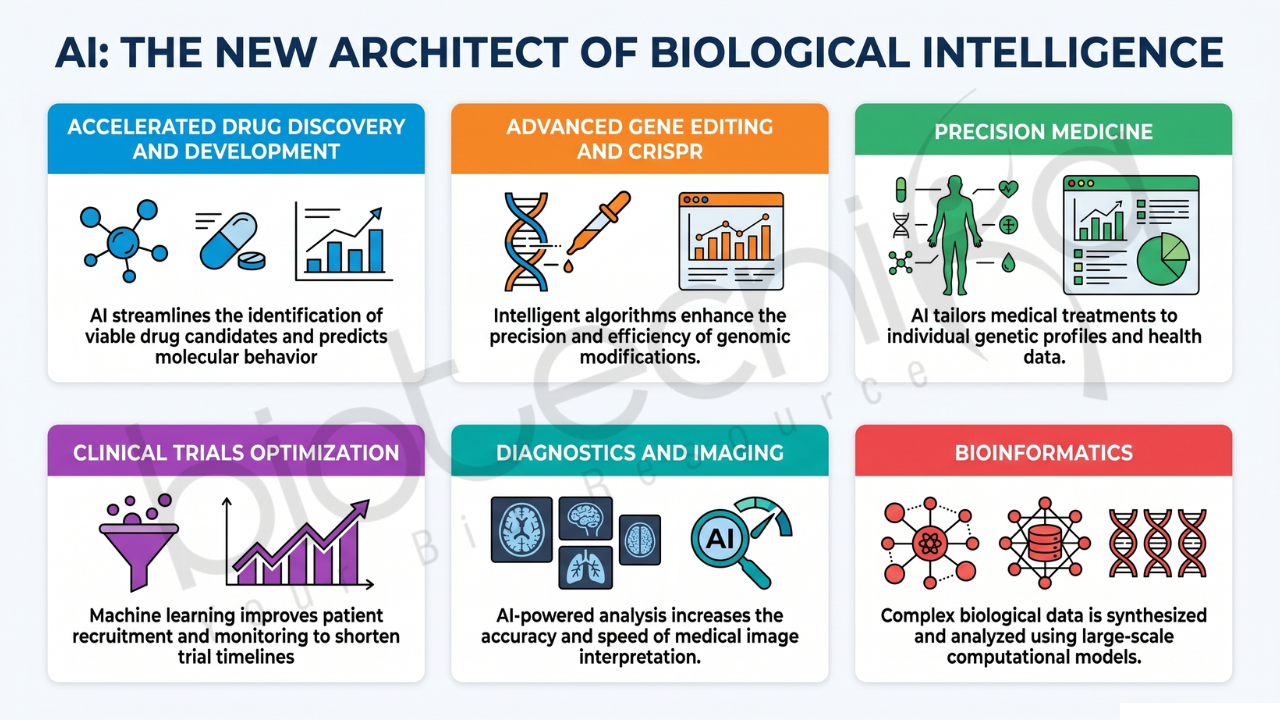
Now that you have understood the evolution of AI. Let us now discuss the applications of AI in biotech, which are wide-ranging and impactful. AI is transforming every stage of the drug development pipeline.
1. Drug Discovery and Development
AI helps identify drug targets faster. It can analyze thousands of molecules and predict which ones may work as drugs. This reduces the time needed for drug discovery from years to months. AI tools are also used for protein structure prediction. This helps scientists understand how diseases work at a molecular level.
2. Precision Medicine
Today, we know that one model does not fit everyone. Here comes the AI-enabled personalized treatment. By analyzing a patient’s genetic data, doctors can design treatments specific to each patient. This is especially useful in cancer treatment.
3. Clinical Trials Optimization
Then comes the emerging area of life, Clinical research and trials. For years. Clinical trials have been expensive and time-consuming. But not anymore, because with AI, this process can be improved. Such as:
- Selecting the right patients
- Predicting trial outcomes
- Monitoring patient data in real time
4. Diagnostics and Imaging
Not only the drug discovery and clinical trials, but it also plays an important role in disease detection. AI improves disease detection using medical images. With this, researchers and doctors can diagnose diseases at an early stage. This leads to better treatment outcomes.
5. Gene Editing and CRISPR
AI helps improve the accuracy of gene editing tools like CRISPR. It predicts possible errors and reduces risks.
6. Bioinformatics
AI is widely used in bioinformatics for:
- Genome sequencing
- Gene expression analysis
- Data mining in biological databases
This is especially important in large-scale research projects and national genomics programs.
Biotech Careers in the Age of AI
The rise of AI is creating new biotech careers across the world. Professionals who understand both biology and data science are in high demand. Here is the list of job roles you can build your career in:
Top Career Roles
| Job Role | Key Skills Required | Industry Demand |
| Bioinformatics Scientist | Genomics, Python, data analysis | High |
| AI Research Scientist | Machine learning, deep learning | Very High |
| Computational Biologist | Biology + programming | High |
| Data Scientist in Pharma | Statistics, AI tools | Very High |
| Clinical Data Analyst | Healthcare data analysis | Growing |
Skills You Need
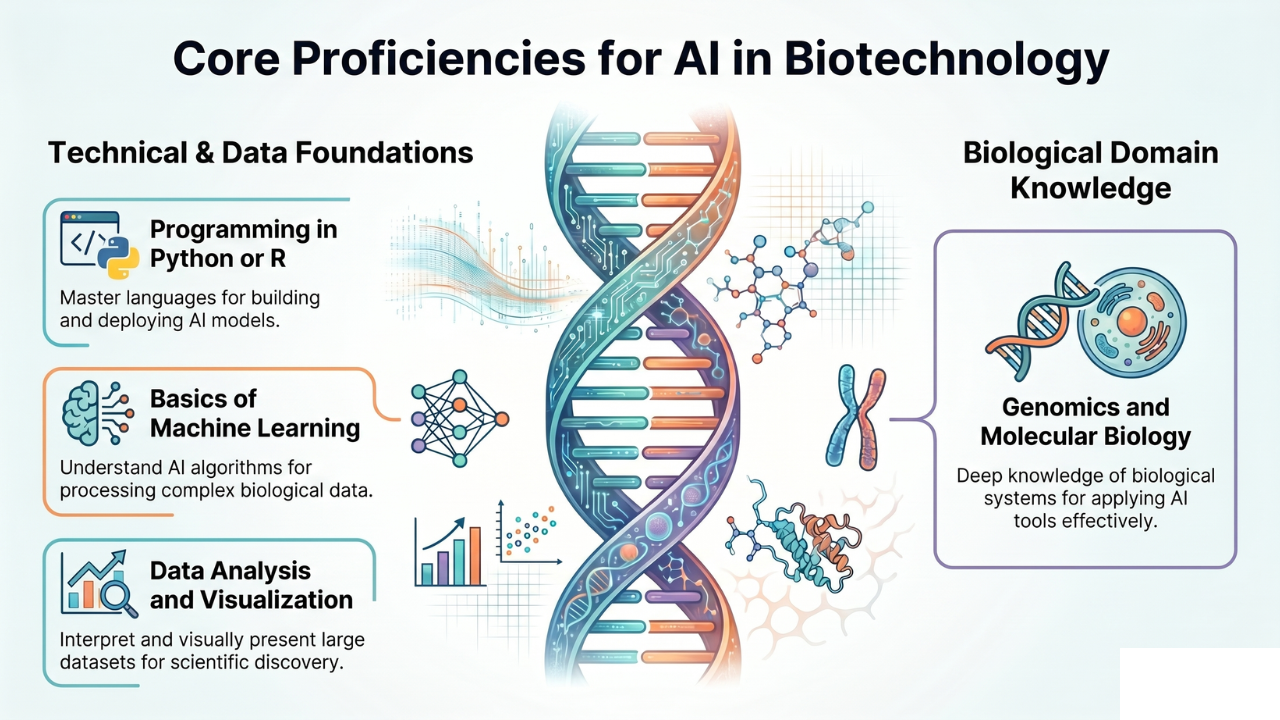
To build a promising career in this field, you should focus on:
- Programming languages like Python or R
- Basics of machine learning
- Knowledge of genomics and molecular biology
- Data analysis and visualization
Opportunities in India
With the advancement in Indian research, the nation is becoming a global biotech hub. As a biotech student, you can find several opportunities in:
- Biotech startups and incubators
- Government initiatives in digital health
- Expansion of pharmaceutical companies
This makes it a great time for students and professionals to explore AI-driven biotech careers.
Impact of AI on the Pharmaceutical Industry
AI is changing how pharmaceutical companies operate. We are moving from traditional methods to advanced technologies. The biotech industry has key benefits such:
- Faster drug development
- Lower research costs
- Improved success rates in clinical trials
- Better drug safety monitoring
AI also helps in pharmacovigilance by analyzing real-world patient data. This ensures that drugs remain safe even after they are released in the market. For India, which is known as the pharmacy of the world, AI can strengthen its global position by improving efficiency and innovation.
Challenges and Ethical Considerations
Despite its benefits, AI also comes with challenges.
Major Concerns
- Data privacy and security
- Bias in AI algorithms
- Lack of transparency in decision-making
- Intellectual property issues
AI systems depend on data. If the data is biased, the results will also be biased. This is why ethical guidelines are important. Experts also stress the need for explainable AI. This means understanding how AI makes decisions, especially in healthcare.
Regulatory Landscape
Governments and regulatory bodies are working to manage the use of AI in healthcare.
Global Regulators
- FDA in the United States
- EMA in Europe
- MHRA in the United Kingdom
These organizations are creating guidelines for AI-based medical tools.
India’s Scenario
India is also developing its regulatory framework. Agencies like CDSCO are working on policies for digital health and AI-based systems. A key challenge is distinguishing between regulated and unregulated AI applications.
Future of AI in Biotechnology
The future of Artificial Intelligence in Biotechnology looks promising. As a biotechnology student, you can expect:
- Integration of AI with genomics and multi-omics data
- Growth of generative AI in drug design
- More personalized treatments
- Strong collaboration between scientists and AI experts
Experts believe AI will not replace humans. Instead, it will support researchers and improve their capabilities. The future will depend on how responsibly we use AI. Ethical standards, global cooperation, and strong regulations will be essential.
Ready to take your first step into the future of biotech?
WATCH THIS: AI & ML in Biotech: Build Your Future Today – Become an AI-Driven Biotechnologist
Conclusion
The world of life sciences is evolving rapidly. What once relied only on lab work is now driven by data and intelligent systems. AI in Biotechnology is not just improving processes; it is expanding what scientists can achieve.
For students, the message is clear. Learning the basics of AI and machine learning alongside biology can create strong career opportunities. You do not need to master everything at once, but staying curious and adaptable will make a big difference.
There is also a real reason for hope. AI is helping develop better medicines, detect diseases earlier, and move closer to personalized healthcare that can improve lives.
At the same time, this progress comes with responsibility. Future professionals must ensure AI is used ethically and fairly.
The opportunity is here. With the right skills and mindset, you can be part of shaping the future of biotechnology.