





















GenomeIndia Project Finds 44 Million Indian Genetic Variants the World Had Never Seen Before
Did you know that the medicines that we use in our country were never designed for us? Yes, most of these were based on the genetic databases built on the European and North American genomes. While the world was celebrating genomic breakthroughs, our Indian geneticists were working on a genome that was invisible to science. With the GenomeIndia Project, our scientists are working on rewriting the genomic story of the world.
This project is one of the largest genomics studies that has ever been carried out in India. The researchers have identified more than 44 million previously unknown genetic variants. With this discovery, the doctors can now understand the diseases better.
We will have more improved and advanced drug treatments that are built based on genetic databases that actually reflect India’s population. These findings have arrived at the time of rapid development in personalized medicine.
Yet, for years, most genetic databases used in medical research were built mainly on the European population. This creates a big gap for the countries with different and deeply complex genetic diversity, like India. Indian geneticists have always raised concerns about the treatment provided to Indian patients based on Western genetic databases. With the GenomeIndia Project, our researchers can now get a clear picture of the Indian genetic landscape.
Why India’s genomes matter?
To understand the importance of this project, one must have to understand what a genome actually is. A genome is the complete set of DNA that is present in the human body. Let’s think of it as an instruction manual of biology made up of billions of genetic letters. Human beings share almost identical DNA with each other. But tiny differences in those sequences can affect disease risk, drug response, and inherited conditions. Those differences become especially important in India.
We know that India is home to more than 4,600 population groups. Many of these communities have been practicing marriage within their own groups for centuries. The geneticists call this endogamy. Over time, this has created distinct genetic patterns across the regions and communities.
As a result of this, some rare disease-causing mutations became more common within certain groups. There were cases where researchers were not able to understand these mutations due to poor representation of indian genetic database. That lack of data had real medical consequences for people.
The doctors have always relied on treatment guidelines based on studies from Western countries. But a medicine that works for Europeans may behave differently in people from rural India or tribal communities. The Indian researchers have highlighted that drug metabolism, disease risk, and treatment outcome can vary between populations.
What did the GenomeIndia Project actually do?
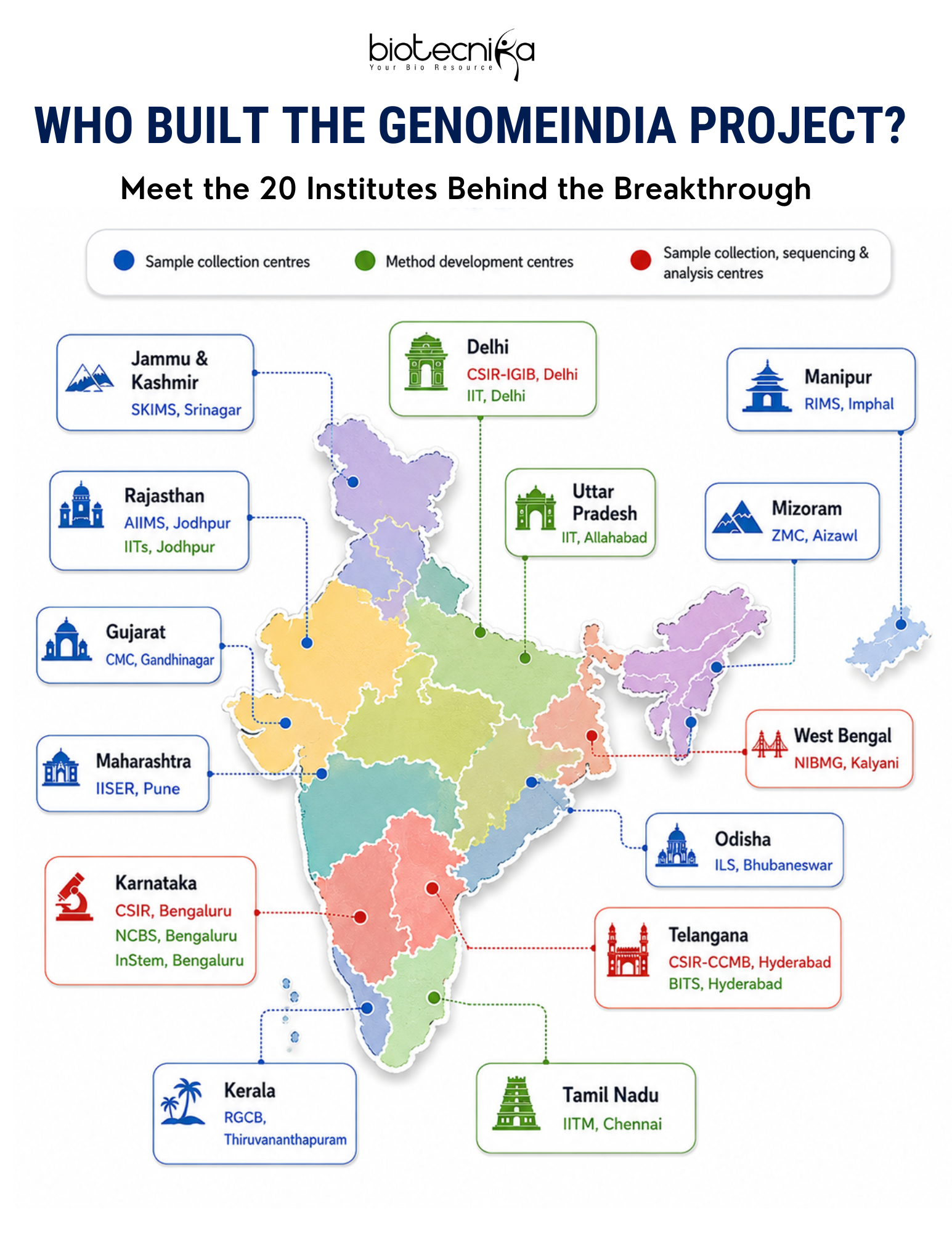
Launched in January 2020, the GenomeIndia Project was led by the Department of Biotechnology under the Ministry of Science and Technology. More than 20 leading research institutes joined the effort, including IISc Bengaluru, IITs, CSIR labs, and genomics centers across India.
The goal was simple but important: build a national genetic database that truly reflects India’s diversity.
Researchers collected over 20,000 blood samples from healthy and unrelated individuals. The final sequencing covered 10,074 people from 83 population groups, including tribal, rural, and urban communities. The study also represented India’s four major linguistic groups: Indo-European, Dravidian, Austro-Asiatic, and Tibeto-Burman populations.
The scale of the project was huge. The first Human Genome Project took 13 years and cost nearly $3 billion. Thanks to advances in sequencing technology, Indian researchers completed genome batches within months, despite delays caused by the COVID-19 pandemic.
In February 2024, the government announced the completion of sequencing for more than 10,000 individuals. A year later, in April 2025, the first major findings were published in Nature Genetics.
Researchers identified nearly 130 million genetic variants, including more than 44 million variants never recorded in global genetic databases before. They also found around 27 million rare variants, with nearly 7 million completely new to science. Those numbers are remarkable for geneticists.
What could the findings mean for medicine?
One of the biggest impacts could be on how medicines are prescribed. Researchers found 38 important genetic variants linked to the way the body processes drugs. Some Indian populations also carried gene variants that may reduce the effectiveness of antiviral medicines.
This matters because the same drug dose may not work equally for everyone. Some patients may get too little benefit, while others could face stronger side effects.
The GenomeIndia Project also found genetic links to several inherited diseases, including heart disorders, high cholesterol conditions, muscular dystrophies, epilepsy, and certain cancers. The data could also improve understanding of diseases like sickle cell anemia and thalassemia, which are more common in some tribal communities.
For doctors and biotech companies, this information could help develop better tests, more targeted treatments, and medicines designed for Indian populations.
The project may also boost India’s role in global drug discovery. India is already one of the world’s largest producers of generic medicines, but many drugs were originally developed using foreign genetic data. A national genomics database gives Indian researchers the opportunity to develop treatments based on Indian biology.
Big opportunities, but also big questions
Even with these discoveries, researchers say that it is just the beginning. So far, the GenomeIndia Project has sequenced only 10,000 genomes. This is a very small sample of our population. The government is now planning to spend millions more in the coming years.
At the same time, the project also raises important questions about privacy and data safety. Genomic data is highly personal. It does not just reveal information about one person. It can also show inherited health risks shared by families and even entire communities.
Experts warn that if proper protections are not in place, such data could be misused through privacy breaches or insurance discrimination. Storing and managing such a massive amount of information is another challenge. The project has already produced around 8 petabytes of genomic data.
Still, researchers believe the GenomeIndia Project is a major step forward. For the first time, India now has a genetic map built from its own people. Scientists say this could help doctors, researchers, and biotech companies develop better treatments and move closer to personalized medicine for one of the world’s most diverse populations.