



















IISc Study Shows How a Virus Tricks Cells Into Making Viral Proteins
Have you ever wondered what the challenges are that a tiny virus, which has the power to lock the whole world up, can have? Every virus has one common problem. That is, synthesising its own proteins without the need for a host. The researchers have been working on solving this mystery for years. But there were lots of finer details that remained hidden. The scientists at IISc have now filled in an important piece of this puzzle. With their latest study, they have explained how the encephalomyocarditis virus (EMCV) can capture the host’s protein synthesis machinery. This study has given the scientific community fresh insights that could support future antiviral research.
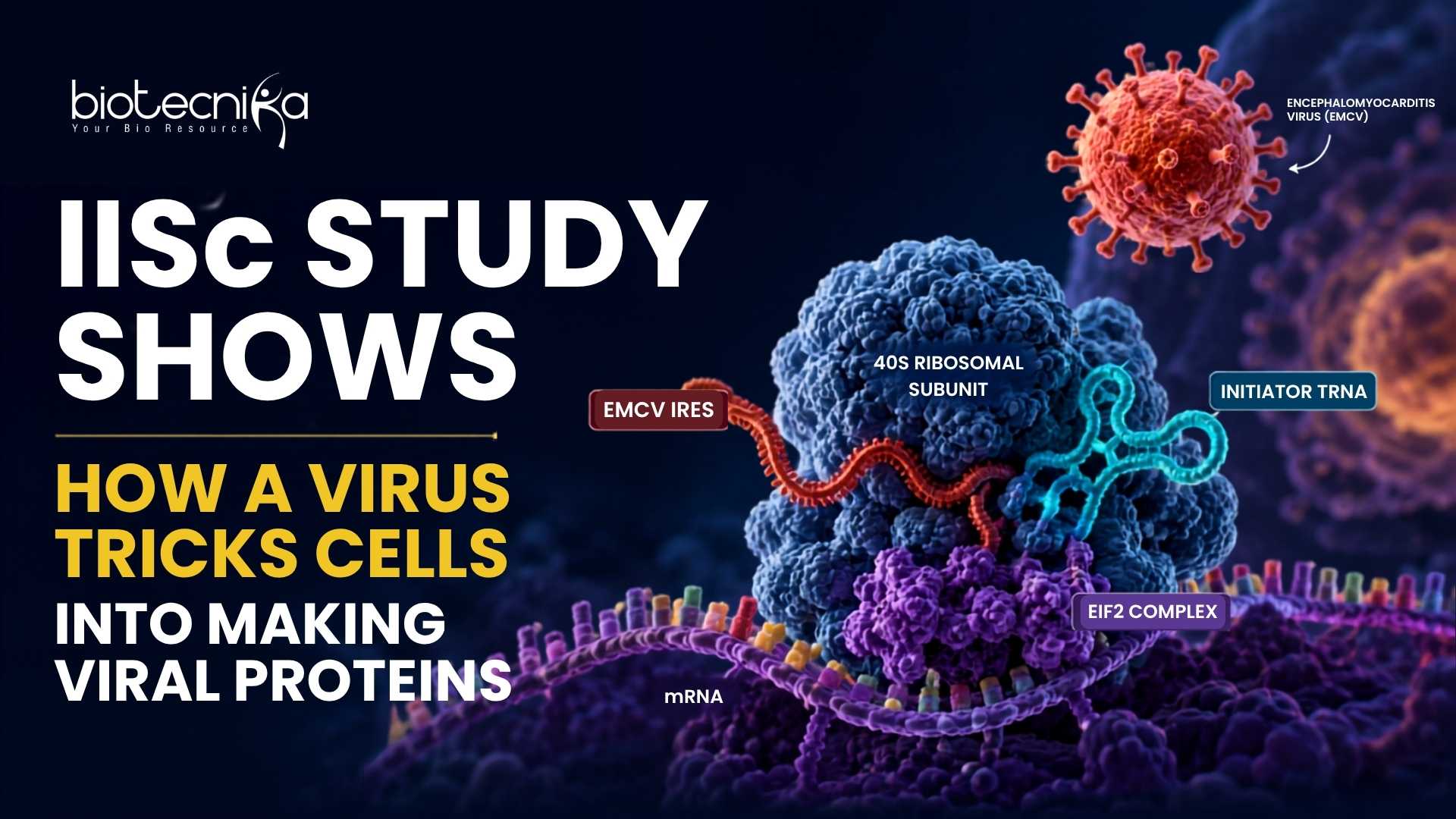
These findings were published in the journal eLife. The study was led by Associate Professor Tanweer Hussain from the Department of Developmental Biology and Genetics. The first author, Deepakash Das, developed a method to isolate the viral complex from rabbit reticulocyte cell extracts. Using a specially designed bait protein, the team pulled out the viral RNA along with several important parts of the host’s translation system. These included the 40S ribosomal subunit, the initiator tRNA and a protein complex known as eIF2.
Getting to that stage was anything but easy.
A virus, EMCV, is commonly found in rodents, but it has the ability to infect several mammals. In animals, the virus has been linked to heart and brain inflammation, reproductive problems and neurological disorders. EMCV also has a similar mechanism to other viruses. It even depends completely on the cells it infects for protein synthesis, as it does not have its own machinery. This dependence is what caught the attention of the IISC researchers.
Inside every cell are tiny structures called ribosomes. Think of them as the cell’s protein factories. They read genetic instructions and build the proteins needed for normal cell function. Viruses have learned to exploit this system. Instead of carrying their own factories, they simply borrow the host’s.
Scientists already knew that EMCV uses special RNA structures called Internal Ribosomal Entry Sites (IRES) to grab hold of ribosomes. These RNA elements allow the virus to continue making its own proteins even when the infected cell slows down its normal protein production. What researchers did not know was exactly how this capture happened at the molecular level.
To answer that question, the IISc researchers turned to cryo-electron microscopy, better known as cryo-EM. This powerful imaging technique allows scientists to see biological molecules in remarkable detail.
In a statement released by IISc, Prof. Hussain said that while the first purification experiments looked promising, many later attempts failed. The cryo-EM samples often did not produce enough usable particles for detailed analysis. Rather than giving up, the team kept refining the process until they finally obtained high-quality images.
Those images revealed something unexpected.
The researchers found that the EMCV IRES directly interacts with both the host’s 40S ribosomal subunit and the initiator tRNA. According to the team, this is a mechanism that has not been seen in other viruses studied so far. Instead of depending only on the usual translation factors, the viral RNA appears to establish direct contact with key parts of the host’s protein synthesis machinery, making it easier for the virus to begin producing its own proteins.
This discovery is not just about one virus. It also includes other viruses like poliovirus, as they depend on Internal Ribosomal Entry Sites (IRES) to start protein synthesis. With the understanding of RNA structures and the working mechanism, the researchers can identify new drug targets. If they are able to block these sites early, then there is a chance of stopping viral protein production. We can also slow down the process or prevent infections too.
The study does not offer a new treatment today, but it provides something equally valuable. It gives researchers a clearer picture of one of the earliest events in viral infection. That deeper understanding could guide future work on antiviral therapies against viruses that use similar strategies.
Sometimes, the biggest breakthroughs come from answering a simple question: how does a virus get the upper hand? Thanks to this work from IISc, scientists are now a little closer to that answer.