








NASA Develops New Approach to Medicine in Space Using Plants and Viruses
Mission Moon, Mission Mars is fascinating, until it’s about surviving the microgravity conditions. These are longer missions which might take days, weeks or months. We all know what happened with NASA’s recent expedition with Sunitha Williams and fellow astronaut Butch Wilmore. Due to some technical glitches, they had to spend over nine months in space. What happens if such incidents recur in the future? What happens to their food and medicines? Getting everything from Earth again is another task. To address this, NASA, in collaboration with the research team, has come up with the idea of growing medicines in space! Yes, Scientists are now studying whether medicines can be produced directly in space using a tobacco-related plant and a harmless virus.
A New Role for Plants Beyond Food and the Need for Medicine in Space
For many years, NASA has successfully grown plants aboard the International Space Station (ISS). These experiments were mainly aimed at providing fresh food and supporting life during long-duration missions. These resulted in the successful cultivation of radishes, lettuces, and chilli peppers.
Considering this, the research expanded to something beyond food, that is medicine.
For instance, the Mars mission can last for several years. Packing everything to space can cost much more, and it is not feasible for the astronauts to carry everything in the limited space vehicle. Also, due to the microgravity conditions, the medicines may lose their potency and immediate supply from the Earth is quite impossible in real time. However, being able to produce fresh medicines whenever required would solve this and help to act immediately.
Hence, researchers are taking the idea a step further by exploring whether plants can act as small biological factories capable of producing important therapeutic proteins.
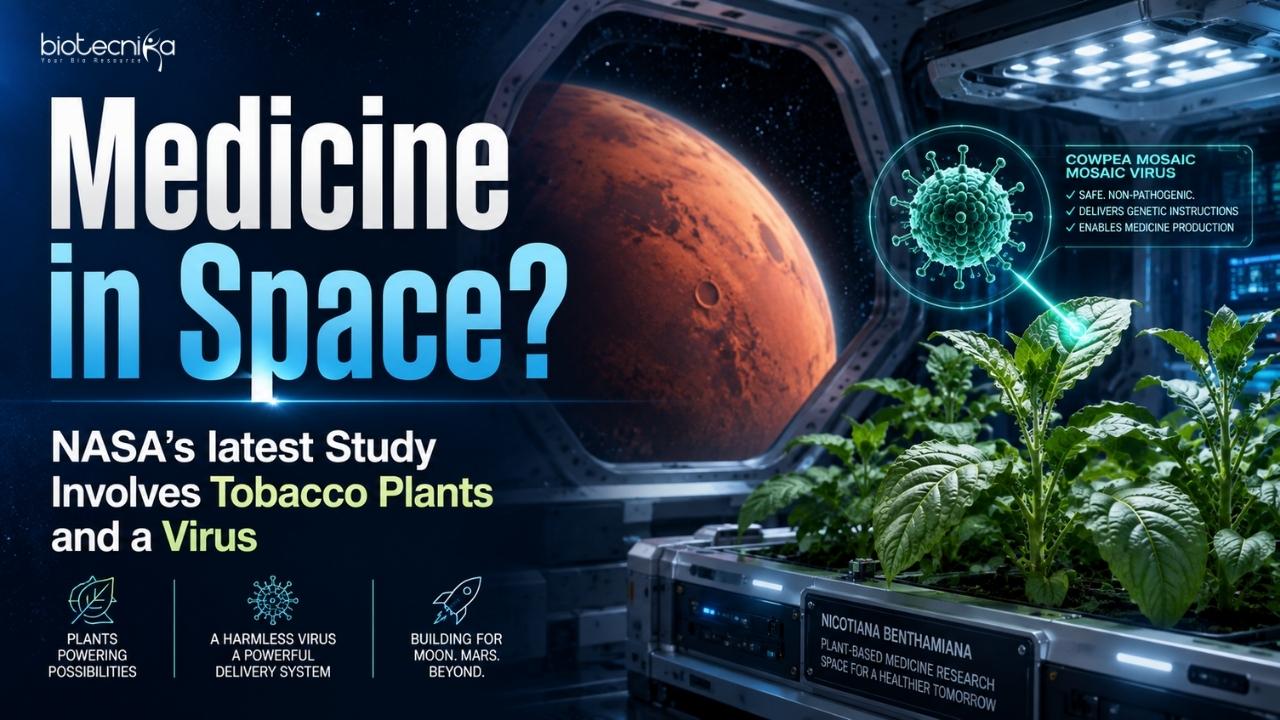
The latest study focused on a relative of the tobacco plant and a virus.
Why Tobacco Plant and a Harmless Virus?
The research team selected a member of the Nicotiana family, Nicotiana benthamiana, a close relative of tobacco, because these plants are already widely used in biotechnology. They grow quickly, are easy to cultivate, and can produce large amounts of proteins that are useful for making medicines. The plant is already being used on Earth in manufacturing experimental vaccines, antibodies and other therapeutic proteins.
To help the plant manufacture these compounds, scientists used the cowpea mosaic virus (CPMV). Despite its name, the virus is harmless to humans. Instead of causing illness, it acts like a biological messenger, delivering genetic instructions into plant cells. These instructions tell the plant which protein to produce, effectively turning it into a small medicine factory. The protein shell of the CPMV can be genetically modified to produce medicinal effects and is being studied in cancer immunotherapy, targeted drug delivery, and vaccine development.
Researchers believe this combination could provide a practical and efficient way to support medicine in space production during future deep-space missions.
Extraction of Medicines in Space
The study was not conducted in space; instead, the scientists created a microenvironment that mimics space, including oxidative stress and temperature fluctuations. Early results showed that the plants were able to support the production of virus-based therapeutic materials, demonstrating the potential of the technique.
But how can the medicines in space be extracted? The study’s unique feature is the development of a new extraction method. This enables the astronauts to collect the therapeutic proteins without harming or destroying the plants. Usually, the collection process includes the harvesting of leaves followed by crushing and chemical processing. But the new approach uses a vacuum-assisted infiltration process followed by centrifugation and filtration. As the plants aren’t harmed, they continue to grow, making it sustainable and efficient.
Challenges Still Remain
Although the findings are encouraging, scientists emphasise that the technology is still in the research stage. More testing is needed before astronauts can routinely produce medicines in space. Researchers must ensure that the process is safe, reliable, and capable of generating high-quality medical products under real spaceflight conditions.
The study represents an important step toward making future space missions more independent from Earth. If successful, astronauts may one day grow not only food but also life-saving medicines whenever they are needed. Such advances could play a key role in supporting human exploration of the Moon, Mars, and beyond while also inspiring new methods of low-cost pharmaceutical production on Earth.