






Govt Life Sciences Internship at CSIR-NIScPR for UG/ PG/ PhD Candidates – Apply Now
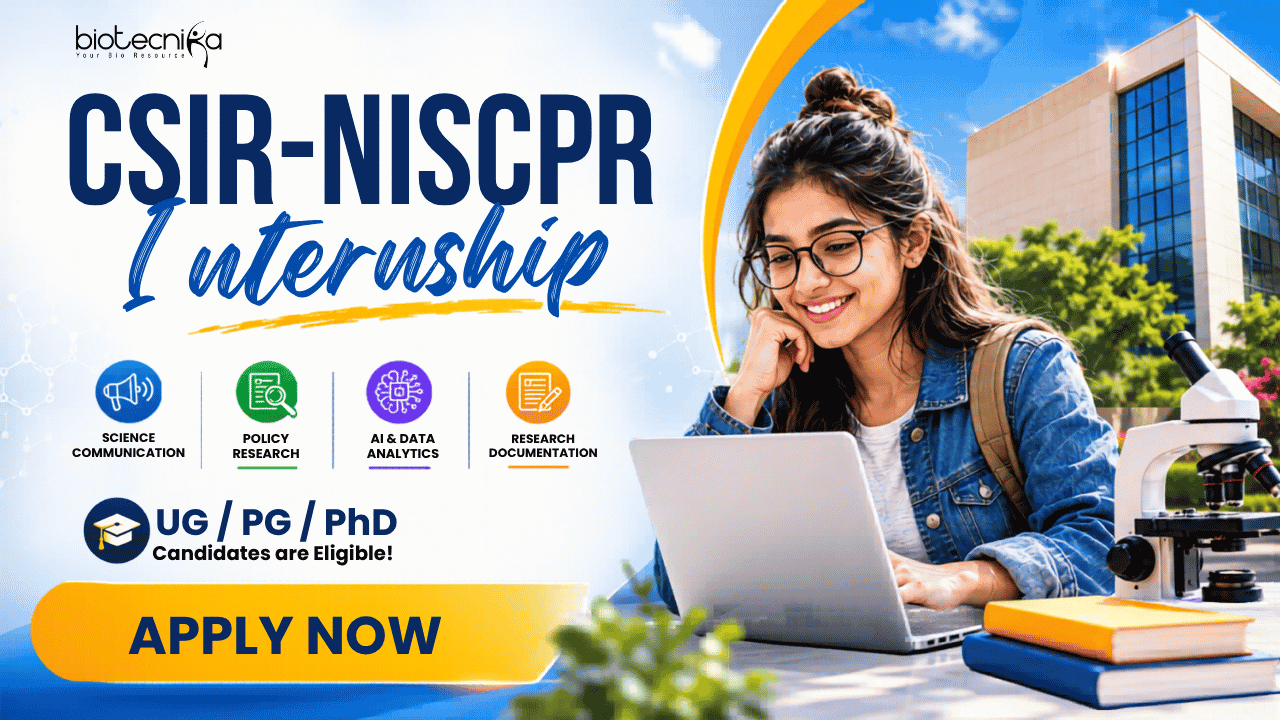
Are you searching for an internship for life science students 2026 and want to gain research exposure beyond the classroom and build a strong academic profile? The CSIR Internship at CSIR-NIScPR offers a unique Govt Life Sciences Internship opportunity for students interested in science communication, policy research, data analytics, AI, knowledge management, and scientific documentation. This is an opportunity that provides practical learning and valuable certification.
About the Institute
CSIR-NIScPR (Council of Scientific and Industrial Research – National Institute of Science Communication and Policy Research) is a premier research institute dedicated to science communication, science policy research, and knowledge dissemination. The institute works at the interface of science, society, and governance by promoting evidence-based policymaking, scientific awareness, research communication, and information management. CSIR-NIScPR plays a significant role in advancing scientific knowledge and policy development in India.
About the Programme
The internship aims to provide hands-on experience in science communication research, science policy research, science writing, and knowledge dissemination at the interface of science, society, and governance. Candidates with interdisciplinary backgrounds and demonstrated interest in science communication or policy research are strongly encouraged to apply.
Potential Areas of Internship
- Science Policy Research: Evidence-based policymaking for emerging technologies, Identification of policy gaps in rural science infrastructure, Science diplomacy and India’s global positioning, Socio-Economic Impact Assessment-Impact of science-led agricultural interventions, Foresight studies in science policy research explore future trends, guide strategic decisions, prioritize research, and support long-term innovation and development planning, Energy and circular economy practices, Environmental sustainability, evidence-based studies, Sustainable Development Goals, Analysis of Technology Readiness Levels (TRLs) for emerging innovations.
- Science Communication: Popular science writing, Science journalism and media communication, Writing policy briefs, articles, and commentary pieces, Content development for digital platforms and social media, Communication and dissemination of traditional knowledge, Science communication in Indian languages, Research in science communication and impact assessment studies.
- Research Documentation and Knowledge Management: Data compilation and report writing, Editing, proofreading, and content standardisation, Supporting editorial processes of publications, Documentation of workshops, seminars, and conferences.
- Library & Information Science Management: Introduction to different Sections of Library viz. Circulation, Books, Serials, etc. Hands-on training in Cataloguing, Classification, technical processing, shelf rectification and management, storage, and retrieval, Special exposure of KOHA (A Library Automation Package) and ISSN (International Standard Serial Number), Bibliometric analysis based on Citation analysis, Impact Factor of Journals, H-Index, etc., using Citation Indexes like Web of Science (WoS) and SCOPUS.
- Information Technology, Data Science, Data Analytics, and AI-Enabled Knowledge Systems: Web and application development, database management, cybersecurity, network management, digital repositories, Software Development Life Cycle (SDLC) and automation, Machine learning (ML)/Natural language processing (NLP)/Deep learning and neural networks/Predictive modelling/AI for scientific information processing, Statistical analysis, data visualization, big data analytics, and policy research analytics, Knowledge graphs, AI-based classification and indexing, intelligent search systems, automated metadata extraction, chatbots, and semantic web/ontology development.
Eligibility Criteria
- Students enrolled in recognised universities/institutions (only Indian citizen).
- Pursuing undergraduate, postgraduate, or doctoral programmes.
Duration of Internship
- Minimum: 4 weeks
- Maximum: 6 months
- Any extension shall require approval of the Competent Authority.
Certification
Internship completion certificate will be issued subject to satisfactory performance and submission of required deliverables.
Important Information
- No stipend, honorarium, TA/DA, accommodation, or any other financial support shall be provided.
- Interns shall make their own arrangements at their own cost and risk.
- CSIR-NIScPR shall bear no financial or legal liability, whatsoever.
- Interns shall maintain strict confidentiality of data and information.
- All outputs shall remain the intellectual property of CSIR-NIScPR.
- Any publication/use requires prior approval.
- Internship may be terminated at any stage due to misconduct or unsatisfactory performance, without assigning any reason, on the recommendation of the competent authority.
- Intern may also withdraw with prior intimation of at least one month.
Documents Required
- Resume / Curriculum Vitae (CV)
- Bonafide Certificate / Recommendation Letter from the Parent Institute
How to Apply?
Applicants are advised to keep their CV and bona fide certificate/ recommendation letter ready at the time of application. Ensure that all information provided is accurate before submission.
For students seeking a Govt Life Sciences Internship, this CSIR Internship provides valuable exposure to research, science communication, policy development, AI, and knowledge management. The programme offers a strong platform to develop professional skills, gain practical experience, and strengthen future academic or career opportunities. Interested candidates should apply and take advantage of this internship for life science students 2026.