


















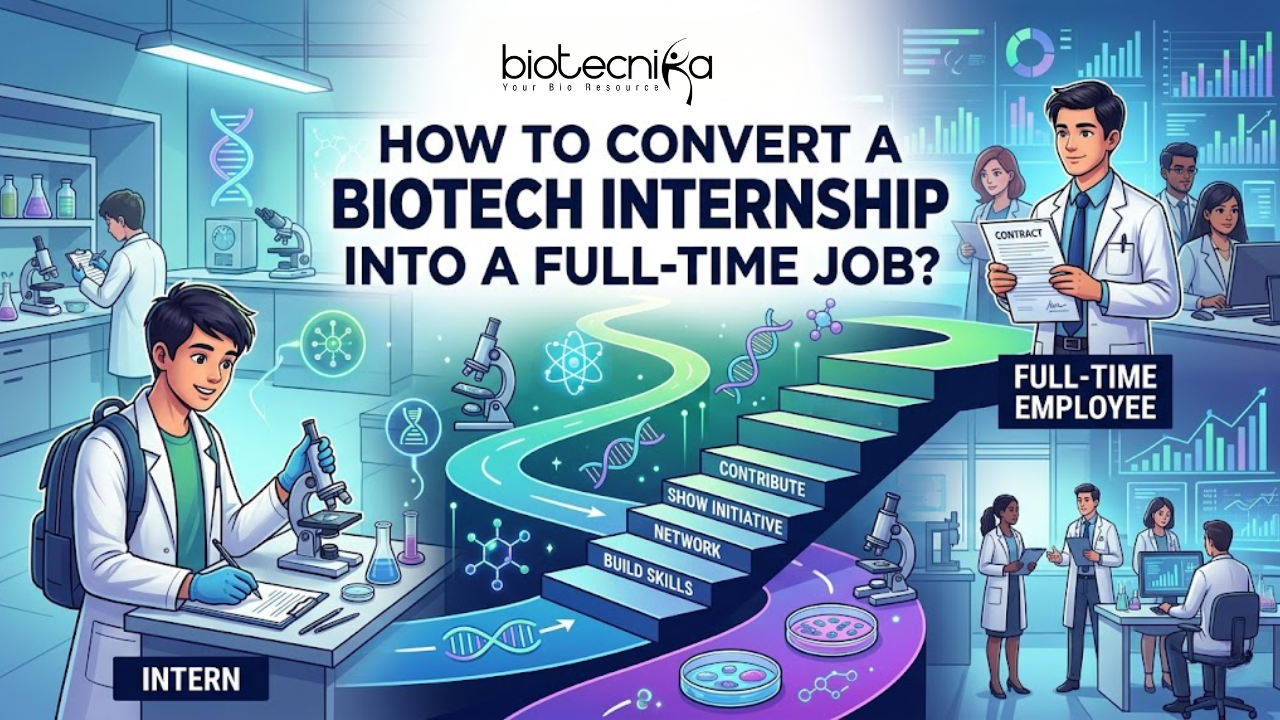
How to Convert a Biotech Internship Into a Full-Time Job?
With the humming of the centrifuge in the background, Aadhya adjusted her lab coat for the fifth time that day. She was going to complete her biotech internship at a prestigious research institute. Even after long hours and repetitive tasks, her passion for science remained strong. Every pipette she held, every gel she ran, felt like a stepping stone towards her dream. A dream of becoming a molecular biologist and a part of groundbreaking research.
However, the reality was concerning her. With her internship ending in two weeks and no job offer yet, she was tense. All others were making their next move. Some of them were submitting applications while others were leaving the field entirely. Aadhya was wondering how she could turn this internship into a permanent position.
If you are also wondering like Aadhya. If you are someone driven by hard work and ready to build a career in biotechnology, then this article is for you. Let’s walk you through the practical steps and strategic moves that can help you transition from an intern to a full-time professional in biotechnology. Whether you are going to complete your internship or just starting, this will help you shape your scientific future.
Maximizing Your Internship Experience
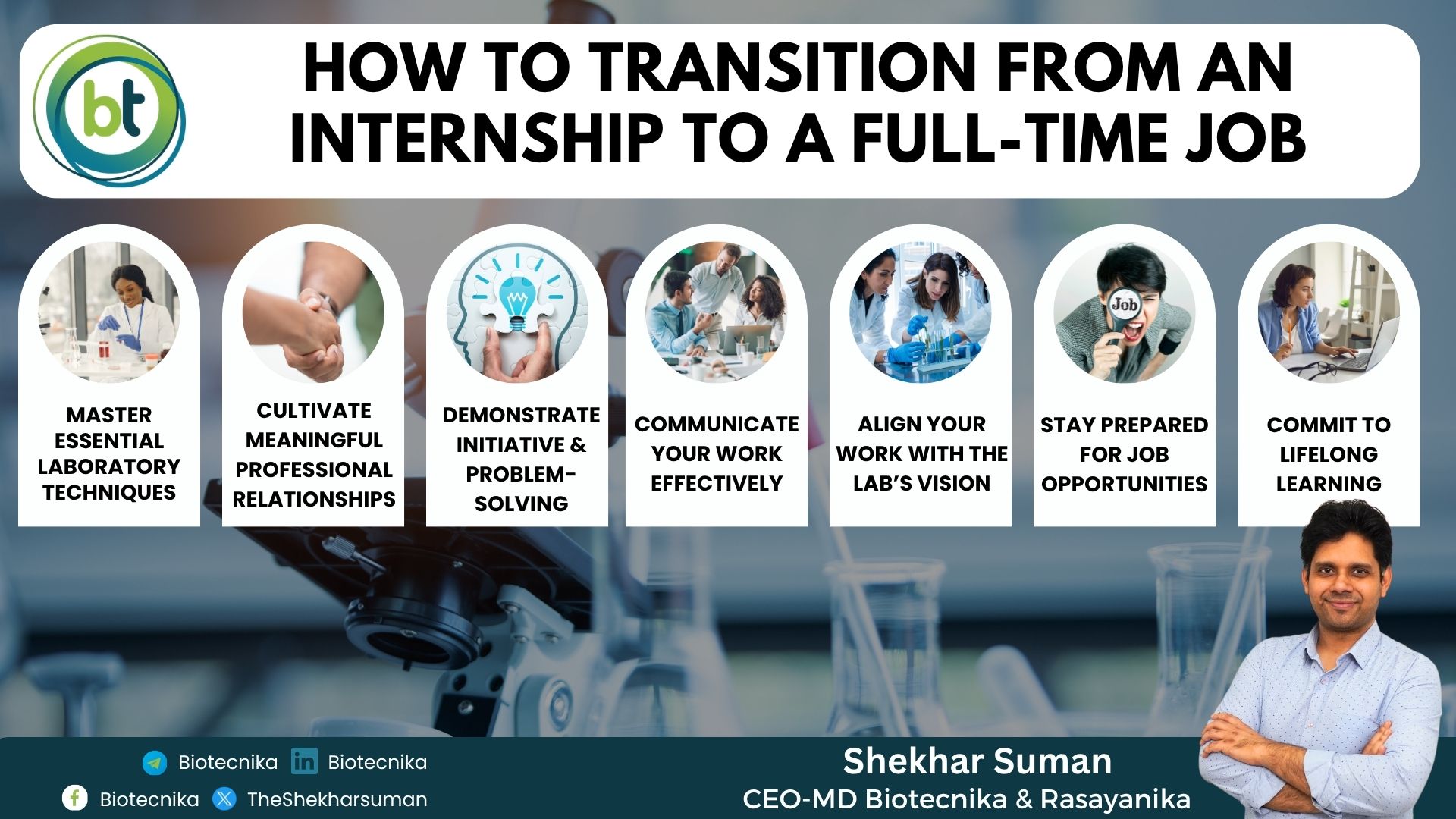
The first step towards your dream job is to shine during your internship. This will be the foundation of your career. During this biotech internship period, don’t just show your technical abilities. Show your commitment to learning and contributing to the lab’s objectives. Here are a few tips to help you:
A. Work on Your Core Technical Skills
The primary goal of your internship is to develop your core technical skills. Internships in biotechnology involve gaining expertise in areas such as:
- DNA/RNA extraction
- PCR (Polymerase Chain Reaction)
- Gel electrophoresis
- Western blotting
- Cell culture techniques
By learning these techniques, paying attention to details, and understanding the protocols, you will make yourself an ideal candidate for the team. The higher management looks for candidates who are well acquainted with the skills. You have to be confident in handling biological samples and tools.
B. Go Beyond Assigned Tasks
Be active and take responsibility. Provide assistance with other projects or lab work. Share your ideas with the supervisor to improve protocols and research procedures. Remember, while sharing ideas, be polite. Suggest how the current methods used in the lab can be improved. This will showcase your problem-solving skills and eagerness to contribute to the well-being of the lab.
C. Stay Organized and Communicate Clearly
The field of biotechnology requires attention to detail. Maintain clean and accurate lab notes. These notes should be detailed and well-documented with the results. If not daily, at least weekly, share your work progress with your mentor. Be open to feedback. Keep in mind that effective communication is the key. Do not focus only on lab work; collaborate with other members of the lab. Build meaningful relationships.
Building Professional Relationships
Building a connection within the workplace is very important. This will open new doors in the field of life science. You can be a step ahead of others with your connections.
A. Network Strategically
Build connections with lab technicians, senior scientists, postdoctoral researchers, and research administrators. The most effective strategy to build relationships is by attending seminars, lab meetings, and scientific events. Make genuine attempts to connect with people on both scientific and professional levels.
B. Seek Mentorship
To excel in the field, find a mentor. Someone who can help you in your growth, provide feedback, and find opportunities. This can be your direct supervisor or a senior lab member who sees your potential. Your mentor will guide you through the transition from intern to employee.
C. Express Career Aspirations Early
During your internship, let your mentor or supervisor know that you’d like to stay. While interacting, ask if there are any openings. Analyze yourself on what you can do to improve your chances.
Demonstrating Long-Term Value
Companies look for interns who showcase themselves as a worthy investment. During your internship, prove that you can add value to your organization. Demonstrate that your contributions will continue to add value beyond the biotech internship.
A. Document and Present Your Work
If possible, share your work at a team meeting or an internal review session. Use clear data and visuals to highlight your progress, even if your project isn’t finished yet. This can be your chance to create an impact on your higher authorities.
B. Align with Organizational Goals
Understand the vision and mission of your organization. Show how your work can help them achieve their goals. Work on real outcomes. Let it be your publications, supporting a grant application, or streamlining workflow.
C. Showcase Soft Skills
Along with the technical skills, soft skills also play an important role. This will add value to your resume. Focus on developing your problem-solving skills, time management, adaptability, and team collaboration. This will help you become a capable intern.
Preparing for Full-Time Opportunities
If you want to become a full-time employee, you need to involve yourself in administrative work. Have a strategic plan to utilize your chance.
A. Update Your Resume and LinkedIn
Make sure your internship can clearly outline specific techniques learned, quantify outcomes (e.g., “Increased PCR efficiency by 20% through protocol optimization”), and highlight research publications. Request a LinkedIn recommendation from your mentors during your biotech internship.
B. Apply Internally
Be attentive to the job opening within the organization. Many research institutions and companies post jobs internally before going public. Ask your supervisor if your internship qualifies for internal referral.
C. Prepare for Interviews
Be serious when you are given a chance for an interview for a full-time position. Even if you are already part of the team. Be prepared with technical competencies, interpersonal skills, internship contributions, and your plans for the future. Work on both behavioral and technical questions. Practice explaining complex topics clearly, as you may need to present your work to HR or non-scientific managers.
What to Do If No Offer Is Available Immediately?
Even after putting your all into it, sometimes you may not receive the offer right away. It’s okay. There can be various reasons behind it, such as budget constraints or timing. Look out for the opportunities outside your lab.
A. Stay in Touch
Send a professional thank-you note at the end of your internship. Express gratitude, highlight what you learned, and reaffirm your interest in future opportunities. Stay connected via email or LinkedIn.
B. Request Feedback
Instead, ask for constructive feedback on your performance. This will help you to strengthen your profile for future opportunities. You will get an idea of the future openings.
C. Keep Growing
If there are no openings available, don’t stop. Continue your journey of acquiring knowledge and skills. This can be through academic research, part-time lab work, further certifications, and contract positions. You can apply later with an even stronger profile.
Enhancing Your Career with Certifications and Continued Learning
Biotechnology is a fast-evolving field. With ongoing research and innovations, you need to stay updated. With continuous learning, you can improve your employability.
A. Earn Relevant Certifications
Certification plays an important role in your career growth. These certifications will show your commitment to mastering your skills. Also, they will help you stay updated with industry trends. Consider doing a certification in:
- Molecular Diagnostics (ASCP)
- Good Laboratory Practices (GLP)
- Bioinformatics Tools
- Genomics & Transcriptomics (RNA-Seq, Single-cell analysis)
- CRISPR and Gene Editing Workshops
B. Attend Conferences and Webinars
Scientific conferences, webinars, and networking events are excellent for staying informed and connecting with potential employers or collaborators.
C. Consider Further Education
If you are interested in research, pursue higher education to increase your prospects. Consider a master’s or PhD in Biotechnology. This degree will be used to increase your understanding of the field.
Key Takeaways and Final Advice
For a smooth transition from an intern to a full-time employee in biotechnology, consider the following checklist:
- Excel at core lab skills and document your work.
- Be proactive and contribute beyond your assigned tasks.
- Network within your team and seek mentorship.
- Make your interest in a full-time role known.
- Align your work with lab and institutional goals.
- Continue to develop professionally, even after the biotech internship ends.
Many interns like Aadhya are at the crossroads between a temporary role and full-time employment. To build a successful career in science, the transition from intern to full-time employee plays an important role. It’s not something that happens overnight or automatically. It requires proper planning, effort, and determination to step forward.
The internship is not just a learning experience. It’s a chance to prove yourself, build professional connections, and show your commitment towards the organization. You need to stay focused, be proactive, and align your efforts with the team’s goals.
The field of biotechnology is competitive, but if you stay curious, work hard, and keep improving, that lab coat you wear might one day carry your name, not just on a tag, but as part of a growing legacy in biotechnology.











Fresher job requirements