


















How GCCs Are Becoming the AI Powerhouse of Global Pharma
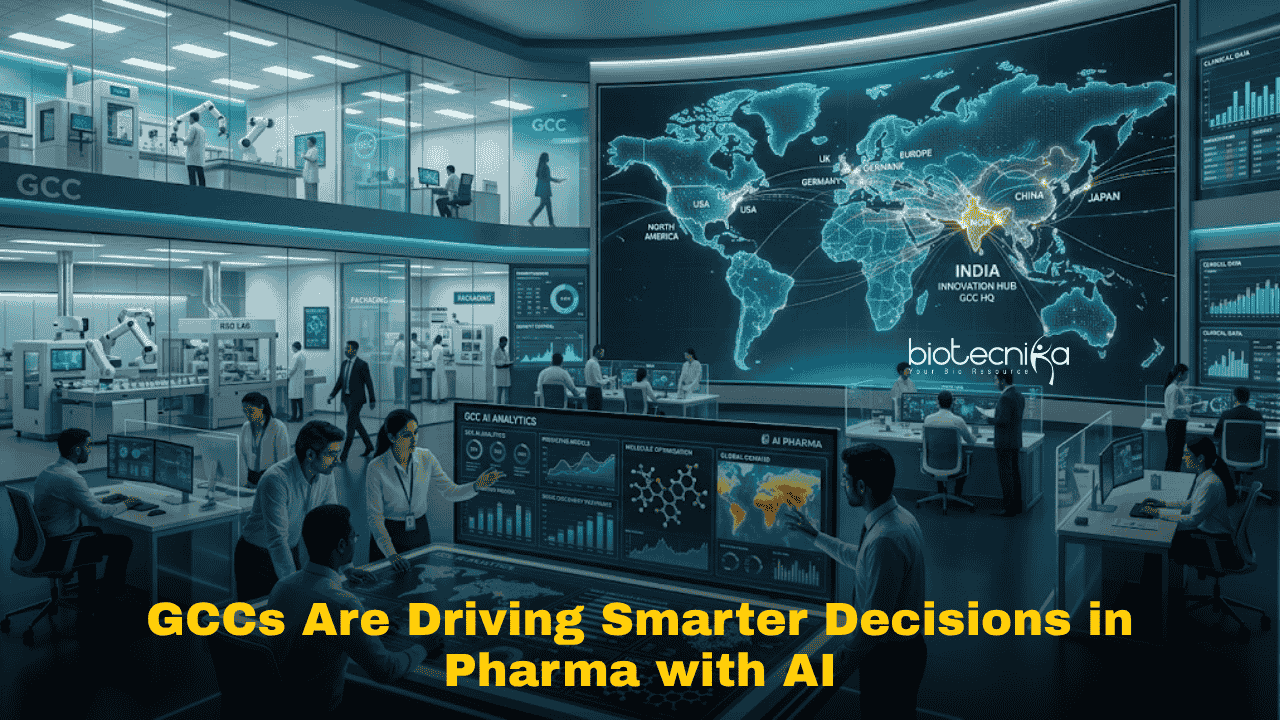
India’s Global Capability Centers (GCCs) are undergoing a fundamental transformation. Once known for cost efficiency and back-end support, these centers are now emerging as AI-powered decision-making hubs in the pharmaceutical industry, reshaping how global pharma companies operate, innovate, and scale.
Today, GCCs are no longer just supporting global teams; they increasingly own outcomes, influence strategy, and drive enterprise-wide decisions. This shift is possible because of AI.
The Transition of Pharma GCCs Into Decision-Making Engines
The foundation on which Pharmaceuticals’ Global Capability Centers (GCCs) were built has always been rooted in the ability to execute, maintain efficiency, and scalability. Pharmaceuticals have always relied on their GCCs to provide analytical, operational, and reporting execution at scale.
Now, this model is evolving due to rapid advancements in AI-enabled workflows. The Global Capability Centers within Pharmaceuticals are becoming decision-enabling organizations rather than just insight-based ones. AI is not only accelerating workflows, but also allows organizations to rethink how decisions are made
“What we are seeing is a structural reset. Execution is what happens when strategy meets reality, and reality always wins,” says Sreemannarayana Balineni, ED BSI Data Analytics, Novartis International.
Industry leaders say the biggest challenge in executing the right strategies is not the strategy itself, but fragmented systems and poor access to data. When AI is properly integrated into decision-making, it can connect these systems, remove inefficiencies, and help organizations work faster and make better, more accurate decisions.
This shift is already evident across the industry, with many GCCs now taking full ownership of global end-to-end processes rather than serving only as execution support centers.
The Scale of India’s Pharma GCC Ecosystem
India has firmly established itself as the global hub for Global Capability Centers in life sciences.
- Over 80+ healthcare and pharma GCCs operate in India
- Out of the world’s top 50 companies, 23 are controlled by these centers.
- A majority of regulatory affairs (60%), more than half of pharmacovigilance processes, and around 45% of global drug discovery activity are managed here.
This scale is further reinforced by real-world industry moves. Companies like Sanofi, Eli Lilly, and Amazon are expanding their GCC footprint in India, focusing heavily on AI, data analytics, and digital innovation. The analytics market is also growing rapidly and is expected to increase from $13.78 billion in 2025 to $27.75 billion by 2032.
At the same time, the broader GCC ecosystem in India is projected to grow into a $100B+ market, driven by talent, digital infrastructure, and increasing global reliance. According to EY’s GCC Pulse Survey 2025, 58% of GCCs in India are already investing in agentic AI, while many others plan to invest soon.
India has emerged as one of the top destinations for pharma GCC expansion. Cities such as Bengaluru, Hyderabad, Chennai, and Pune offer a pool of skilled professionals in biotechnology, pharmacy, AI, engineering, and data science. Many leading global life sciences companies now operate GCCs in India, as it offers a rare combination of scientific talent, technical expertise, and scalable operations, making it highly attractive for multinational pharma companies.
Why AI Is the Catalyst for This Shift?
The rise of AI in the pharmaceutical industry is the single biggest driver behind this transformation.
AI is now deeply embedded across the pharma value chain:
- Drug discovery and molecule screening
- Clinical trials and patient recruitment
- Regulatory documentation
- Commercial analytics and market access
Industry data show that AI adoption is already delivering measurable impact by shortening drug development timelines by years and significantly reducing costs. However, the real differentiator is not just AI adoption, but how deeply AI is integrated into decision-making workflows. Many GCCs have built advanced AI models, but only a few have successfully connected those models to real business decisions.
“The next phase of AI is not just about technology, but about what leaders are ready to take responsibility for. When supported by the right data, platforms, and governance, AI can transform how organizations think, make decisions, and manage performance at a large scale,” says Manish Mittal, Managing Principal, Axtria.
The Structural Challenges Holding AI Back
AI is growing quickly in the pharmaceutical industry and creating many opportunities for Global Capability Centers (GCCs). However, for GCCs to become strong decision-making centers, they must overcome several challenges. Building AI models is no longer the main issue. The real challenge lies in using AI effectively within the complex decision-making systems of global pharma companies.
One major problem is fragmented data systems. Pharma companies operate across many functions, including research, regulatory affairs, sales, marketing, and market access. Each area generates large amounts of data, but this data often remains separated in silos. Because of this, AI models cannot always provide complete insights, reducing their value in important business decisions.
Another challenge is accountability. As AI moves from a support role to one that influences decisions, it becomes unclear who is responsible for the final outcomes. In traditional systems, the decision-maker was clearly accountable. With AI, responsibility may be shared among model developers, reviewers, and company leaders.
A third issue is outdated governance systems. Older frameworks are not designed for fast, adaptive AI-driven processes.
Many GCCs in India are already investing in advanced AI systems, including agentic AI that can learn and improve independently. But technology alone is not enough. Companies must also improve processes, connect data systems, and define clear ownership. Only then can AI become a trusted decision-making partner in GCCs.