











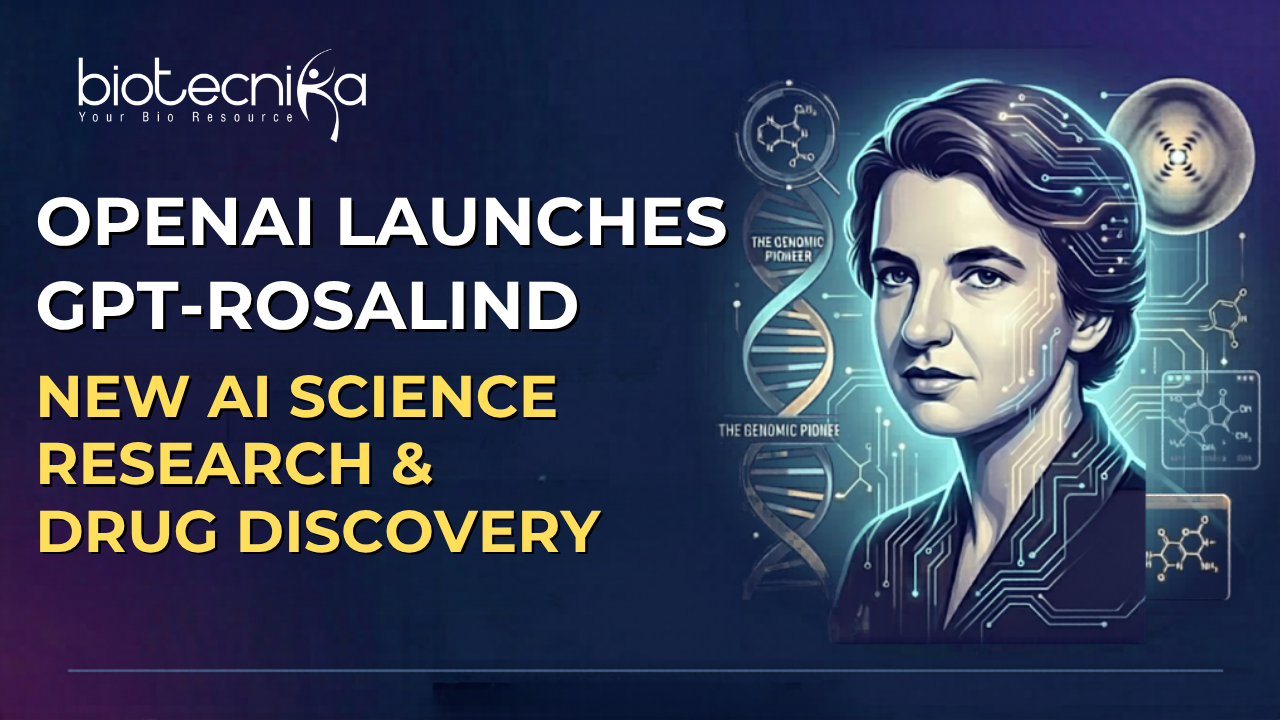
OpenAI Launches GPT-Rosalind: New AI Model for Life Science Research & Drug Discovery
In most labs across the globe, breakthroughs do not begin with a big idea. They start with a mess. Yes, with the half-read paper, scattered datasets, conflicting results, and a whiteboard that’s filled with countless hypotheses. This early stage of research is slow and frustrating, and most good ideas quietly die here. But not anymore. With OpenAI’s new system, GPT-Rosalind, researchers are all set to clean up this mess.
If you think it is just any other AI tool, then let’s take a moment and understand what it really is. GPT-Rosalind is built specifically for life science work, where the challenge is not just solving problems. It’s about figuring out which problems are worth solving in the first place. The system is designed to help researchers read faster, connect ideas, and move from raw data to a testable hypothesis without getting lost along the way.
The system was named after Rosalind Franklin, whose work helped us reveal the structure of DNA. The Life Science community remembers Franklin as a scientist who paid more attention to details and not shortcuts. That’s the same spirit shown in this model. It will not replace the scientists. It will help them to think through complex questions with more clarity.
Across the world, researchers have spent years validating a target before a drug program even begins. By the time the drug reaches patients, it would have taken decades. Much of that time is spent not in the lab, but in reviewing literature, comparing datasets, and refining ideas that may or may not hold up. GPT-Rosalind tries to compress that front end.
It can scan large volumes of scientific literature, synthesize relevant findings, and suggest possible connections among genes, proteins, and disease pathways. It can also assist with experimental planning, helping researchers map out what to test next.
In simple words, it helps move from “What do we know?” to “What should we try?” a bit faster.
This promise has grabbed the attention of biotech giants like Amgen and Moderna. Even a small improvement in picking the right targets or designing better experiments can save years of work.
The researchers have noticed some early signals that the system can handle complex tasks. In tests, GPT-Rosalind has shown strength in areas like protein analysis, gene interpretation, and experimental design. In a study with Dyno Therapeutics, it performed well on RNA-related tasks, in some cases approaching the level of experienced researchers.
Still, no one in the field is taking benchmarks at face value. Lab reality tends to be less forgiving than controlled tests.
Where GPT-Rosalind may prove more useful is in how it fits into daily workflows. OpenAI has paired it with a Life Sciences plugin that links to dozens of databases and research tools. For scientists, this could reduce the constant switching between platforms that eats up time and breaks focus.
That kind of improvement is easy to overlook from the outside. Inside a lab, it matters. A lot of research time disappears into small inefficiencies. Searching for the right dataset. Rechecking a reference. Formatting inputs for yet another tool. If those steps become smoother, the overall pace of work can change.
At the same time, access to GPT-Rosalind is being tightly controlled. OpenAI is rolling it out through a limited program, mainly to organizations that can show strong oversight and clear research goals. The caution reflects a broader concern across the field. Tools that can work with biological data need to be handled carefully.
Research groups like the Allen Institute and Los Alamos National Laboratory are also starting to explore how systems like this can be used in areas such as protein design and complex biological modeling. These are not simple problems, and progress often comes in small steps rather than big leaps.
It is important not to overstate what GPT-Rosalind can do. This is not a system that will suddenly churn out new drugs or replace years of lab work. Science does not work that way, and most researchers know it.
What can it do that is a bit more practical? It can help scientists think through messy early-stage questions, where data is incomplete and ideas are still taking shape. That is often the point where projects slow down or fall apart.
A lot of research never makes it past this stage. Not because the science is wrong, but because the path forward is unclear. If a tool like GPT-Rosalind can help narrow down options, highlight useful directions, or simply save time in sorting through information, that alone could make a difference.
The impact, if it comes, will likely be gradual. It will show up in better experiments, fewer wasted cycles, and stronger starting points for research programs. The kind of progress that does not always make headlines, but adds up over time.
Right now, GPT-Rosalind is still early and needs to prove itself in real-world settings. But it does point to a shift. AI is no longer just supporting tasks on the side. It is starting to sit closer to the core of how life science research is done.
And that shift, even if it unfolds slowly, could shape how future discoveries take off.