


















More Than 1,700 Hidden Microproteins Discovered in Human Cells
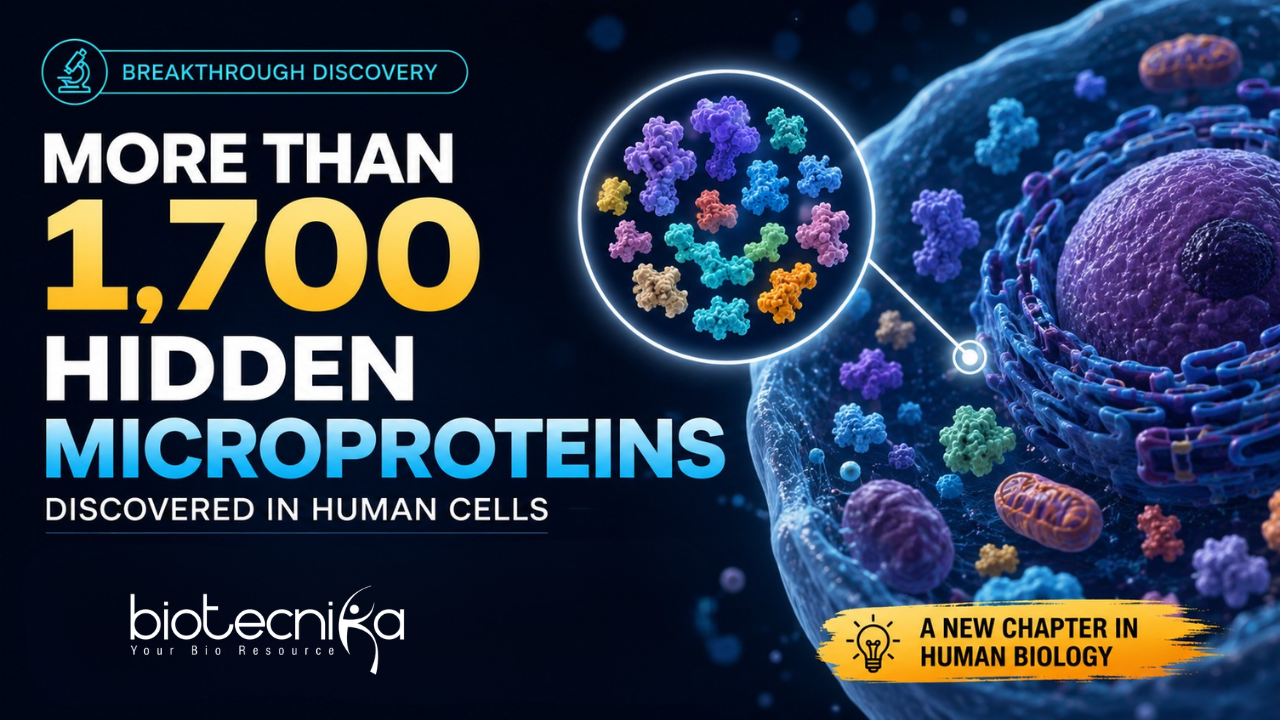
For years, our biology textbooks have told us that only a small fraction of the human genome encodes proteins. These are molecular workhorses that build our tissues, regulate cells, and keep our bodies alive. While the rest was often labeled as “Junk”. Yes, now, a new study is turning that idea upside down. The researchers have discovered more than 1,700 hidden “dark proteins” inside human cells. They reveal the human genome that may be far more active than any other.
The discovery was published in Nature. This study was a collaboration of an international team of scientists who have spent years studying the parts of DNA that were largely ignored. The newly discovered molecules are extremely small and unusual. This was because they don’t fully fit the standard definition of proteins. That’s when the researchers came up with a new name for them, “peptideins.”
The results have already created a wave of excitement across the life science community. The scientists believe this can reshape the future study of cancer, heart disease, and many other conditions linked to the human genome.
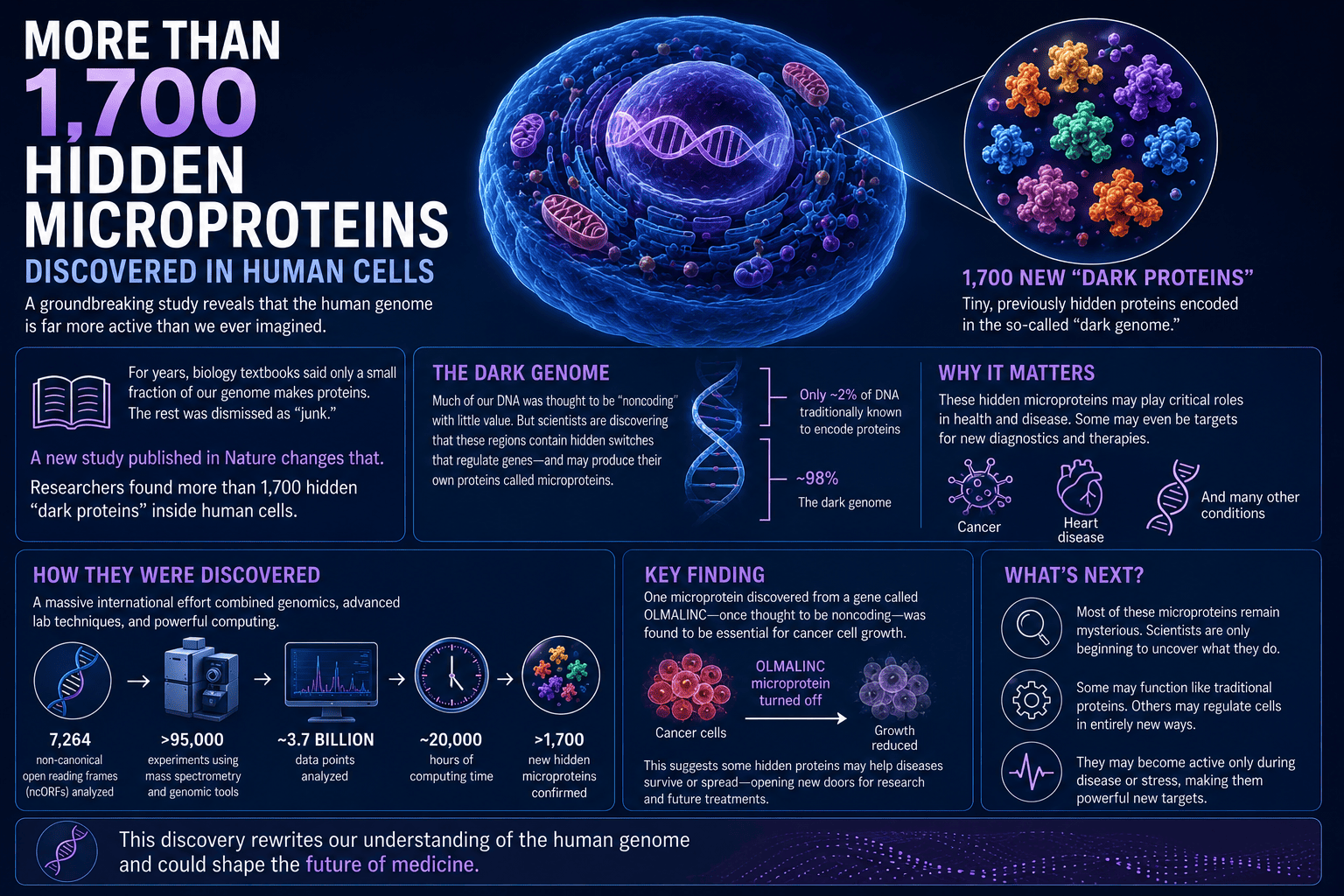
For many years, biology has followed a simple rule that genes contain instructions for making proteins. These proteins carried out most of the important work inside the cells. The rest of the genome was considered noncoding DNA with little biological value.
This version of biology has slowly changed over the last few years. Researchers began finding that these inactive regions of the genetic material actually contain switches and controls. The one that will help regulate genes. And scientists started calling this a hidden area that is the “dark genome.” This genome may also produce its own set of molecules known as microproteins.
Pediatric oncologist Sebastiaan van Heesch from the Princess Máxima Center in the Netherlands is one of the lead researchers behind the study. According to him, we know that the current overview of recognized proteins doesn’t capture the full picture.
The team has investigated whether these overlooked regions of DNA were quietly producing tiny protein-like molecules that scientists have been missing for years.
They analyzed 7,264 regions of DNA known as non-canonical open reading frames or ncORFs. These regions were previously suspected to have some role in protein production, but there was little proof. The amount of data that was involved was massive.
Scientists have examined around 3.7 billion data points collected from more than 95,000 experiments. According to the research team, the analysis required roughly 20,000 hours of computing time before they finally confirmed 1,785 peptideins.
van Heesch said that it was very special when we realized this really is something new.
Unlike traditional proteins, many of these microproteins are extremely short. Some are so small that earlier technologies could not detect them properly. Others may only appear under specific conditions inside the body, which makes them even harder to find.
That is one reason scientists overlooked them for so long. Advances in genomic analysis, mass spectrometry, and computational biology finally gave researchers the tools needed to spot these hidden molecules.
The most interesting part of the study is that some of these dark proteins do not appear to be random cellular leftovers. They may actually play important biological roles.
One peptidein identified in the study came from a gene called OLMALINC. Scientists had previously classified it as noncoding. During laboratory tests, researchers found that cancer cells struggled to grow when this peptidein was turned off.
That result suggests some peptideins may help diseases survive or spread. The researchers now
John Prensner, a pediatric neuro-oncologist at the University of Michigan and one of the senior authors of the study, said researchers are only beginning to understand what the dark proteome may contain.
He said that it’s like the trailer to a movie. We see the outline of a game-changing view of human biology. Scientists are still cautious about making big promises. Most peptideins remain poorly understood, and researchers still do not know exactly what many of them do inside cells.
Some may function like standard proteins. Others may help regulate cellular processes in ways scientists have not yet discovered. There is also the possibility that certain microproteins only become active during disease or stress conditions.