








Table of Contents
Google AI Achieves Cancer Drug Discovery Milestone in Biomedical Research
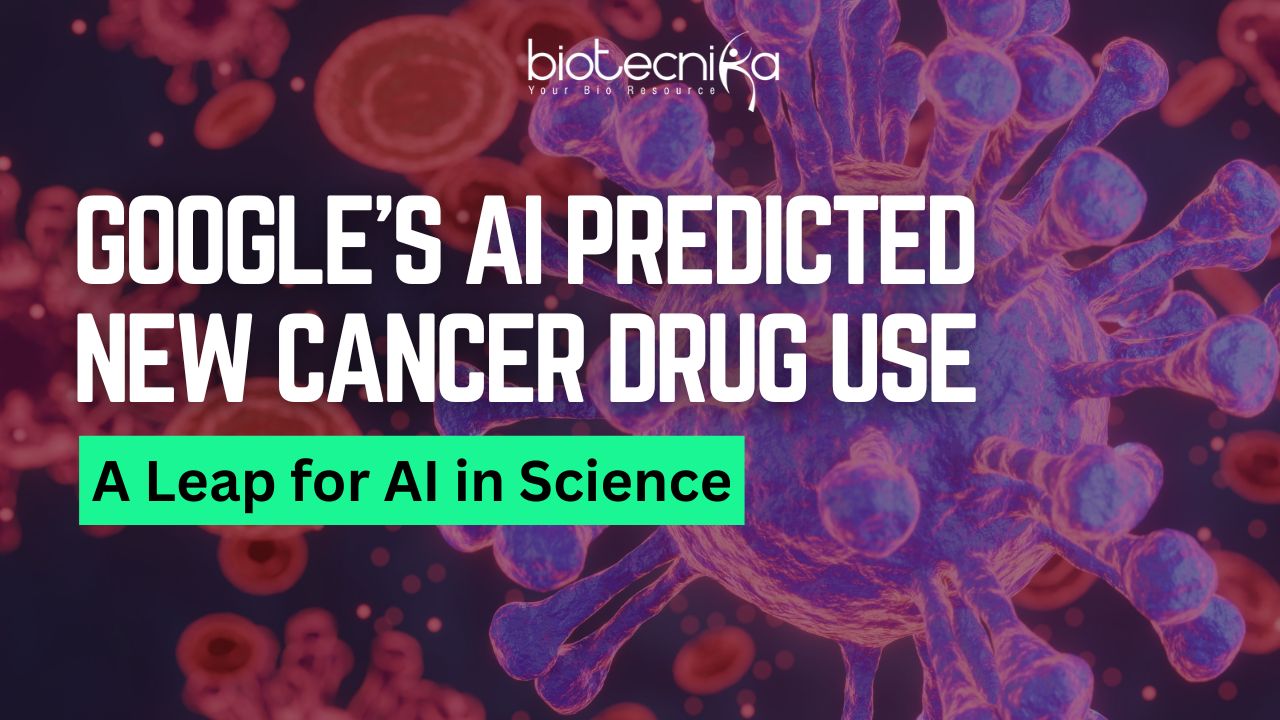
Built on the Gemma model family, Google’s new 27-billion-parameter foundation model, Cell2Sentence-Scale, has successfully proposed and validated a new drug combination for cancer treatment, marking a milestone in AI-driven biomedical research.
A Leap for AI in Science
In a landmark announcement, Google has unveiled a suite of artificial intelligence (AI) tools that go beyond prediction; they’re beginning to discover.
> Its researchers revealed that their model, Cell2Sentence-Scale (C2S-Scale), not only suggested a new drug combination for cancer therapy but also passed early laboratory validation, signaling a new era for AI-assisted scientific discovery.
“This announcement marks a milestone for AI in science,” wrote Shekoofeh Azizi and Brian Perozzi, staff scientists at Google DeepMind and Google Research, in an official blog post.
> “C2S-Scale generated a novel hypothesis about cancer cellular behavior, and we have since confirmed its prediction with experimental validation in living cells.”
Decoding the Breakthrough
C2S-Scale, built on Google’s Gemma open model family, is a 27-billion-parameter foundation model trained to “understand” the language of individual cells at an unprecedented scale for biomedical AI.
> Unlike traditional bioinformatics models that rely on predefined biological rules, C2S-Scale learned directly from vast datasets of patient and cell-line data.
In doing so, the model suggested that silmitasertib (CX-4945), a drug already in several clinical trials for multiple myeloma, kidney cancer, and advanced solid tumors, could be repurposed to enhance the immune system’s ability to identify cancerous tumors in their earliest stages.
A Novel Use for a Known Drug
Silmitasertib isn’t a new compound. It received orphan drug status from the U.S. FDA in 2017 for treating advanced cholangiocarcinoma.
> However, the novelty of Google’s approach lies not in rediscovering the drug but in revealing an unexpected new therapeutic use, one that might have taken a team of scientists months, if not years, to uncover through traditional research.
“It’s a nice result and was a well-chosen problem to test the capabilities of a large language model (LLM),” said Dr. Sunil Laxman, systems biologist at the Institute for Stem Cell Science and Regenerative Medicine, Bengaluru, in a comment to The Hindu.
> “This would, in the usual course, have taken a focused team of dedicated researchers several months to suggest such a use of the drug.”
Google AI Is Promising, But Not Revolutionary Yet
While the model’s success is impressive, Dr. Laxman urged caution.
> “The model hadn’t suggested something that couldn’t have occurred to a trained biologist nor discovered something entirely new about cancer biology,” he noted.
“It’s very good, not great. It certainly shortened the time to a potential discovery, but it isn’t a path-breaking one yet.”
His remarks reflect a growing consensus in the scientific community: AI models like C2S-Scale may not replace researchers, but they could supercharge the pace and efficiency of discovery.
Beyond Biology: The Rise of Reasoning AI
The implications of this breakthrough reach beyond medicine.
> Prof. Siddhartha Gadgil, a mathematician at the Indian Institute of Science (IISc), Bengaluru, believes such reasoning models represent the next frontier of research collaboration between humans and machines.
“The best AI models in mathematics today are at the level of a skilled mathematician, though not yet at genius-human levels,” he said.
“There’s no reason to suppose that AI won’t one day solve some of the most challenging problems in mathematics.”
He cited OpenAI’s experimental reasoning model, which recently performed at the gold-medal level in the International Mathematical Olympiad 2025, under the same time constraints as human participants.
While Olympiad questions test high-school mathematical talent rather than professional research, they demonstrate AI’s growing reasoning capabilities.
A Future of Collaborative Discovery
From predicting drug mechanisms to generating mathematical proofs, large language models are now entering domains that once demanded years of human expertise.
> Researchers like Prof. Gadgil believe the scientific community is still “divided” on integrating AI tools but that hesitation may fade as the technology matures.
“There are several models showing no signs of plateauing, with latent capabilities not yet fully explored,” he said. “We ought to see them as tools, powerful ones that researchers should be incorporating.”
The Big Picture for Google AI
Google’s C2S-Scale isn’t just a medical or technical milestone; it’s a sign of what’s to come: AI models that don’t just process human knowledge but create it.
> By identifying new drug applications and validating them in living cells, C2S-Scale has shown that machine reasoning can now play a real, measurable role in scientific progress.