






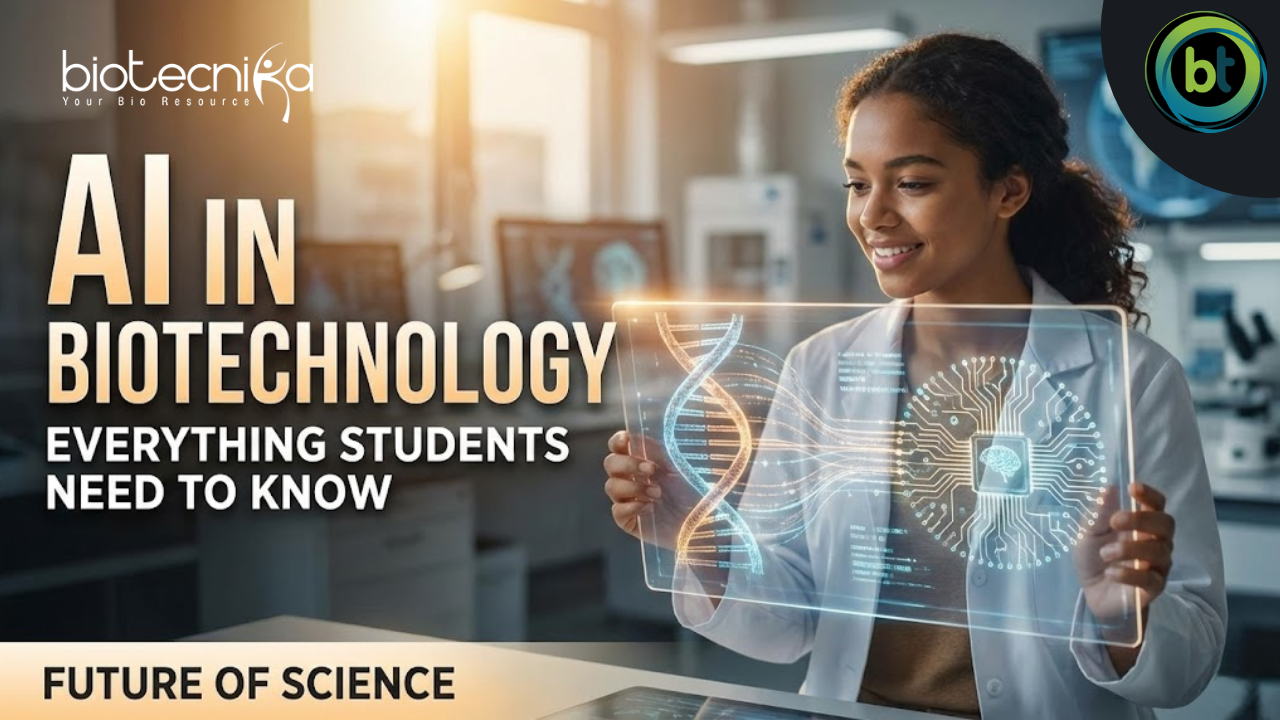
AI in Biotechnology: Everything Students Need to Know
AI in Biotechnology is reshaping the Life Sciences in subtle yet powerful ways; changes students are just beginning to discover, yet will soon be required to master.
What if I tell you that one of the most powerful tools for your Biotechnology career is something you were never taught in your classes or laboratories?
While Life Sciences students memorize metabolic pathways or perfect their pipetting techniques, the Biotech industry is undergoing a silent, futuristic transformation.
Every Protein modeled, every patient record stored, or every Genome sequenced adds to a massive wave of Biological datasets. These Biological datasets are far beyond the capacity of any human mind to interpret alone or manually. The most difficult yet essential thing is understanding Life (Sciences) and interpreting these Biological Datasets.
This is where AI (Artificial Intelligence) enters the world of Life Sciences, not as a threat, but as an essential turning point for the sector. AI is already shaping how Biological decisions are made, how Medicines and Therapeutics are designed, as well as how diseases are detected and diagnosed.
Yet numerous students are still preparing and striving for Life Sciences careers that no longer exist in the same form (due to Technological advancement).
A quiet divide is emerging in Biotechnology: those who can work with intelligence and Biological datasets, and those who cannot work with these futuristic Technologies. The gap is not about knowledge or talent; it is about awareness and evolution with Technology. And for Biotechnology students standing at the edge of their Life Sciences careers, that awareness can change everything and help them succeed in thier futuristic and promising career path.
The real challenge in the field of Life Sciences or Biotechnology is no longer producing massive datasets, but understanding, analysing, as well as interpreting them into meaningful forms. This is where AI helps Scientists and Researchers look out for Biological patterns, make accurate predictions, and gain insights and analyze datasets that were once beyond reach in the field of Life Sciences.
For Biotechnology students, graduates, or young Professionals, this AI in Biotechnology shift is not just an Academic trend, but a career-defining opportunity to stand out and outshine their peers.
Understanding the trends and advancements in AI in Biotechnology today means staying future-ready, relevant, and competitive in the Life Sciences field. This specially curated article is not just about the Biotechnology trends you might hear anywhere tomorrow. But it is about the futuristic transformation happening right now at this very moment. If you want to stay ahead and confident in Biotechnology, what follows below is not just an optional reading; it is essential.
What Does AI in Biotechnology Actually Mean?
AI in Biotechnology refers to the usage of intelligent Computational Systems and Algorithms, particularly Deep Learning and ML (Machine Learning), to analyze complex Biological data as well as assist Scientific decision-making in today’s Biotechnology & Life Sciences world.
Modern Biotechnology settings produce diverse and massive Biological datasets, including:
- Protein structures & Protein interaction networks
- Multi-omics Datasets across diverse populations
- DNA (Deoxyribonucleic acid), RNA (Ribonucleic acid), as well as whole-genome sequences
- Pathology slides & Medical images
- Patient Health & Clinical Trials Datasets
Artificial Intelligence in Biotechnology doesn’t replace Biological thinking; rather, it enhances it to another futuristic level. By learning from data, AI systems help Researchers & Scientists focus experiments, identify patterns, and predict outcomes where they matter most.
The bottom line is that Artificial Intelligence allows Biotechnologists and Life Sciences Professionals to move from the guessing and testing (trial & error) method to predicting and validating the massive Biological Data.
Why Biotechnology & Life Sciences Need Artificial Intelligence
Biological systems are incredibly complex. A single disease can involve thousands of environmental factors, genes, as well as proteins interacting simultaneously within. Conventional experimental approaches & Methodologies, while important, struggle to keep up with their complexity as well as scale.
AI became important because it can:
- Learn from historical Biological datasets in a quick span and with increased efficiency
- Analyze thousands of variables at once and with ease
- Reduce failure rates in R&D (Research & development)
- Predict results before costly experiments start
How Biotechnology Workflows Have Evolved?
|
Conventional Biotechnology |
AI-Enabled Biotechnology |
|
Trial-and-error experiments |
Data-driven predictions |
|
Limited data analysis |
Large-scale pattern detection |
| Long discovery timelines |
Faster & optimized pipelines |
| High experimental risk |
Informed decision-making |
This advanced evolution has reshaped how Healthcare systems, Research laboratories, as well as Pharmaceutical & Biotechnology companies operate across the world.
Where AI Is Transforming Biotechnology
-
Precision Medicine & Genomics
AI in Biotechnology plays a vital role in decoding Genetic information. It helps in:
- Predicting inherited disease and disorder risks
- Detecting disease-causing Genetic variants
- Analyzing population-scale Genomic datasets
- Designing Personalized Treatment Strategies and Therapeutics
This AI wave has accelerated the shift toward Precision Medicine, in which therapeutics are customized to an individual’s or a patient’s Genetic profile rather than to generalized medications.
-
Drug Discovery & Development
Drug discovery has always been relatively slow and expensive overall. Although AI in Biotechnology has changed this by helping Scientists & Researchers in:
- Predict how the molecules bind to proteins, as well as how they interact
- Identify novel drug targets
- Identify toxicity risks early
- Screen a massive (millions) number of compounds virtually with high precision
As a result, Researchers and Scientists can focus their laboratory work on the most promising drug components, saving years of effort and resources.
-
Medical Imaging & Diagnostics
AI-powered tools analyze medical images such as MRIs (Magnetic Resonance Imaging), X-rays, pathology slides, and CT (Computed Tomography) scans. These systems aid in:
- Reducing human error & variability
- Detecting diseases and Disorders at earlier stages
- Improving Diagnostic & Therapeutic accuracy
Doctors & Healthcare personnel remain central to patient care. Still, AI in Biotechnology acts as a powerful second set of eyes, enhancing accuracy, confidence, and speed in diagnosis and Treatment.
-
Environmental & Agricultural Biotechnology
Applications of AI in Biotechnology extend far beyond Healthcare & Pharmaceuticals. It is also helping the Agricultural sectors to:
- Study plant & soil microbiomes
- Improve crop disease resistance & yield
- Develop sustainable bio-based solutions
- Support climate-resilient Agriculture
In a world facing the adverse consequences of climate change and food insecurity, this AI in Biotechnology & Life Sciences application is more important than ever.
-
Synthetic Biology & Protein Structure Prediction
As you know, proteins are the workhorses of lifeforms. Hence, understanding their structure is key to developing industrial enzymes, drugs, as well as vaccines.
AI in Biotech has dramatically improved our ability to:
- Accelerate therapeutic and vaccine development
- Predict protein structures
- Design novel proteins and enzymes
These Technological advances are driving progress in next-generation therapeutics, Synthetic Biology, as well as industrial Biotechnology.
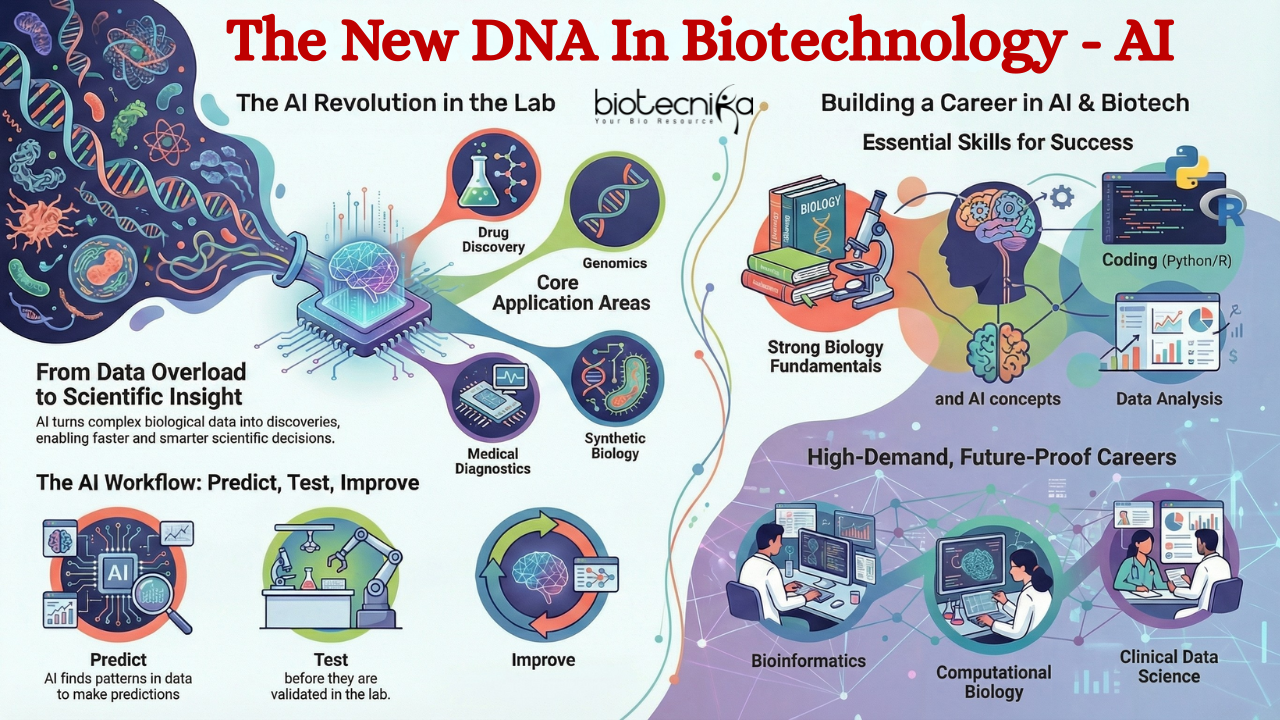
How Artificial Intelligence Fits Into a Biotechnology Project?
Artificial Intelligence Biotech is transforming how Biological data is analyzed, aiding Researchers to move from observation-driven experiments to predictive, data-backed innovations. AI is woven throughout the Biotech industry Research cycle:
|
Stage |
How AI Contributes |
|
Data generation |
Handling large Biological datasets |
|
Data preparation |
Cleaning and integrating data |
|
Model training |
Learning Biological patterns |
| Prediction |
Identifying trends and outcomes |
| Validation |
Supporting laboratory or Clinical testing |
| Optimization |
Continuous improvement |
This feedback loop allows both Science and models to improve together.
What Skills Do Students Really Need?
Are you thinking that to be ahead in the game, you have to become a Software or AI Engineer? Well, there’s no need to become a full-time Software Engineer if you wish to work at the AI & Biotechnology intersection career path. What matters most is the balance between the evolving Technology and foundational Life Sciences knowledge.
Essential Skill Areas for Students
|
Area |
What to Focus On |
|
Life Sciences |
Strong Biology fundamentals |
| Data Literacy |
Statistics and data interpretation |
|
Programming |
Basic Python or R |
| AI Concepts |
How Machine Learning works |
| Bioinformatics |
Databases and Sequence Analysis |
| Thinking Skills |
Logical and critical reasoning |
Students who can ask the right Biological questions and understand data-driven answers are in high demand.
Futuristic Career Paths in AI-Driven Biotechnology
The rise of AI in the Biotech industry has sprouted exciting new career roles, including:
- Computational Biologist
- Clinical Data Analyst
- Bioinformatics Analyst
- AI-Based Drug Discovery Scientist
- Genomics Data Scientist
Many of these career paths are accessible with a Bachelor’s (BSc or BTech) or even Master’s (MSc or MTech) degree, supported by practical experience, skills, as well as projects and Publications, often without a PhD (Doctor of Philosophy).
Some Common Myths Biotechnology Students Should Let Go Of
- “AI is only for Computer Science students.”
Biological insight remains irreplaceable. - “AI & ML will replace Biotechnology jobs.”
In reality, AI increases demand for skilled professionals who can interpret and analyse Biological results. - “Only expert coders can succeed.”
Conceptual clarity matters more than perfect coding and algorithms.
Why Biotechnology Students Have a Unique Advantage Today?
The Biotechnology industry faces a clear talent gap. Many Biotechnology professionals understand Biology but lack data or Computational skill sets. Other Professionals know AI but lack Biological knowledge. Biotechnology Students who start building interdisciplinary skills early can naturally bridge this gap and succeed in their careers.
This AI in Biotech combination is future-proof, unique, as well as valuable.
Why This Field Truly Matters in Today’s World?
AI-driven Biotechnology is helping humanity tackle some of its biggest challenges, such as:
- Early disease detection & prevention
- Faster development of life-saving drugs & treatments
- Sustainable Food Systems & Agriculture
- More affordable & personalized healthcare treatments
A career in this area is not just about a growth mindset; it is about impact on yourself as well as the world. As Artificial Intelligence Biotech continues to evolve, students who combine Life Science knowledge with data and AI skills will be best positioned for future-ready Biotech careers.
AI is not changing the Biotechnology sector, but it is redefining it with evolving Technology. For Life Sciences students and graduates, this AI in Biotechnology intersection offers one of the most future-ready, exciting, as well as meaningful careers available in today’s growing, competitive world.
You don’t have to master everything at once, or even today. Start with some enthusiasm, curiosity, and awareness. Build strong foundations in AI and Biotechnology. Learn step by step, every day. Biological Sciences and AI together are shaping the future of Science, and those who understand both will help lead it and outshine.
Frequently Asked Questions (FAQs)
- Do I need a Computer Science background?
-> No. A Life Sciences background combined with basic data and AI skills is enough to get started.
- Which Programming language should I learn first?
-> Python is the most widely used, followed by R for Statistics and Genomics.
- Can I enter this field without a PhD?
-> Yes. Many industry roles value skills and experience over Doctoral degrees.
- Is wet-laboratory experience still necessary?
-> Absolutely. AI supports experiments; it does not replace them.
- Is this a long-term career option?
-> Yes. As Biological data continues to grow, demand for AI-skilled Biotechnologists will only increase.





This is beautifully crafted and mind awakening. It’s important that student are exposed to this kinds Information and also exposed to practical aspects of Ai in biotechnology.
Let’s the impact become stronger as students graduate and grow.
Thank you i love this article its was impactul.
This was really helpful, but of course AI is evolving so whats stopping it from taking certain jobs. You made it clear that instead of taking jobs AI is creating but there are jobs that are at risk like those involved in the drug development process, AI reduces time and resources spent in other words jobs. Your article was really wonderful it was a really helpful read. I aim to sharpen and grow my understanding of AI and programming languages. Thank You very much
AI is applicable in almost all Biological Sciences field.
Conservation Biology,Hydrobiology and Environmental Biology are the most common field of Biology that requires AI applications.
Also Ecology,Entomology, Parasitology, Cell Biology,Molecular Biology, Anatomy Physiology, Biochemistry,Microbiology and Fisheries require AI applications.
Various fields of Biology like Botany, Zoology also require AI applicarions.