










Axolotl: The Regeneration Super Star
There is a superstar that goes against the concept of death and can regrow almost any part of its body! Yes, you heard it right. Ambystoma mexicanum, also known as the Axolotl, a small, smiling amphibian, has cracked the code of healing. Unlike other creatures or humans, Axolotl can regenerate entire limbs, parts of the central nervous system (Brain & Spinal Cord), tissues of skin, heart and also some portions of the eyes. Surprisingly, these regenerated portions restore their original form and function normally. Understanding the Axolotl Regeneration mechanism can lead to a breakthrough in Regenerative medicine. For Life Science students, this organism is a classic model for studying regeneration and exploring next-generation advancements in tissue-repairing technologies.
What makes the Axolotl Unique?
Axolotl is actually an aquatic Salamander, often called the “Mexican Walking fish”. The unique feature of this organism is the retention of Juvenile characteristics into adulthood; this condition is called Neoteny. The organism stays in a prolonged juvenile phase, carrying its gills externally as a characteristic of the larval stage. Another interesting info is that even though there is a delay in the physical/ somatic development, the organism can still reproduce in its juvenile form.
But this is not the wow fact! Axolotl has the superpower to regenerate its body parts. When they lose a limb or experience any wound, they trigger some complex pathway that heals the damage without leaving scars.
The Science Behind Axolotl Regeneration
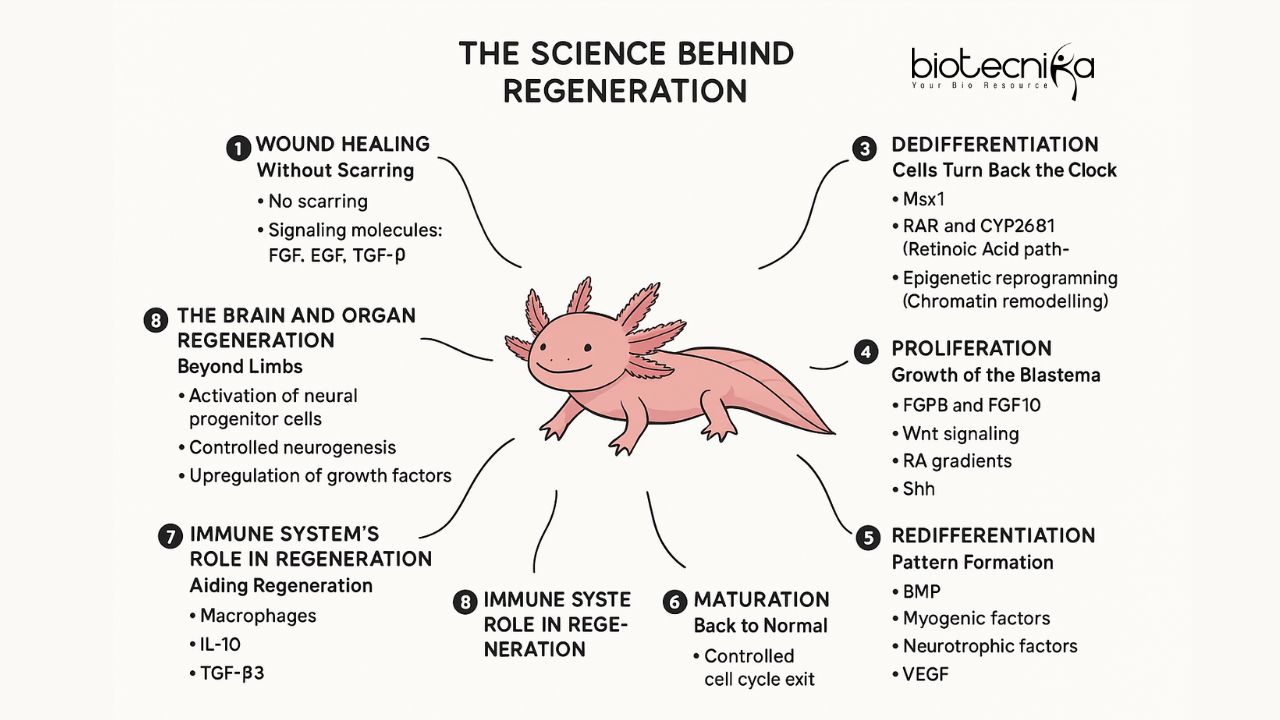
This interesting mechanism has three stages:
- Wound Healing – For instance, an axolotl loses a limb, the wound closes quickly without forming scars. Instead, signalling molecules such as FGF (Fibroblast Growth Factor) and EGF (Epidermal Growth Factor) help epithelial cells to migrate and cover the wound. This thin layer is known as the Wound epithelium. TGF-β (Transforming Growth Factor-beta) prevents scar formation. In humans, the scar prevents further growth, while in axolotls, this response is suppressed by anti-inflammatory molecules and growth factors. In addition, the nerves at the wound site signal the cells required for regeneration.
- Dedifferentiation & Blastema Formation – Cells at the site of injury revert to their primitive stage, stem cell-like, to be more precise. The cells re-enter the cell cycle and behave like embryonic progenitors. This is called dedifferentiation.
There are specific molecular pathways that guide this step:- Msx1: The master gene that promotes dedifferentiation.
- RAR & CYP26B1 (Retinoic Acid Pathway): RA acts as a positional signal; it helps cells recognize the pattern of formation, such as limbs, shoulders, elbows, etc.
- Wnt signalling: Prevents early differentiation and maintains cell proliferation.
Beneath the wound epidermis, these dedifferentiated cells gather together to form a mass of highly proliferative, undifferentiated cells called Blastema. These cells retain the memory of their origin and grow into their respective parts later.
3. Regrowth – Blastema cells begin to specialize again into their respective parts. This initiates with bone formation, followed by muscles, nerves, and skin.
Molecular events that guide the formation:
-
- BMP signalling: Drives bone and cartilage formation.
- Myogenic factors (Myf5, MyoD): Direct muscle regeneration.
- Neurotrophic factors: Guide the formation of new nerve connections.
- Vascular Endothelial Growth Factor (VEGF): Builds blood vessels to nourish new tissue.
The limb elongates gradually, forming cartilage structures, blood vessels, nerve connections and finally muscles. This process creates the original architecture which is now fully functional. The new limb finally gets integrated into the body and leaves no mark of regeneration.
Molecules that play a crucial role in Axolotl Regeneration
- Retinoic acid (RA): The amount of RA present in the body defines the cells that it is supposed to form. Any changes in the RA levels can lead to accidental extra growth of other parts as well.
- Hand2: A gene that acts like a “positional memory” switch found in the limb region that helps the cells regrow the correct pattern.
- Signalling pathways: Pathways like FGF, TGF-β, Wnt, and Sonic hedgehog (Shh) orchestrate the growth and organization of the tissues.
- Macrophages: These are the immune cells that engulf the debris and pathogens. Instead of causing inflammation, macrophages send healing signals that promote regrowth.
The Stem Cell Connection
Here is the most fascinating part! Axolotl doesn’t have a fixed number of stem cells for regeneration. Instead, it is the somatic cells/ body cells that revert to progenitor-like cells and reconstruct the tissues. This mirrors the Induced Pluripotent stem cell (iPSC) technology that scientists have already developed by reprogramming adult cells. Understanding the mechanism of Axolotl regeneration that safely induces proliferation and redifferentiation could help researchers design a new approach in the field of regenerative medicine. With the revelation of signals and epigenetic switches in Axolotl, we could come up with therapies that surpass scar formation and focus on tissue repair.
To the World of Genome
Axolotl has a giant genome, about 10 times larger than that of humans. The completion of successful sequencing reveals the reason for this “superpower”. The size of the genome is enormous due to expanded introns and transposable elements, but the functional genes are conserved, as in humans. Studies also suggest that there are many genes that are shared with humans. The story turns out that Axolotls don’t have any “magic” genes; it’s the function and usage that make them unique. The switching on and off mechanisms play the key role here. Emerging tools like CRISPR gene editing, single cell sequencing and spatial transcriptomics support the research to track the mechanism if each cell during the regeneration process.
Research Applications from Axolotl Regeneration to Humans
The actual research kicks in when we apply this special factor to the benefit of humans. Axolotl Regeneration opens new ways in various domains.
- Regenerative Medicine Models – The discovery of molecular signal pathways that trigger the regrowth could lead to designing therapies for organs and tissue repair, using the body’s own cells.
- Tissue Engineering – The studies serve as a manual for scaffold designing, growth factor delivery and nerve/vascular integration in the creation of lab-grown organs/ organoids.
- Neuroscience – Axolotl’s capacity to regenerate parts of the CNS, like the Brain and Spinal cord, may help to develop new strategies to treat neurodegenerative disorders and repair nervous system injuries.
- Ageing and Rejuvenation Research – They serve as models for understanding the ageing mechanism and for prolonging cell lifespan.
The concept of Axolotl Regeneration is fascinating and has various applications in the life sciences world. Axolotl is not just a Regeneration Superstar but a matter of preservation, as they are endangered. This small creature holds the secret of regeneration and evolution in the field of science. Axolotl again proves that there are many more yet to be uncovered. From here, the journey toward new innovations starts.