




















Vascular Disease Studies Enter a New Era with Realistic Blood Vessel-on-a-Chip Models
Have you ever thought about your blood vessels until something goes wrong or you give blood? Well, inside our body, these blood vessels form intricate networks that curve, narrow, branch, as well as expand, thereby shaping how blood flows and how Vascular Disease develops in us.
For ages, Scientists and Researchers have tried to study the complexity of these blood vessels using straight and simplified laboratory models that hold little resemblance to real human vasculature. The functional disconnect has limited the accuracy with which Vascular Diseases can be examined and analysed.
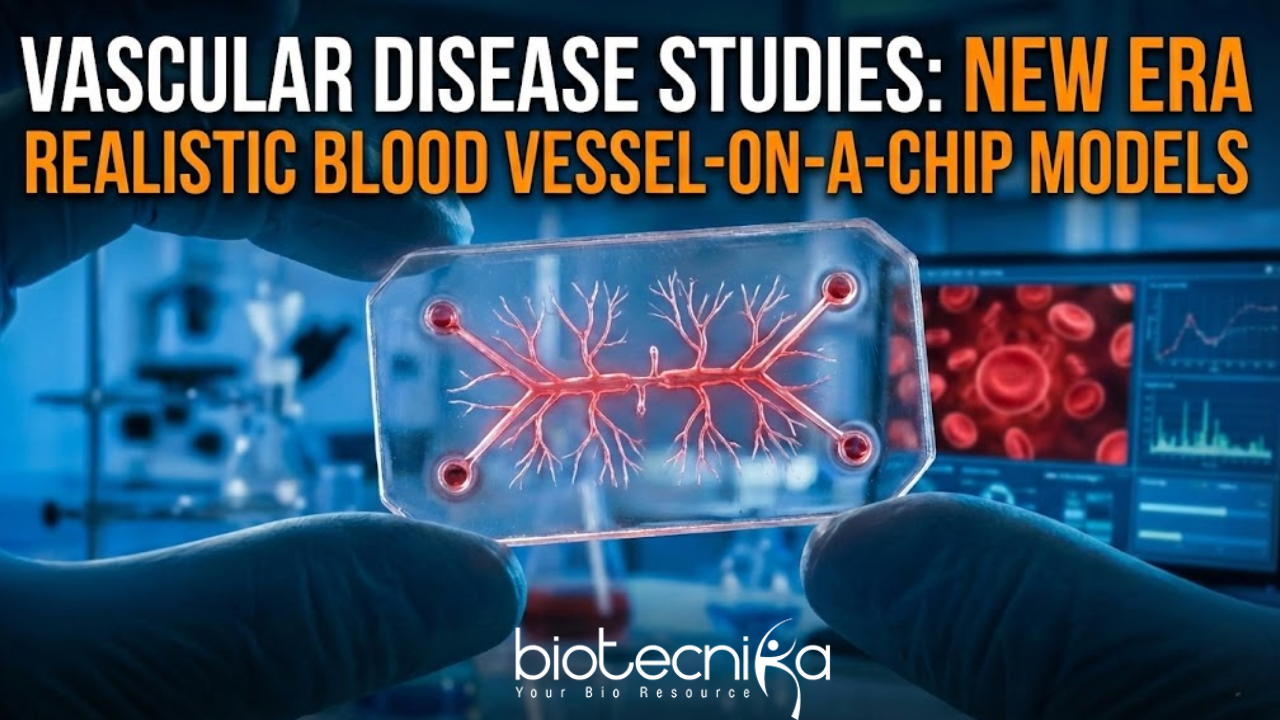
Renowned Researchers at Texas A&M University are extensively working to close that technical and functional gap. They have developed a customizable ‘Vessel-Chip’ platform that closely replicates the true architecture of human blood vessels. This would aid Scientists & Researchers in recreating different Vascular Geometries in the laboratory and conducting successful experiments. By capturing the structural complexity of real blood vessels, this developed platform enables more realistic studies of cellular behavior and blood flow under conditions that closely mirror those in the human body. This Technical approach offers a clearer view of how vessel structure influences Disease, as well as why understanding the complex blood vessels as they truly exist matters more than ever in Research.
Why Blood Vessel Geometry Matters?
Blood vessels in our body function more like a crowded road network, where bottlenecks, forks, as well as turns alter how blood traffic moves in the body, rather than behaving like mere straight pipes. In Biological systems, these structural changes affect shear stress, the force generated by blood flow along blood vessel walls. Shear stress plays a key role in how endothelial cells, which line blood vessels, respond to their environment and how Disease can begin or progress.
Many conventional laboratory models fail to reproduce these forces accurately because they oversimplify blood vessel shapes. As a result, they provide limited information on why diseases develop at specific sites within the Vascular system. This new ‘Vessel-Chip’ platform has been designed to overcome this model limitation by enabling precise control over flow patterns and vessel architecture.
Engineering a More Realistic Vessel-Chip
This ‘Vessel-Chip’ platform was designed by a Biomedical Engineering master’s student, Jennifer Lee, working in the laboratory of Dr. Abhishek Jain at Texas A&M University. Lee focused on recreating structural features commonly observed in diseased human blood vessels, including narrowed sections known as Stenosis, branching regions, as well as aneurysm-like expansions.
Lee stated, “There are branched vessels, or aneurysms that have sudden expansion, and then stenosis that restricts the vessel. All these different types of vessels significantly alter the blood flow pattern, and the inside of the blood vessel is affected by the shear stress levels associated with these flow patterns. That’s what we wanted to model.”
By reproducing these variations, the ‘Vessel-Chip’ allows Researchers to examine how changes in blood flow influence endothelial cell behavior, an important factor because many Vascular Diseases develop in areas where flow patterns are disrupted by vessel Geometry.
Building on Earlier Research
This extraordinary Research was published on March 5, 2025, in Lab on a Chip. This Research builds on earlier work by a former Biomedical Engineering graduate student, Dr. Tanmay Mathur, who developed a straight ‘Vessel-Chip’ model.
Both these Research studies were conducted in the Bioinspired Translational Microsystems Laboratory under the guidance of Dr. Jain, an associate professor and Barbara and Ralph Cox ’53 Faculty Fellow.
Dr. Jain stated, “We can now start learning about Vascular Disease in ways we’ve never been able to before. Not only can you make these structures complex, but you can also put actual cellular and tissue material inside them and make them living. These are the sites where Vascular Diseases tend to develop, so understanding them is critical.”
Expanding the Living Vessel Model
At present, the ‘Vessel-Chip’ platform utilizes endothelial cells that line blood vessels. Dr. Jain and Lee plan to expand the platform by incorporating additional cell types, enabling researchers and scientists to study how interactions between blood flow and cells influence vascular function in the body.
To support this, Dr. Jain emphasized, “We are progressing and creating what we call the fourth dimensionality of organs-on-a-chip, where we not only focus on the cells and the flow, but this interaction of cells and flow in more complex architectural states.”
Advancing Vascular Research
The Research study was supported by Texas A&M University’s Office of Innovation Translational Investment Funds, the U.S. Army Medical Research Program, the National Science Foundation, the Biomedical Advanced Research and Development Authority, NASA, the U.S. Food and Drug Administration, and the National Institutes of Health.
By successfully replicating the true complexity of human blood vessels, this new ‘Vessel-Chip’ platform is a meaningful and milestone step forward in how Vascular Disease can be studied, analysed, and understood with better accuracy. As the system continues to evolve, it provides a stronger experimental foundation for advancing future Vascular Research and for understanding blood-flow dynamics.