


















Research Associate Job at IISER Tirupati | Life Sciences | Apply Now
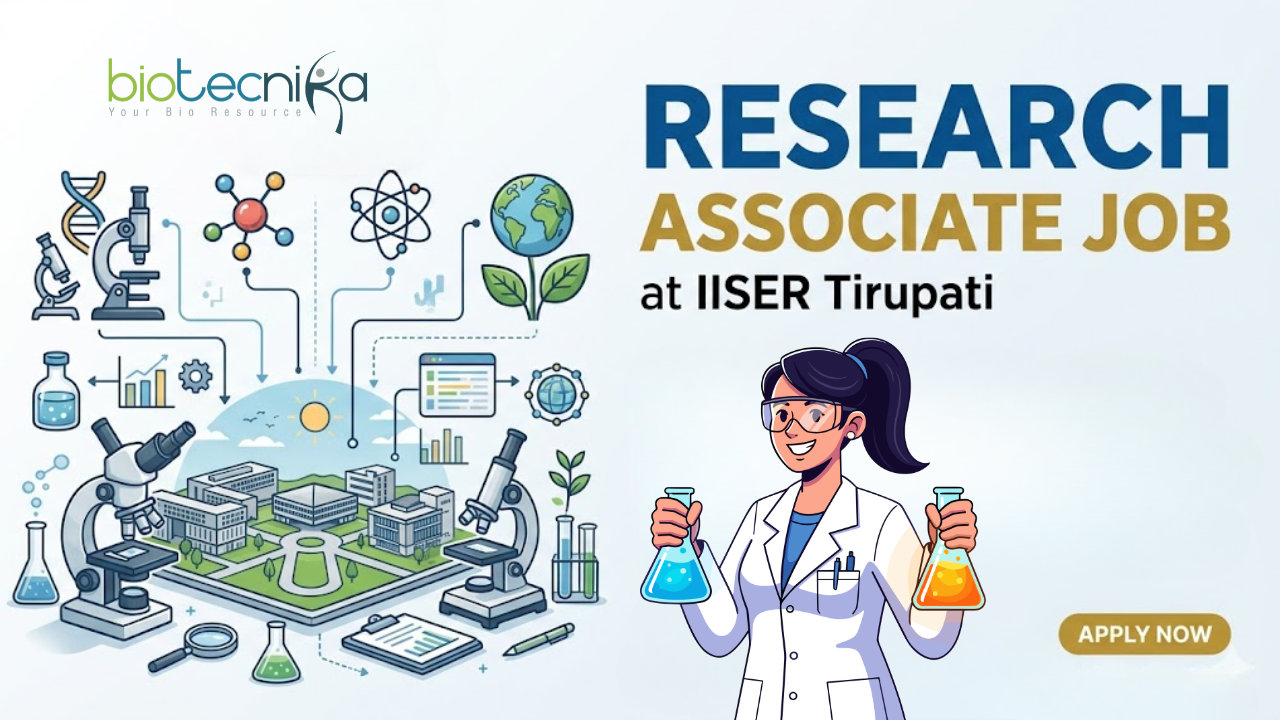
The Indian Institute of Science Education and Research (IISER) Tirupati is inviting applications for a high-level Research Associate Job under the mentorship of Dr. Prasanna Katti. This Life Sciences Opportunity focuses on a cutting-edge project titled “Spatial Interactome of Organelles in Muscle Aging,” exploring how the internal architecture of muscle cells changes as we age. If you hold a Ph.D. and have a passion for mitochondria and molecular biology, this IISER Recruitment offers a prestigious platform to conduct advanced research in an autonomous institution of national importance.
About the Institute
IISER Tirupati is the sixth institute in the chain of IISERs established by the Ministry of Education, Government of India. Since its inception, the institute has been dedicated to promoting high-quality science education and state-of-the-art research. For those considering a Research Associate Job, it provides a vibrant, interdisciplinary environment where researchers are encouraged to bridge the gaps between fundamental biology, chemistry, and physics. For a postdoctoral researcher, IISER Tirupati offers world-class infrastructure and the opportunity to apply for competitive fellowships like SERB N-PDF through the institute’s administrative support system.
Research Focus: Organelle Interactomes in Muscle Aging
The project explores the “Spatial Interactome”—the physical and functional connections between organelles like mitochondria and the endoplasmic reticulum within muscle fibers. Within this context, candidates for a Research Associate Job will be expected to navigate these challenging molecular networks.
- Muscle Aging: Understanding how the spatial arrangement of organelles degrades over time, leading to sarcopenia (muscle loss) and decreased metabolic efficiency. For the research associate role, this area is central to the job requirements.
- Mitochondrial Dynamics: Investigating mitochondrial fusion, fission, and tethering as primary drivers of cellular health.
- Methodology: The research involves high-resolution cell biology, molecular techniques, and Omics analysis to map these interactions at a granular level.
Role Details & Requirements
IISER Tirupati is seeking a highly skilled scientist capable of independent research and complex data analysis. Applying for the Research Associate Job means demonstrating competence across these areas.
- Minimum Qualification: Ph.D. in Life Sciences (Candidates who have submitted their thesis and are awaiting the award are also eligible).
- Desirable Qualities: Experience in genetics, developmental biology, and research analytics is highly sought after. These skills are valued for anyone considering an opportunity at IISER Tirupati.
- Fellowship Amount:
- ₹58,000 + 9% HRA: For Ph.D. degree holders applying for this research associate job opportunity.
- ₹42,000 + 9% HRA: For those whose Ph.D. is awaited (viva pending) and for those interested in research associate positions.
- Tenure: Initially for one year, renewable based on performance. Those offered a Research Associate Job will have tenure based on annual renewal.
- Age Limit: Not more than 40 years as of the closing date, which applies to the research associate job opening.
Application Details
- Last Date to Apply: April 9, 2026, by 5:00 PM.
- How to Apply:
- Download the prescribed application format from the IISER Tirupati website.
- Convert the completed form into PDF format. Begin your research associate job application by carefully following the document instructions.
- Email the PDF to [email protected].
- Important Note: Mention “Research Associate-1: 20/2026” in the email subject line. Resumes/CVs sent alone will not be considered a complete application for the research associate job.
In summary, this Research Associate Job is a definitive Life Sciences Opportunity for postdoctoral scientists interested in the mechanics of aging. This IISER Recruitment cycle provides a robust fellowship and a nominal research grant, making it an ideal environment for those looking to transition into independent faculty roles or apply for national postdoctoral fellowships. Because the project involves “Spatial Interactomes,” candidates with experience in advanced microscopy or spatial transcriptomics will likely stand out during the screening process.
CLICK FOR THE ORIGINAL NOTIFICATION