










Table of Contents
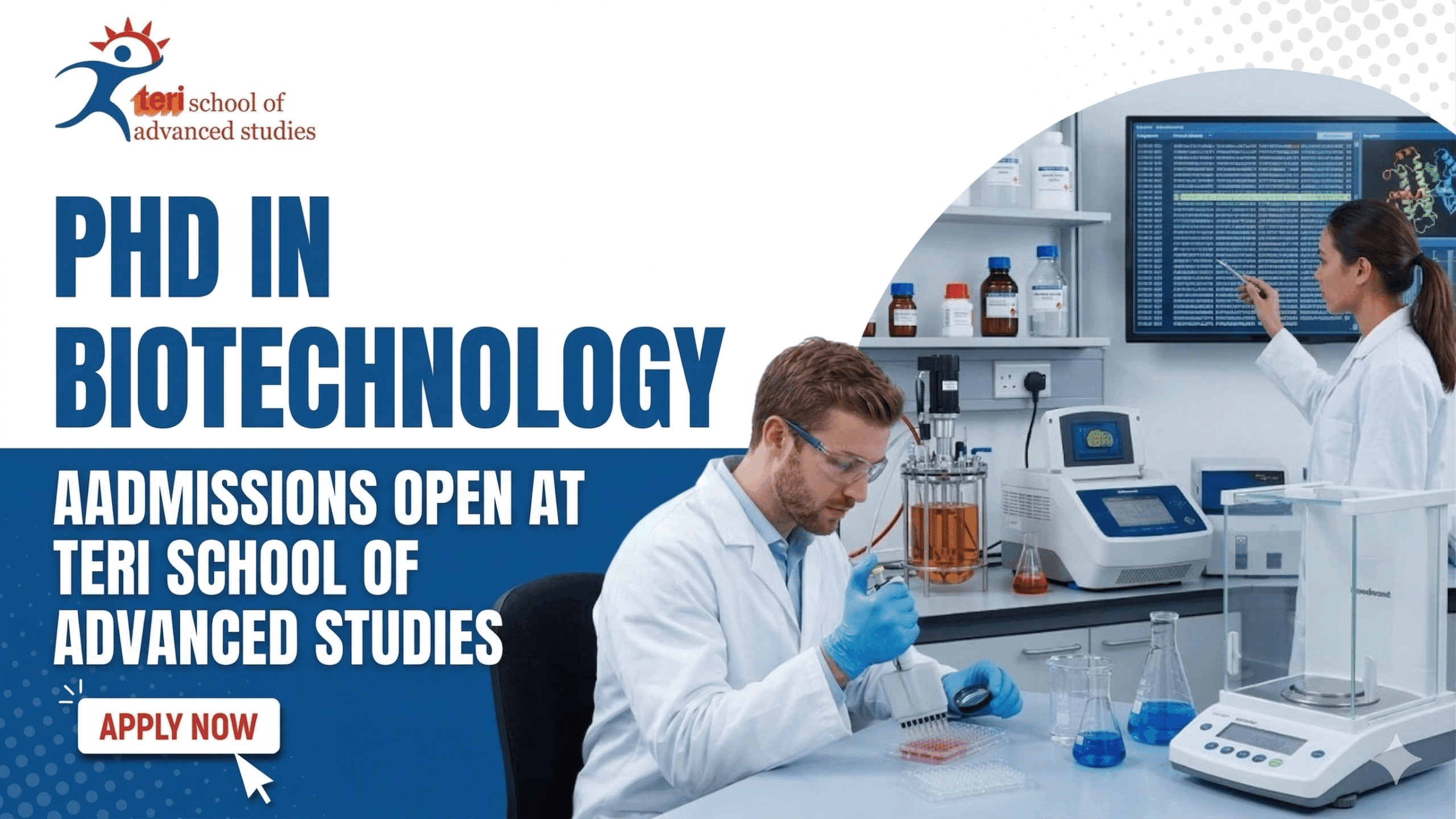
PhD in Biotechnology Admissions at TERI School of Advanced Studies
Looking to advance your research career in biotechnology and life sciences? PhD in Biotechnology Admissions at TERI SAS offer an exceptional opportunity to work on cutting-edge interdisciplinary research in bioresources, molecular biology, and computational sciences. With a strong focus on sustainability and innovation, TERI SAS provides a globally recognized platform for aspiring researchers to excel in advanced scientific domains.
About TERI School of Advanced Studies
The academic programmes at TERI SAS are focused on the challenges of providing the rising global population with a limited and degraded natural resource base. In moving towards sustainability, the implicit understanding is that there is no panacea or straight road, with recognized and established methodologies, tools or specializations leading to such development.
The solutions, therefore, do not lie in a specific subject discipline but must be appropriate and relevant to the context. Developing such an understanding among its students is best achieved through exposure to a variety of subjects, tools, and methodologies offered in an interdisciplinary mode. This has been the guiding philosophy behind the programmes offered by the TERI SAS and is practiced by building a theoretical understanding in courses covering a variety of traditional disciplines, such as ecology, natural and social sciences, governance, policy, and engineering.
Apart from doctoral research, TERI SAS offers 12 Master’s programmes focused on Renewable Energy, Environment, Water, Climate Science, Biotechnology, Economics, Sustainable Development, and Management. TERI SAS is one in a selected group of 22 institutions chosen worldwide by the MacArthur Foundation, USA, to run the Sustainable Development Practice programme.
The institute provides the very best in equipment and instruments, which includes state-of-the-art computer facilities, well-equipped laboratories, video-conferencing facilities, and access to South Asia’s most comprehensive library on energy and environment.
TERI SAS has established excellent partnerships and collaborative arrangements with several institutions overseas, including Yale University, USA; The Freie University of Germany; Utrecht University, The Netherlands; North Carolina State University, USA; and the University of Technology, Australia.
Programme Overview
DBT-TERI School of Advanced Studies (TERI SAS) provides an opportunity to PhD students to nurture their independent, analytical, and critical thinking. It offers a conducive environment to achieve academic excellence and meet the highest global standards.
The PhD programme offered by DBT-TERI SAS draws its strength from the expertise and areas of interest of its faculty members and its adjunct faculty from TERI, its parent organisation.
The operational aspects of the PhD programme are governed and guided by the provisions laid down in the “TERI School of Advanced Studies PhD Regulations-2019 (and its subsequent amendments)”.
Research Themes
- Structural and Molecular Biology
- Nanosciences and NanoBiotechnology
- Brassica Developmental Biology and Crop Improvement
- Bioinformatics and Computational Biology
- Plant Molecular Breeding
- Microbial Pathogenesis and Genetics
Programme Outcomes
At the end of the PhD programme, the students should be able to:
- Have an in-depth understanding of the nuances of the problem being researched and the literature surrounding it.
- Explore frontiers of fundamental, applied, and interdisciplinary research as decided by the chosen field of study.
- Understand and apply scientific methods, tools, and techniques to carry out high-quality research work.
- Independently plan and execute original research with high ethical standards.
- Develop suitable communication and interpersonal skills, critical thinking, and a problem-solving attitude as appropriate for a
Ph.D. student.
Admission For PhD in Biotechnology
Admission will be made based on written tests and an interview. A weightage of 70% to the written tests and 30% to the performance in interviews shall be given. The written test will have two papers of equal weight. Paper I will be on ‘Research Methodology’, which will be a common paper for admission in all departments of the University. Paper II will be
department/subject specific
SYLLABUS FOR RESEARCH METHODOLOGY
Syllabus for Paper II
Protein Biochemistry and Structural Biology: Biological macromolecules (Proteins, Carbohydrates, Lipids, Hormones, and Vitamins), Acids and Bases, Classification of proteins, Enzymes and kinetic parameters, Immunoglobulins, X-ray crystallography, Electron Microscopy and NMR techniques, Metabolic pathways and Bioenergetics (Gibbs’ free energy, Enthalpy and Entropy, First and second laws of thermodynamics and limitations).
Plant Science: Plant Physiology, Cell Biology, Molecular Biology & Biochemistry.
Bioinformatics: Introduction to Bioinformatics and its Application, Molecular Biology for Bioinformatics, Biological Databases and their Annotation, sequencing techniques, Pairwise and multiple sequence alignment algorithm, Phylogenetic Analysis, homology modelling, molecular modelling.
Microbiology & molecular biology: General microbiology, germ theory of disease, pathogens and disease, laws of genetics, Hardy-Weinberg equilibrium, central dogma, sequence hypothesis, nucleic acid structure and function.
Ecology and evolution: Concepts of evolutionary biology (organisms and molecules), spontaneous generation, convergent and divergent evolution, principles of ecology, ecological niches and community ecology, symbiosis.
Nanosciences: Atomic structure, chemical bonding, gaseous state, solid state chemistry, solutions, nanomaterials, stereochemistry, analytical techniques
Eligibility Criteria
Master’s degree in a relevant field or equivalent with at least 55% marks in aggregate or an equivalent grade in a point scale, wherever the grading system is followed.
Fee
For details regarding the fee for doctoral programmes, please refer to the link given below:
FEE DETAILS
PhD Guidelines
For PhD guidelines, please refer to the link to the student handbook. The PhD regulations are on page no. 57 to 69
STUDENT HANDBOOK
APPLY ONLINE HERE
FOR MORE DETAILS CLICK HERE
Contact Details:
- Address: Plot No. 10, Institutional Area, Vasant Kunj, New Delhi – 110 070, India.
- Tel. +91 11 71800222 (25 lines)
- Web www.terisas.ac.in