










Table of Contents
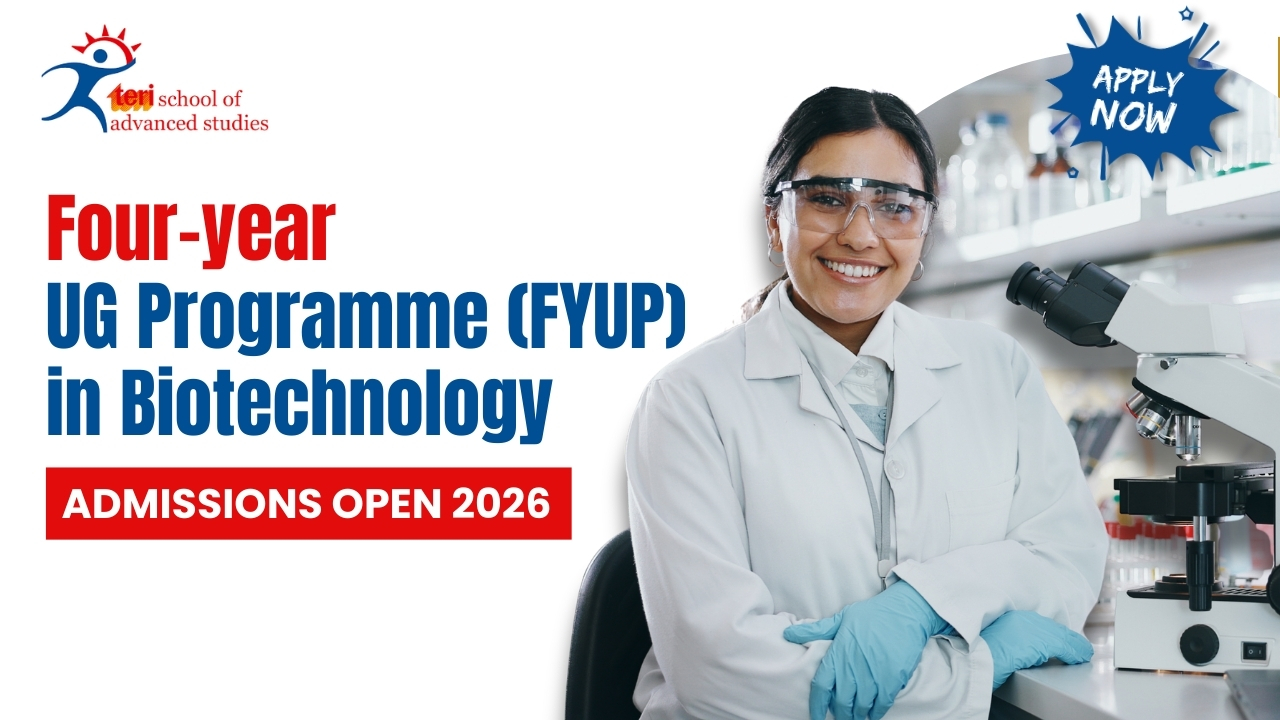
Four-year UG Programme (FYUP) in Biotechnology (B.Sc. Honours/ Honours with Research) at TERI SAS | Admissions Open 2026
Explore Biotechnology Career with TERI SAS. Admissions Open for Four-year UG Programme (FYUP) in Biotechnology 2026
About TERI School of Advanced Studies
TERI School of Advanced Studies (TERI SAS) was established as a Trust in 1998 and was granted a “Deemed to be University” status in 1999 by Ministry of Human Resources Development, Department of Education, Government of India. Its overall mission is to create new knowledge through research and contribute to the discourse on sustainability at national and global level. The Academic programmes at the TERI SAS are developed around the global challenges of sustainability which have arisen due to the increasing needs of mankind combined with limited and ever-diminishing natural resource base.
TERI School of Advanced Studies (TERI SAS) is renowned for its commitment to sustainability studies and biotechnology. With a strong focus on inter-disciplinary capacity building, TERI SAS aligns with national missions of both critical sectoral and inter-sectoral importance. Our dedication to sustainability and biotechnology makes us a leader in the integration of education, research, and policy to contribute to national and global objectives.
Academic programmes at the TERI SAS are focused around the challenges of providing the advanced studies rising global population with a limited and degraded natural resource base. In moving towards sustainability, the implicit understanding is that there is no panacea or straight road, with recognized and established methodologies, tools or specializations leading to such development.
TERI SAS has established excellent partnerships and collaborative arrangements with a number of institutions overseas, including Yale University, USA; The Free University of Germany; Utrecht University, The Netherlands; North Carolina State University, USA; and the University of Technology, Sydney, Australia.
Department of Biotechnology
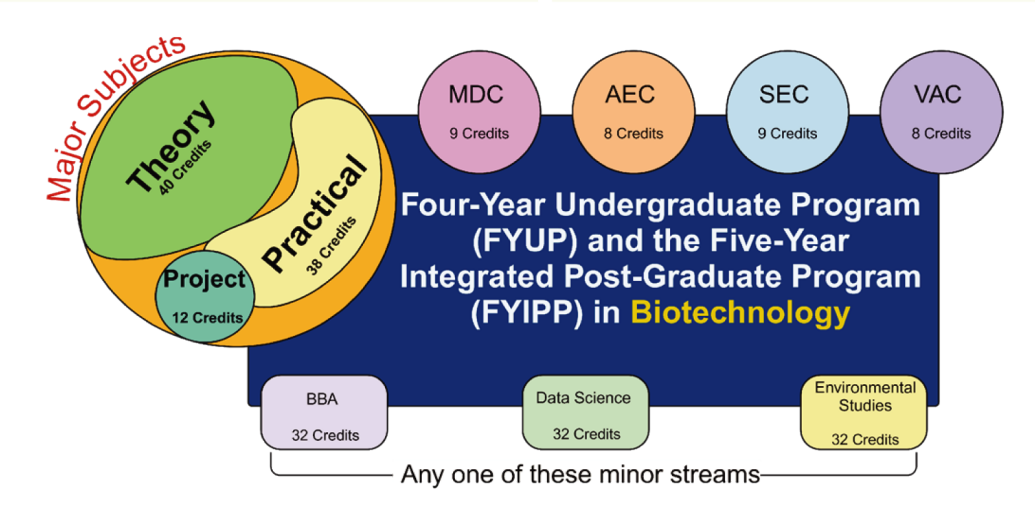
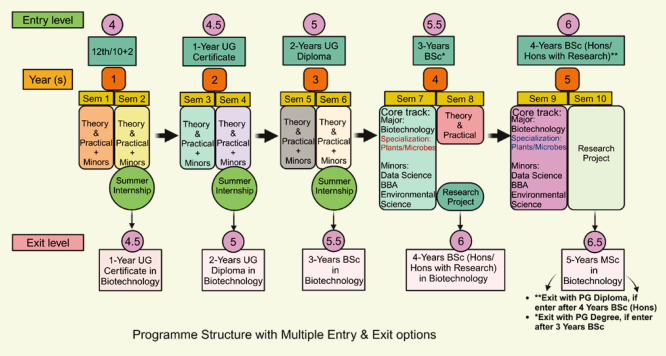
The Department of Biotechnology at TERI School of Advanced Studies (TERI SAS) is committed to advancement of Biotechnology research and contributing to goals of Sustainable Development by way of knowledge dissemination and capacity building. The aim is to cater to national requirements in the field of energy, agriculture, healthcare and environmental sectors. The Department offers a range of research-led academic programmes at several levels with flexible multiple entry and exit options of Four-year Undergraduate Programme (FYUP) and Five-year Integrated PG Programmes (FYIPP). Our academic programmes are aligned to national curriculum and credit framework as prescribed by University Grants Commission, Government of India, under the aegis of National Education Policy 2020. Further, the students also get exposure to commercial aspects of Biotechnology by way of active collaboration with TERI adjunct-faculty who are primarily engaged in Applied and Industrial Research. Such opportunities enhance the employability of students by equipping them with skills in demand. The first M.Sc. (Plant Biotechnology) programme was started in 2008 with seed grants from the Department of Biotechnology, Government of India. The programme was restructured in 2021, as M.Sc. Biotechnology with two specializations, namely, Microbial biotechnology and Plant biotechnology. From academic session 2025, the Department is set to offer FYUP and FYIPP in Biotechnology. The programme provides a unique option to have Major in Biotechnology with any one of three Minor streams, namely, Environmental Studies, Data Science and Business Administration.
Students enrolling in our academic programmes are exposed to an academically stimulating and interdisciplinary environment. Significant emphasis is given to hands-on laboratory training, and original, critical and creative thinking. Doctoral students may choose to carry out their research in areas such as mammalian cell culture and disease modelling, microbial pathogenesis, plant developmental biology, plant molecular breeding and structural & molecular biology. Further, students may also choose to carry out their research projects in the research facilities of TERI in fields as varied as sustainable agriculture, environmental bioremediation and biofuels to name a few.
- POSHAN Abhiyaan (Development of biofortified and protein rich wheat)
- National Action Plan on Antimicrobial Resistance
- IndCEPI (Coalition for Epidemic Preparedness Innovations – a mission to develop affordable vaccines against emerging infectious diseases)
- National Biopharma Mission
- National Solar Mission
- Swachh Bharat Mission
- Swasth Bharat Mission
- GARBH-Ini Programme (A mission to promote maternal and child health, and develop prediction tools for pre-term birth)
- Nano Mission (National program on nanoscience and technology (formerly Nano Mission))
- Atmanirbhar Bharat Abhiyan (National self-reliance)
TERI SAS aims to create a skilled cadre of biotechnology professionals, while maintaining quality parameters at par with current requirements in academia, industry and allied professions. The proposed program leading to an integrated Masters’s degree aims to provide students with an understanding of advanced concepts and techniques in biotechnology, while promoting inter-disciplinary and holistic skill development and learning that contributes to the attainment of SDGs.
Overall guiding principles of the proposed integrated program based on NEP 2020
Removal of disciplinary barriers to entry, while maintaining the rigor of disciplinary requirements.
Provision of multidisciplinary and interdisciplinary learning opportunities for students by integrating minors in other fields of study available at TERI SAS.
Emphasis on inclusive, barrier-free entry options at all levels to provide credit- and/or degree-earning opportunities not only for regular students but also for members of the general public who aspire to be lifelong learners.
Salient Features of FYUP Program
1. Open to all students who have passed Senior Secondary School (10 + 2) Certificate (or equivalent) in science.
2. Multiple exit options with skill enhancement-based training as prescribed by UGC.
3. Multiple entry options provided as follows:
- A. May enter in any semester, starting with semester 2, with no disciplinary barriers, after certification of eligibility by the Departmental Program Executive Committee.
- B. Entry contingent on having completed one (or more, as applicable) entire semester(s) in a bachelor’s degree program, provided the said program follows the UGC-prescribed structure and distribution of courses. (Incidentally, this facilitates re-entry for dropouts)
- C. Conferment of degree is contingent on completing the required credits in terms of Major, elective, and other types of courses as prescribed by the UGC. Therefore, students utilizing lateral entry will be given the opportunity to stay back and complete credit requirements for earning their degree/diploma/certificate by choosing appropriate courses, if required.
- D. Students can re-enter within three years to complete the degree program. The total duration for completing the FYUP programme shall not exceed 7 years.
4. The FYUP in Biotechnology program will award a B.Sc. (Hons.) with a Major in Biotechnology (with over 50% of total credits in the major subject) and a single minor (32 credits) in Environmental Studies/Business Administration/Data Science. Other minors are likely to be added as and when TERI SAS diversifies its FYUP offerings.
5. All the major courses offered in the FYUP in Biotechnology may be counted towards fulfilment of credit requirements for a minor subject in other FYUPs offered at TERI SAS based on their requirements.
Eligibility
- Senior Secondary School (10 + 2) Certificate in science or equivalent, from a recognized Board of Education with at least 50% marks in aggregate (best of 3 subjects + English).
- Admission will be based on aggregate marks obtained in the qualifying Senior Secondary School Certificate Examination, followed by interaction/counselling.
- CUET-UG score/NEET score/JEE mains scores of 2023,2024 and 2025 are accepted.
Programme USP
- Lab-intensive program with hands-on training in well-equipped teaching and research laboratories at TERI School of Advanced Studies.
- Multi-disciplinary minor options available in business administration, environmental studies and data science.
- Emphasis on problem-solving skills for biotechnological innovation.
- Interface with biotechnology and policy research at The Energy and Resources Institute, particularly related to Sustainable Development Goals (SDGs).
- Aligned with the National Education Policy 2020 as well as sectoral National Missions.
- Opportunities for undertaking interdisciplinary research projects in academia and industry.
- Capacity-building for entrepreneurship, startups and ESG.
CLICK HERE FOR PROGRAME OUTLINE
LIMITED SLOTS AVAILABLE FOR SCHOLARSHIPS
Career Opportunities
Research and Development in academic and research institutions engaged in biotechnology research. Industries such as pharmaceuticals, seed companies, breweries and dairy. Further career options exist in forensic and diagnostic centers, regulatory and funding bodies, law firms, and knowledge processing offices involved in Intellectual Property (IP) management.
APPLY ONLINE