






















Industry vs Academia: Which Pays Better in Biotech?
Industry or academia: which is the better option? It is a question that is frequently asked by many students, whether they are freshly graduated students or final-year students; they all have the same doubt about their careers. Which is better, or to be claercut which pays better in biotechnology?
Being a biotech student, for sure you must be facing the same problem. Here, one path directly leads to the corporate sector, where you will be working on the development of therapies and different diagnostics, whereas the other paths lead to the universities and research institutes, where you will be a part of the advancing technologies and discoveries in the biotech field. Both of these paths are equally respected and highly sought after and are intellectually demanding. The bigger question is which one pays better? In this article, we will break this down clearly, without any hype, with real data and smart insights.
Comparing Industry and Academia in Biotechnology Jobs
While comparing these two options, the first term to be considered by a student is the salary range and what the growth aspects are. The annual pay in India for biotech professionals depends widely on the basis of experience, the roles offered, and the sectors. With the given stats on average, biotechnology jobs in the industry usually pay more than academic jobs. This trend is especially true in early and mid-career because of the high demand for skilled individuals in the pharma, biopharma, and bioinformatics industries.
Here is a quick comparison table for the key roles in the biotechnology field:
| Role | Average Annual Salary (Industry) | Typical Academic Pay |
| Entry-Level Research Scientist | ₹2.5–8.6 LPA | ~₹750,000/year for Assistant Professor |
| Bioinformatics Scientist | ₹4.4–16.5 LPA | ₹60,000–90,000 monthly (~₹7–10.8 LPA) |
| Regulatory Affairs Specialist | ₹3–10 LPA | Limited structured growth early on |
| Senior Scientist/Manager | ₹12–20+ LPA | Professorship: ₹18–30 LPA+ with tenure |
Why Industry Often Means the Highest Paying Biotech Jobs
The highest paying jobs are usually collected at the industries. The roles in the fields of bioinformatics, R&D, and biopharmaceuticals are usually given out to freshers from experienced roles with a healthy salary figure based on the role demand, plus they increase quickly with experience.
For instance, if we take into account roles such as bioinformatic scientists, these are the roles that amass up to 10 to 16 LPA in the industry and are considered the top-paying biotechnology jobs in India. These are the positions that integrate both computational skills and biology, and they are highly valued by the industries for their work in drug discovery and genomic work.
To understand why the industries pay more.
Let’s take the industry as an express train, where it requires results, but it also gives out rewards for satisfactory performance. Companies highly invest in talent pools so that they can reduce their time to market for the products, improve their efficiency, and also innovate. So if your works help in providing all these criteria, your salary potential increases exponentially.
Plus, in industry, they offer various perks like bonuses, incentives based on performance, and fast promotions, which academia rarely offers in its early days.
Academia: Depth of Research and Stability
Academia is something like a deep-sea dive where the exploration results are slow, but rich in intellectual value. Here in academia, teachers, researchers, and professors’ main focus is on fundamental research, publishing papers, and teaching the next generation.
Here, biotechnology entry-level roles may start off with modest salaries in roles such as research fellows or junior researchers/lecturers; it provides a permanent position with a pay scale of the public sector.
If we take a look at how much assistant professors at indian universities earn, the total amount reaches up to ₹79,000 to ₹1,10,000 per month, which is around ₹9.5–13.2 LPA, whereas for the senior professors, the amount reaches up to ₹1,80,000–₹240,000, which is ~₹21.6–28.8 LPA or even more depending on their payscale of research grants and the allowances they earn for projects.
So what is the trade-off here? Usually in academia, to reach this level, you need specialized education, often a PhD, which takes a few years to attain. This indicates the low pay grade early on, but has the potential for stability through research grants.
Other factors that are responsible for the difference in salary in biotech careers
Skills and Specialization
Skill ans specalization are the biggest parts in determining your career path; irrespective of the path you choose, be it academia or industry, both value individuals with the required skills and specializations. Based on the roles you want to pursue, the skill set for them is very important, along with the theoretical knowledge. Skills like CRISPR, data analytics, python or regulatory affairs are all skills that are currently in high demand in both areas.
Where you work also matters
Where you work also influences how much you earn, mainly because of differences in the cost of living and industry demand. Cities known as biotech hubs, like Bangalore, Hyderabad, Mumbai, and Pune, usually offer salaries that are about 10–20% higher than in other locations.
Experience
Be it academia or industry, the more experience you have, the better it is. This helps you target high-paying jobs. This trend is mostly seen in industrial platforms rather than academia, but applies to both.
Industry vs Academia: Which Path Fits You?
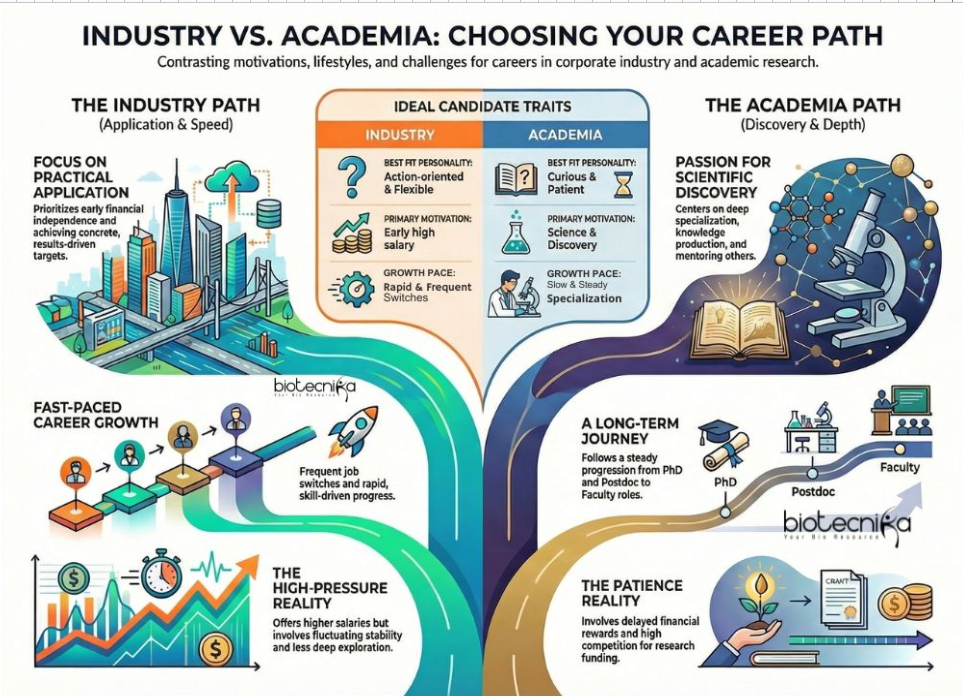
- What you must remember is that skills like computational biology, knowledge in regulatory areas, and advanced lab techniques can lead to high earnings in both paths.
So, from the context, we can safely say that the industry did come out as the winner in terms of salary inputs. It does provide various financial benefits and perks, given the specialized roles and the career growth, making the industry a lucrative option for many people.
But of course, we cannot forget academia as well. Although their start is slow in comparison to the industry, it provides long-term stability with a greater area of freedom to research compared to the industry.
At the end, the choice is yours to make, whether you want to pursue academia or industry. As it totally depends on where your interests and experties lies, which aligns with your goals. Just remember that the path you choose must align with your final goal and ultimately help you grow in your career.