















Table of Contents
Why Life-Science Students Can’t Ignore Bioinformatics Internships
If you’re a student studying biotechnology, microbiology, or any life science discipline, you’ve probably also realized that biology is no longer just about Petri dishes and pipettes. It’s about data—terabytes of it. From genomic sequencing to protein modeling, the life sciences are undergoing a digital revolution. For those interested in gaining hands-on experience and skills, Bioinformatics Internships are becoming increasingly important in today’s landscape.
This shift has given rise to the bioinformatics field that’s been quietly rewriting the rules of biological research. Once seen as a niche branch of computational biology, bioinformatics has now become the backbone of discoveries in genomics, drug design, personalized medicine, and agriculture.
The Rising Relevance of Bioinformatics:
Now universities are slowly integrating and updating their curricula to prepare students for the job market; the pace is still very slow to keep up with market demands. That’s why internships are no longer just an optional add-on; they are now a key requirement.
- According to a 2024 report by Grand View Research, the global bioinformatics market size was valued at over USD 15.8 billion and is expected to grow at a compound annual growth rate (CAGR) of 13.5% from 2024 to 2030.
- This surge is driven by falling sequencing costs, the explosion of biological data, and the integration of artificial intelligence into healthcare.
In simpler terms, bioinformatics careers are no longer just another specialization—it’s becoming the default language of biology. Organizations such as EMBL-EBI (European Bioinformatics Institute), the U.S. NIH (National Institutes of Health), and Biotecknika now offer annual internship programs to train the next generation of data-literate biologists.
Internships are where life science students first experience this ecosystem of real data, real software, and real impact.
Why Bioinformatics Internships Matter?
Even though university courses teach concepts like sequence alignment, molecular databases, or basic Python, real biological datasets are messy. These contain various sequencing errors, missing values, and inconsistent datasets. Learning to handle these issues takes more than theory; it requires experience.
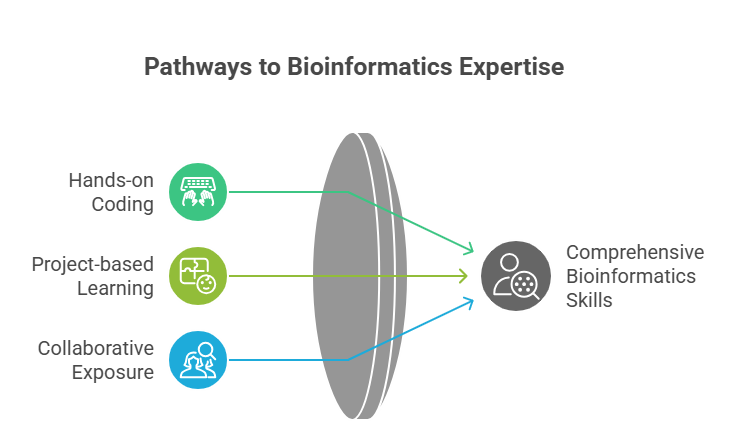
This exposure develops both technical fluency and biological intuition—skills employers value far more than textbook knowledge. In a 2023 Nature Biotechnology career survey, over 70% of hiring managers focus on practical computational experience as a must have skill for life-science recruits.
Bioinformatics internships are now being recognized as the most crucial step towards the vast career options, which can be your academia, big pharma, or even startups.
Skills to Master During a Bioinformatics Internship:
Through the course of your internship, you need to master a set of analytical as well as technical skills, which will be mandatory throughout the research sector or your industrial market:
- Programming Skills: Python for data wrangling, R for statistical analysis, Bash for automation.
- Genomic Data Handling: Using tools like FASTQC, HISAT2, and Samtools to process NGS data.
- Visualization and Communication: Creating readable reports and dashboards to explain findings.
- Statistical Reasoning: Understanding p-values, normalization, and biological variability.
- Collaborative Practices: Using GitHub and cloud computing platforms like AWS or Google Colab.
These competencies don’t just make interns employable—they make them adaptable. Every subsequent role, from a research assistant to a data scientist, builds on this foundation.
The Job Landscape:
According to the U.S. Bureau of Labor Statistics (BLS, 2024), employment of bioinformatics scientists is expected to increase by 15–20% between 2025 and 2032, which is much faster than the average for any occupation.
- In India, bioinformatics analysts earn ₹6–12 LPA at the entry level.
- In the U.S., entry-level salaries range from $70,000 to $110,000 depending on skills.
Industries all over the science field are now in demand for bioinformaticians; Bioinformatics jobs are growing rapidly across sectors:
- Pharmaceutical and Biotech R&D
- Agricultural Genomics
- Clinical Diagnostics
- Artificial Intelligence in Healthcare
- Academic and Government Research Institutes
Guide for Securing Your First Bioinformatics Internship:
- First, try to start with a small project portfolio, which includes an analysis of a public data set from NCBI, and publish this on GitHub.
- Take up a Short Online Certification: Biotecnika, Coursera, and many other governmental and non-governmental portals offer beginner-friendly courses.
- Build a resume focused on skills: Showcase all the tools and systems you have studied.
- Networking: attend workshops, webinars, and join groups aimed at bioinformatics study and jobs. This will help you stay updated.
- On-time application: Stay on alert for internship programs that open up in advance so as not to miss out.
Beyond Bioinformatic Internships: The Future of Bioinformatics Careers
The future of bioinformatics is closely interlinked to AI, from predicting protein folding to drug discovery for many incurable diseases; this generation is fully driven by datasets as their new frontier.
Students who are looking for a chance in the field of bioinformatics need to start early in a bioinformatics internship to adapt themselves so as to start working in a lead role in various multidisciplinary areas or to even start their own biotech startups.
Now it’s no longer an option where we have to decide whether to take the bioinformatics internship or not; it’s a must. This has now become an essential pathway to the biotech industry. It transforms you from just a life science graduate to a problem solver who is ready to take on challenges from both academia and industry.
So, it doesn’t matter whether you are an undergraduate delving into genomics, a postgraduate who is refining their skill sets, or a PhD student trying to broaden your computational expertise; now is your time to grab on and step into the world of bioinformatics and lead the way where biology meets data.
Your next internship might not just change your resume, it might redefine how you see science itself.