





AI in Drug Discovery – Startups, Breakthroughs & Salaries
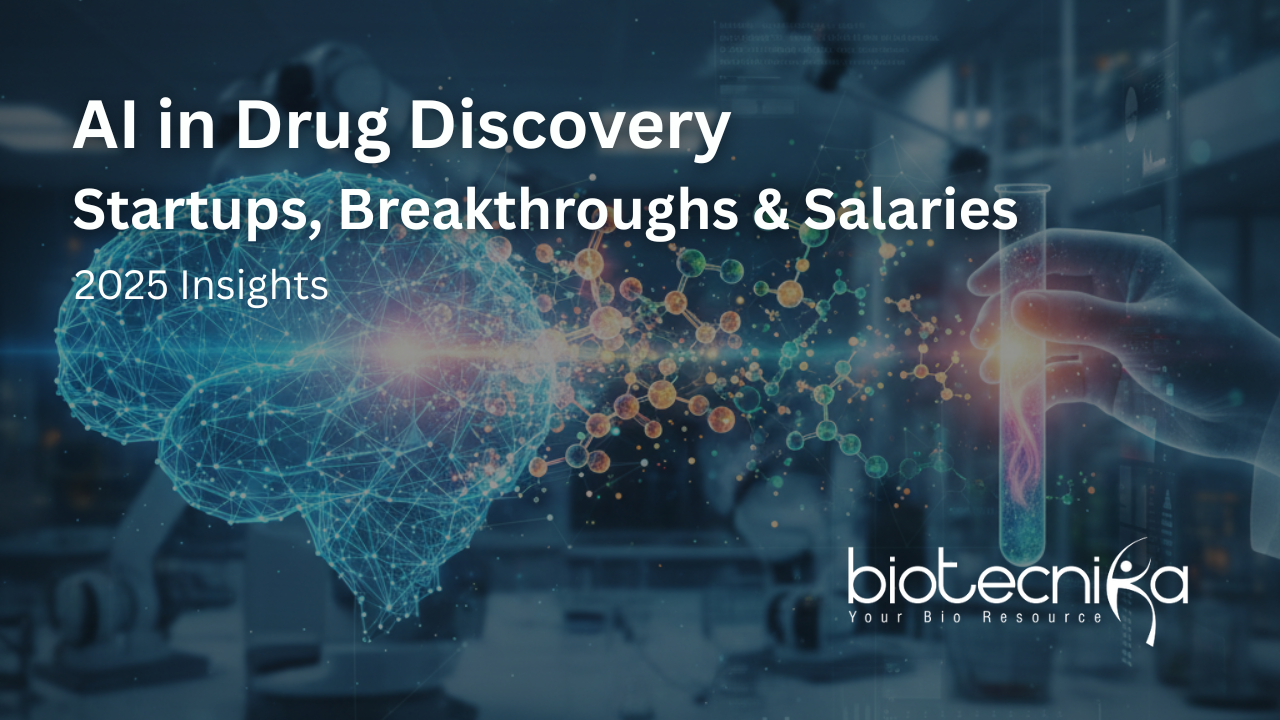
Why AI in Drug Discovery Is Becoming the Next Big Career Wave, in the past few years, the world has undergone a remarkable shift in how we discover drugs. What once took researchers 10–12 years, millions of experiments, and enormous financial investment is now becoming significantly faster and more precise thanks to AI in drug discovery. For Indian life science students and early-career researchers, this field is opening new doors.
Now, the researchers, scientists, biotech graduates, and computational scientists find themselves at the junction where computational algorithms can predict drug responses and design molecules to help pharma companies lower their costs exponentially. The industry is rapidly evolving, and so is the demand for talented individuals who have the potential to learn and experiment.
If you want career paths that merge biology, technology, and real healthcare impact, 2025 is the year to pay attention.
A New Era of Drug Discovery
Drug development has always been one of the slowest and most expensive scientific processes. Today’s AI is continuously transforming and advancing at every step, from prediction to the complete design of an entirely new molecule. Now, instead of waiting months for results in wet labs, an AI stimulation run can give us results in minutes across millions of simulations.
Today’s AI models can not only design novel compounds but also accurately predict how they will behave in the body and simultaneously determine their potential toxicity before they’re tested on animals. A smarter and more advanced pharmaceutical ecosystem is being developed through cloud-based experimentation and high-throughput screenings combined with robotics. A huge reason behind this acceleration is the rise of startups.
The companies are now more welcoming and unafraid to test disruptive ideas and innovations. Their achievements and breakthroughs are now compelling the giants in the pharma industry to rethink their strategies going forward.
Breakthroughs that Defined 2025’s
Some of the most exciting and innovative developments shaping the industry right now include:
- Drug candidates generated through AI are now entering human trials faster than ever, reducing discovery time by almost 70% at early stages.
- Advanced protein prediction tools that help design better and more accurate targeted therapies.
- Automation-integrated labs upgraded with automation handle repetitive tasks with robotic systems, and AI models guide experiments.
- To identify druggable targets with unprecedented accuracy, multimodal models that integrate genomic, imaging, chemical, and patient data are used.
For young researchers and scientists, these breakthroughs are now the prime opportunity to work on projects that are both future-focused and high-impact in reshaping real clinical pipelines.
The Startup Ecosystem: Where Innovation Is Moving Fast
All over the world, startups are redefining drug-discovery strategies. What makes them special is how rapidly they are adopting AI models and integrating them into novel workflows to run experiments, and ultimately scaling up to large pharma companies that have been in this field for decades.
Here’s a snapshot of leading global players driving innovation:
| Startup | Core Expertise | Why They Matter |
| In silico Medicine | Generative AI for small molecules | First AI-designed drug to enter Phase I/II trials |
| Recursion | Phenotypic screening + ML | Massive imaging datasets powering drug insights |
| Exscientia | Precision design using AI | Multiple clinical-stage AI molecules |
| Absci | AI-driven protein design | Emerging leader in antibody development |
| Atomwise | Structure-based deep learning | Strong success in rapid hit identification |
India is on track as well and catching up rapidly. Bengaluru, Hyderabad, Pune, and Mumbai are currently witnessing the rise of computational biotech startups backed by both Indian and global investors. This is opening new career paths for graduates who want to combine biology with data science and innovation.
How AI Actually Supports Drug Discovery
Modern-day drug discovery follows a very different workflow from the traditional bench-only one. Now it requires back-and-forth between digital predictions and laboratory validations.
- It identifies disease mechanisms and druggable targets, using large-scale biological data.
- It rapidly screens chemical libraries and helps predict which molecules may interact with a particular target.
- It designs optimized compounds, reducing the need for repetitive trial-and-error experiments.
- It helps predict toxicity and ADMET properties early, preventing expensive failures.
- It helps design better clinical trials by analyzing patient variability and potential outcomes.
Rather than replacing scientists, AI amplifies what researchers can do, allowing them to work more efficiently and creatively.
Essential Skills to Build a Career in AI-Driven Drug Discovery
For Indian students and early-career researchers, this field is accessible—you don’t need to be an expert at everything. What matters is curiosity and willingness to learn.
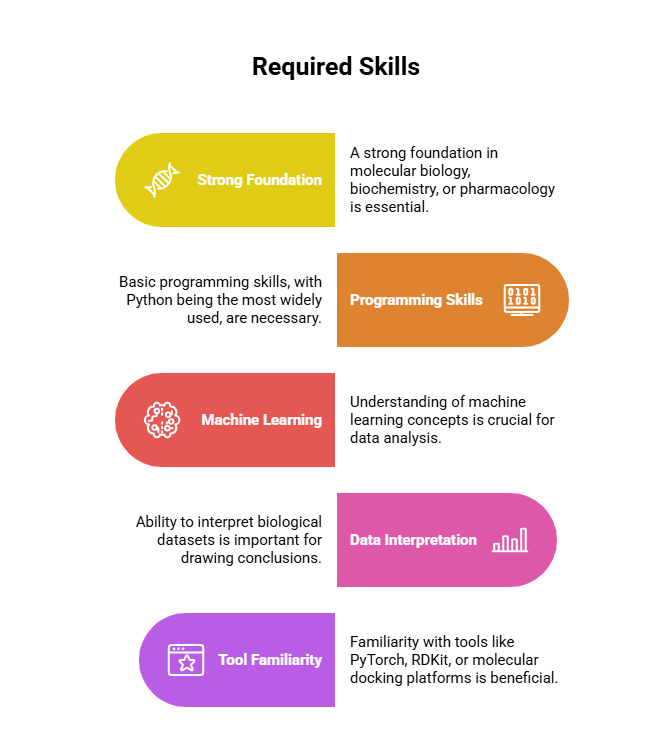
Students from non-computational backgrounds should remember that many companies provide internal training. Plus, collaboration is at the heart of this field — biologists, chemists, data scientists, and AI engineers work together daily.
Career Paths in AI-Integrated Drug Discovery
Opportunities are diverse and growing. Companies need biologists who can think computationally, as well as technologists who can understand biological complexity. Roles You May Consider:
- AI Drug Discovery Scientist
- Computational Chemist
- Machine Learning Researcher (Life Sciences)
- Bioinformatics or Data Science Analyst
- Computational Biologist
- AI-Powered Screening Scientist
- Research Associate in computational workflows
Pharma sector Companies like Biocon, Syngene, Jubilant, and Aragen are now rapidly incorporating AI tools to advance their research capacity further. This change has now introduced job roles that were not present five years ago.
To land roles like AI Drug Discovery Scientist, Computational Chemist, or Bioinformatics Analyst, practical experience is key. Programs like the AI/ML in Drug Discovery & Biopharma – Hands-on Training Program by BioTecNika provide live projects spanning 3 to 12 months, giving you the chance to work on AI-driven Drug Discovery pipelines, Molecular design, and Computational workflows. This extraordinary course is curated for students and professionals eager to develop in-demand AI in Drug Discovery skills while building a portfolio that truly stands out to recruiters.
This has been a golden opportunity for students to build career paths in the new, advancing, cutting-edge science and technology.
AI in Drug Discovery Salary Landscape in 2026
As the demand for interdisciplinary talent grows, salaries in this sector are increasing steadily—especially in AI-first companies and global R&D centers.
| Role | Global Salary (USD/year) | India Salary (INR/year) |
| AI Drug Discovery Scientist | 120,000 – 170,000 | ₹18 – 30 LPA |
| Computational Chemist | 110,000 – 150,000 | ₹10 – 20 LPA |
| Bioinformatics Scientist | 95,000 – 140,000 | ₹6 – 12 LPA |
| ML Engineer (Biotech) | 130,000 – 180,000 | ₹12 – 25 LPA |
| Computational Biologist | 100,000 – 150,000 | ₹10 – 20 LPA |
| Research Associate (Computational) | 55,000 – 85,000 | ₹4 – 7 LPA |
These numbers are rising as companies compete for talent with both biological and computational strengths.
Even though there’s been a lot of progress, it was not free of hurdles. The biological data requires extensive validation; it is often inconsistent, and there are many regulatory guidelines for AI-designed drugs that need to be followed and are still evolving. India, in particular, has significant gaps in specialized training programs, interdisciplinary education, and the infrastructure to support them.
However, these challenges also signal opportunities. Researchers who can bridge biology and AI are becoming incredibly valuable, and companies are investing heavily in training, collaborations, and new technologies.
What You Should Remember
The integration of AI in drug discovery has reshaped the future of pharma and created a space where curiosity, innovation, and interdisciplinary thinking thrive. For life science students and early-career researchers in India, this field offers something rare — the chance to contribute to meaningful scientific breakthroughs while building high-growth career paths.
Whether you’re drawn to startups, pharmaceutical R&D, or computational biology, the coming years will reward those who learn, adapt, and embrace this new era of drug development. AI is not replacing scientists; it is empowering them to explore questions once considered impossible.
If you want to turn your curiosity into real-world impact and master AI in Drug Discovery, consider the upcoming AI/ML in Drug Discovery & Biopharma – Hands-on Training Program with live projects and 100% placement support.
This is your moment to be part of a transformation that could define the next generation of medicine.