





















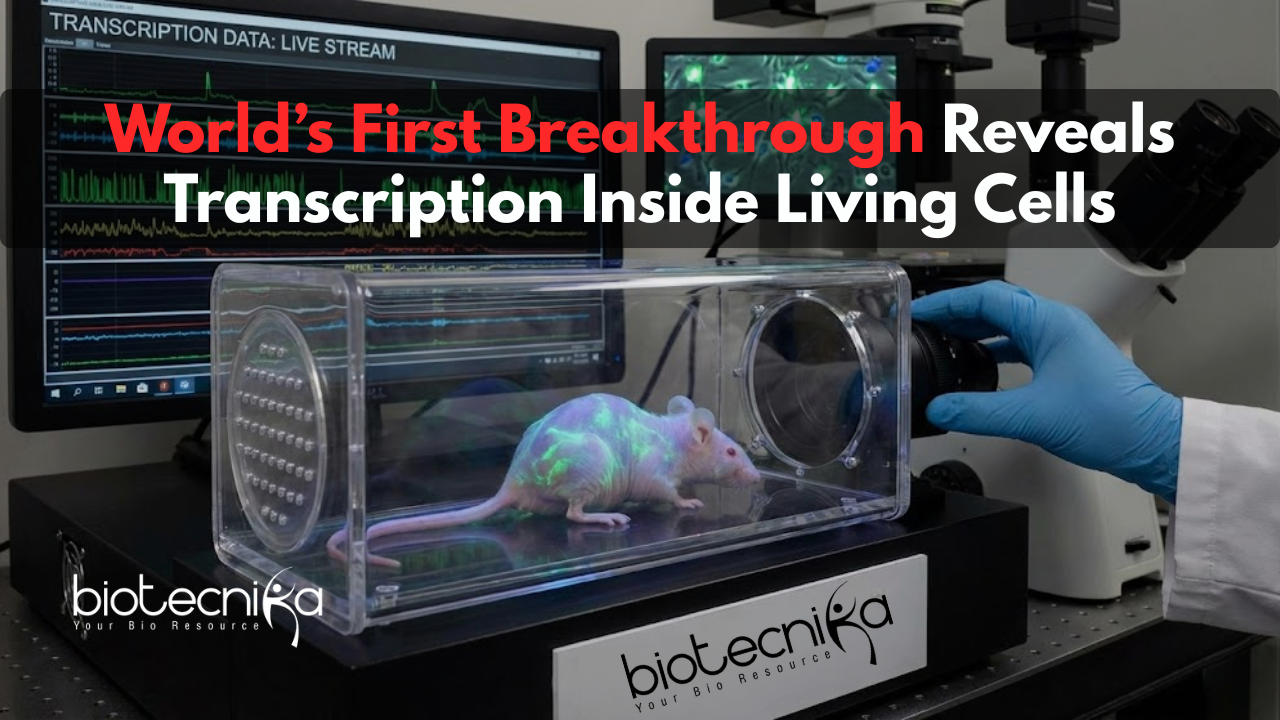
World’s First Breakthrough Reveals Transcription Inside Living Cells
Just imagine if we are able to watch the working of a gene inside a living body, live, not just as a picture but as it’s happening in the body, step by step. This almost impossible-looking idea of how transcription works has been given life by the scientists.
In the recent breakthrough in the scientific community, scientists have developed a mouse that helps scientists to study the process of transcription directly in real time. This research has opened up the possibility of many discoveries and developments in the fields of medicine, biology, and drug discovery.
Why Transcription Is Central to Life:
DNA is considered the fundamental blueprint of life, but you will observe it behaving as a massive data set. These data sets require time to be processed as the cells don’t cover them at once. Rather, they selectively copy only the instructions they need. This process is what we know as transcription. It is the key defining step in producing the proteins that help build and run the body.
At the center of transcription is a molecular machine known as RNA polymerase II. When this enzyme is reading the DNA, a small chemical tag appears on its tail at the site known as Ser2. This site actually works as a flashlight, signaling the scientist that the switch is on and the transcription is ongoing.
Till now, to detect this signal, scientists used to stop the cell altogether in between by chemically fixing them in place. This made it impossible to detect the changes in the transcription at each step inside a living cell.
A Mouse That Makes Gene Activity Glow:
To solve this problem, a research team led by Professor Hiroshi Kimura at the Institute of Science Tokyo took a bold new approach. Instead of stopping cells, they created a way to observe transcription as it happens.
The team used a fluorescent protein known as a “mintbody,” engineered from an antibody that binds only to the Ser2 tag seen during active transcription. They then developed a mouse that expresses this minibody throughout its body.
The result is striking: active transcription appears as glowing dots inside cell nuclei, allowing scientists to watch genes at work inside a living animal for the first time. The findings are published in the Journal of Molecular Biology.
What Researchers Observed:
With the current study, scientists observed thousands of glowing signals in the cell, which represented the active reading of genes. The signal was visible in various tissues, including the liver, brain, and kidney. The effect was similar to how fireflies appear to flicker in the dark, each of which represents the active reading of genes.
It has also been observed that the level of transcription was different in different cell types:
- Immune cells showed the most activity.
- Neutrophils displayed a lower count of activity.
This represents their differentiating roles in the body.
Scientists also discovered that in the actively developing and differentiating cells the transcription rate was rather high compared to the fully matured cells.
In the testes, researchers tracked transcription through multiple stages of sperm formation, observing how gene activity gradually slows and nearly shuts down at later stages.
Why This Breakthrough Matters:
Previously, the transcription studies were all done on cultured cells in the laboratory setting. This new approach has enlightened us toward how the gene activity in the living tissues is far more dynamic and complex than the previously believed concept.
By pairing this mouse with disease models such as cancer or aging, scientists can directly compare transcription in healthy and diseased cells. The approach may also help researchers evaluate how drugs influence gene activity in real time.
“By making transcription visible instead of invisible, this breakthrough brings science closer to understanding life as it truly unfolds—live, dynamic, and constantly in motion.”