















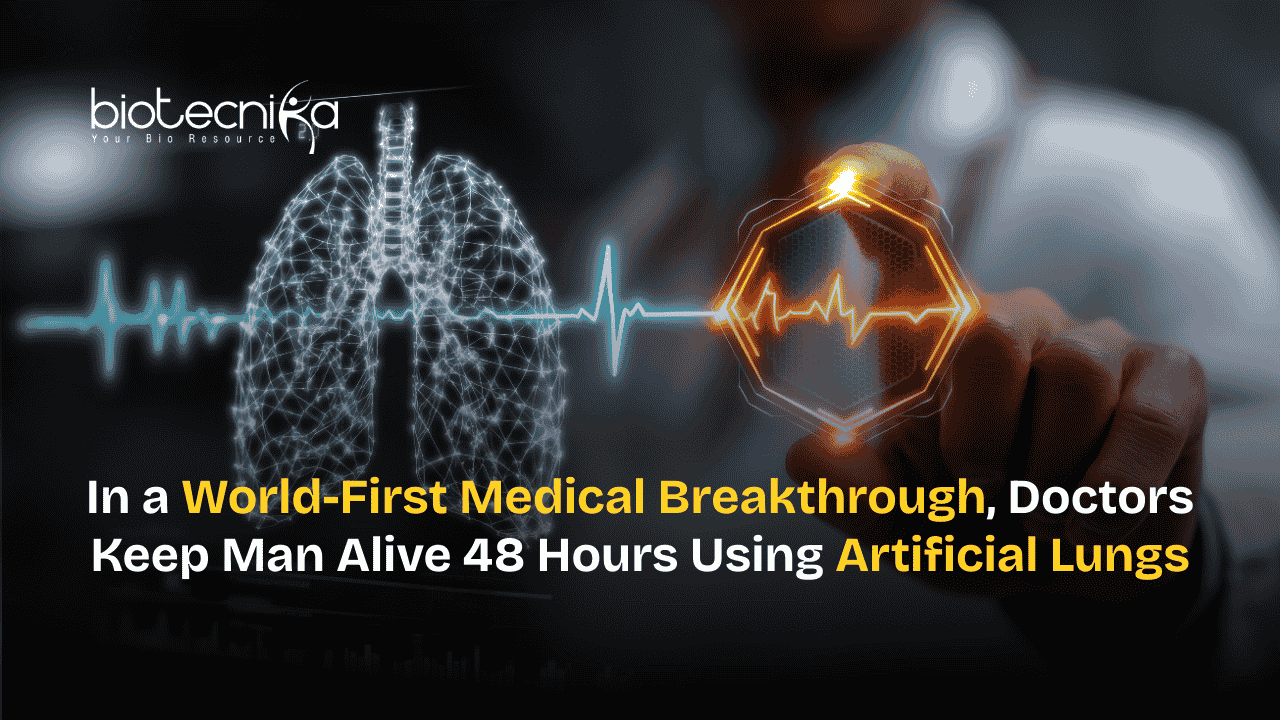
In a World-First Medical Breakthrough, Doctors Keep Man Alive 48 Hours Using Artificial Lungs
It sounds impossible: a person living without lungs. But for two extraordinary days, that is exactly what happened. Doctors at Northwestern University report that a 33-year-old man survived for 48 hours after surgeons removed both of his lungs, a step they took to save his life when a devastating infection left the organs beyond repair. The team relied on advanced artificial lung technology to keep him alive during this critical window.
The man’s illness began in a way that feels all too familiar: the flu. But what followed was anything but routine. The infection rapidly escalated into Acute Respiratory Distress Syndrome (ARDS), a severe condition in which the lungs become flooded with fluid and inflammation, making oxygen exchange nearly impossible.
In his case, bacterial pneumonia compounded the damage. By the time he arrived at the hospital, his condition was critical. His heart stopped, requiring emergency CPR. His kidneys began to fail, and the infection raging inside his lungs was spreading through his bloodstream.
“It was catastrophic,” his surgical team later explained. The lungs were so severely infected they were described as essentially dissolving, and they were fueling widespread organ failure.
The Bold Decision: Removing Both Lungs
Physicians determined that a double lung transplant was his only real chance of survival. However, his body was too unstable to immediately undergo transplant surgery. At the same time, keeping the diseased lungs in place meant the infection would continue to overwhelm him. The solution required bold thinking.
Surgeons made the high-risk decision to remove both infected lungs even though donor organs were not yet available. To sustain him, they deployed a customized artificial lung support system capable of oxygenating the blood, removing carbon dioxide, and maintaining circulation outside the body. This advanced artificial lung setup functioned as a temporary bridge to transplant a strategy rarely attempted in such extreme circumstances.
Remarkably, once the infected organs were removed, the patient’s condition began to stabilize. Freed from the primary source of infection, his blood pressure improved, inflammatory markers declined, and his remaining organs started to recover.
For 48 hours, the artificial lung system performed the essential work his biological lungs once handled.
Transplant Success and Long-Term Recovery
Then, compatible donor lungs became available. Surgeons successfully completed a double lung transplant. More than two years later, the man has returned to his normal life with strong pulmonary function, a recovery doctors say would have been impossible without temporary artificial lung support.
Beyond the remarkable survival story, physicians believe this case could reshape how severe ARDS is managed in the future. Lung transplants have traditionally been reserved for chronic diseases such as cystic fibrosis or interstitial lung disease. In acute cases like ARDS, clinicians often wait, hoping damaged lungs will recover with supportive care.
However, detailed molecular and pathological examination of the removed lungs revealed extensive fibrosis, immune-mediated injury, and irreversible structural damage. In this instance, recovery was biologically unlikely.
Why This Breakthrough Matters for Critical Care
The findings suggest that for carefully selected patients, earlier transplant consideration combined with temporary artificial lung technology could mean the difference between life and death.
For now, only a small number of highly specialized centers have the surgical expertise, perfusion capability, and critical care infrastructure required to attempt such a procedure. The approach remains complex and resource-intensive.
Still, the case challenges long-held assumptions about survival after catastrophic lung failure. It also highlights the rapid evolution of critical care medicine and the expanding potential of next-generation organ support platforms.
Two days without lungs was once unthinkable. Today, thanks to advances in artificial lungs and transplant medicine, it represents a powerful glimpse into the future of life-saving care.