




















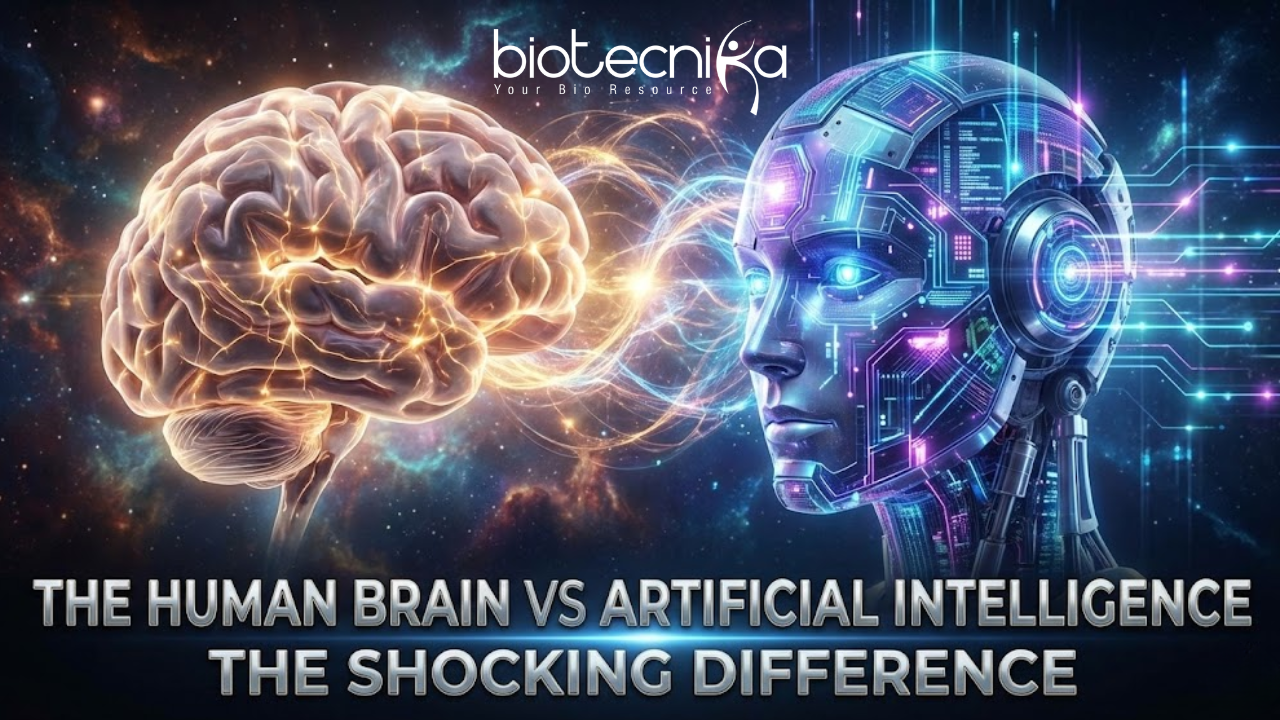
The Human Brain vs Artificial Intelligence: The Shocking Difference
Not very long ago, Artificial Intelligence felt more like a party trick than a partner in thought. Early LLMs (Large Language Models) could be tripped up with clever prompts, nudged into contradictions, or made to confidently state nonsense.
This rapid evolution of Artificial Intelligence marks one of the most dramatic technological shifts of the 21st century. Today, that same class of advanced systems can write software, help draft Research papers, analyse documents in seconds, and even interpret images and audio alongside text. Tools such as Claude, ChatGPT, as well as Gemini have moved from curiosity to utility in just a few short years, marking a dramatic shift in the capabilities of Artificial Intelligence.
Do you even know what changed so dramatically?
The Power of Scale and the Transformer Breakthrough in Artificial Intelligence
The answer is less about a sudden flash of inspiration and more about scale. In 1943, Walter Pitts and Warren McCulloch sketched a Mathematical model of a neuron, a simple unit that takes inputs, weighs them, adds them up, and finally produces an output. On its own, it is almost trivial. But connect enough of these simple units together and, as mathematicians later proved, they can approximate almost any pattern you want to describe.
For ages, that promise remained mostly theoretical. Computers were too slow and datasets too small. Then came the Technical explosion of Computing power. Graphics processing units, first built to render video games, turned out to be perfect for training massive neural networks. At the same time, Researchers developed new and advanced ways of organising these networks.
The biggest innovation came with the “transformer” architecture, which allowed models to attend to different parts of a sentence at once rather than reading words in sequence. This futuristic discovery reshaped the trajectory of Artificial Intelligence Research across the globe.
GPT or Generative Pre-trained Transformer builds on that idea. It learns by predicting the next word in a sentence, over and over again, across vast layers of text. It sounds simple. But at an enormous scale, this simple task forces the model to absorb Grammar, writing style, facts, and even fragments of reasoning embedded in language. What emerges can look strikingly like understanding, one of the most debated outcomes in the rise of AI.
This scaling principle is what propelled modern AI systems into mainstream Research, enterprise applications, and everyday productivity tools.
Artificial Intelligence vs the Human Brain: Similar Numbers, Different Designs
As these advanced systems grow larger, comparisons with the human brain have become inevitable. For example, GPT-3 had 175 billion parameters; newer systems are said to push into the trillions. The human brain contains approximately 100 trillion synapses, a number that is suddenly in the same universe. And yet, the resemblance may be more superficial than it seems.
Most Large Language Models process information in a largely feed-forward way: input goes in, layers transform it, output comes out. Efficient, well-suited, as well as scalable to modern data centres powering AI. The brain, on the other hand, is a dense web of feedback signals and loops. Signals move forward, backward, as well as sideways. Perception is not a one-way street but an ongoing conversation between what we expect and what we see.
For example, read the name “Harry” in a story about wizards, and most people think of Harry Potter. See it in an article about the British royal family, and the mind jumps to Prince Harry. Context does not arrive after perception; it shapes perception from the start.
The Road Ahead: Imitation or Innovation?
Biology achieves this with remarkable efficiency. Neurons fire in brief electrical spikes. If they stay silent, they consume very little energy. Memory and Computation happen in the same place, at the synapse. The entire brain runs on roughly 20 watts, about the power draw of a couple of LED bulbs. By contrast, training and operating large Artificial Intelligence systems can require vast data centres consuming megawatts of electricity and digesting trillions of words, far more text than any human encounters in a lifetime.
This stark efficiency contrast highlights one of the biggest engineering challenges facing AI today: how to replicate intelligence without replicating Biology’s energy demands.
Researchers are now trying to narrow that gap. New architectures activate only specialised parts of a network for a given task, echoing the brain’s modular organisation. Experimental “neuromorphic” chips attempt to mimic spike-based signalling to cut energy use. But these are still approximations. Artificial neurons remain simplified Mathematical constructs; Biological neurons are living, Chemical systems of extraordinary complexity.
Where this path leads is still uncertain. Machines are not bound by the evolutionary constraints that shaped our brains. They could eventually rival, or even surpass, Biological intelligence in certain domains. Or they may diverge entirely, developing forms of intelligence that look nothing like our own.
The future of AI will likely depend not on imitation, but on radical innovation, building systems that complement human cognition rather than copy it. After all, a pacemaker supports the heart without resembling heart tissue. Perhaps Artificial Intelligence will do something similar for the mind, extending and augmenting human thought without ever truly replicating it. In the end, the real question may not be whether machines think like us, but whether they can help us think better.