
















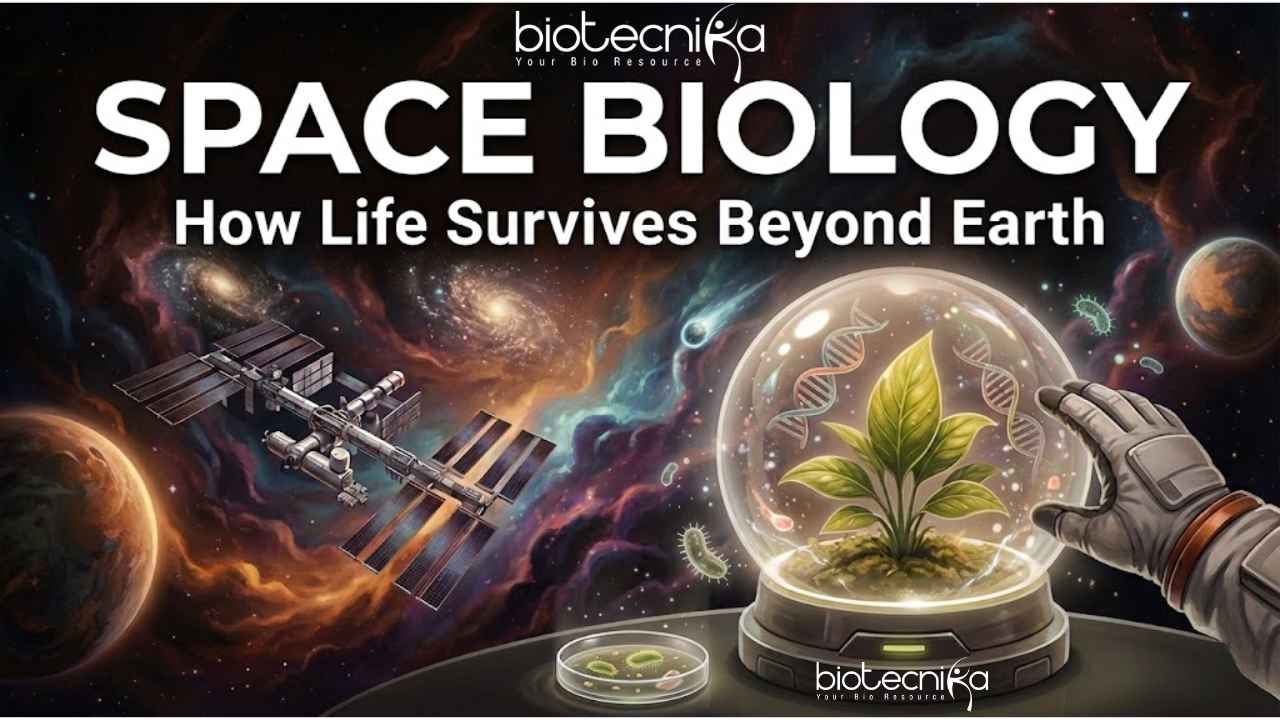
Space Biology: How Life Survives Beyond Earth
Space Biology reveals how life bends, adapts, and survives far beyond Earth’s comfort zone.
Visualize yourself standing on a frozen Antarctic lake, and it’s pitch dark, endlessly, and a robotic probe slips silently below the ice.
Thousands and thousands of miles away, deep inside a pitch-black, toxic cave, Scientists and Researchers study the microorganisms thriving there, where humans cannot even survive. There’s no sunlight, no oxygen, no safety, no mercy; yet life persists and is thriving.
These extreme worlds are not Science fiction; they are rehearsal stages for the Universe’s greatest mystery: how does life survive beyond Earth? From ice-covered moons to alien oceans, the Cosmos may host organisms as resilient, cunning, and strange as the extremophiles we study on our planet.
The story of life is no longer limited to Earth’s boundaries. In today’s world, Astrobiology and Space Biology reveal that life is not fragile; it is endlessly adaptive and inventive.
The question is no longer whether life exists elsewhere, but how it endures the unimaginable.
The journey from icy lakes and toxic caves to distant cosmic worlds in our solar system and beyond will challenge everything you ever thought you understood about Biology, sheer tenacity, as well as survival of life and beyond.
From Sci-Fi to Survival Life Sciences
For decades, the search for extraterrestrial lifeforms belonged to just blockbuster movies. Today, it is anchored in Space stations, Research laboratories, and extreme environments on our planet.
Astrobiology explores the origins, evolution, and distribution of lifeforms in the Universe. Whereas Space Biology asks an important question: how does life actually function when Earth’s protective shield ceases to exist?
Do you know? In space, radiation intensifies, gravity weakens, and familiar cycles of day & night disappear. The cells face great forces they never evolved to handle. Yet, instead of failing, life adapts and evolves.
This magical shift, from asking if life exists elsewhere to understanding how it actually and Scientifically survives, marks a profound evolution and advancement in Science.
Biology in Space
Earth enforces the Biological Sciences order silently. Gravity guides our blood flow, influences cellular organization, as well as shapes bones.
Our atmosphere shields DNA from cosmic radiation. Remove these protections, and Biology must negotiate survival in unfamiliar terrain.
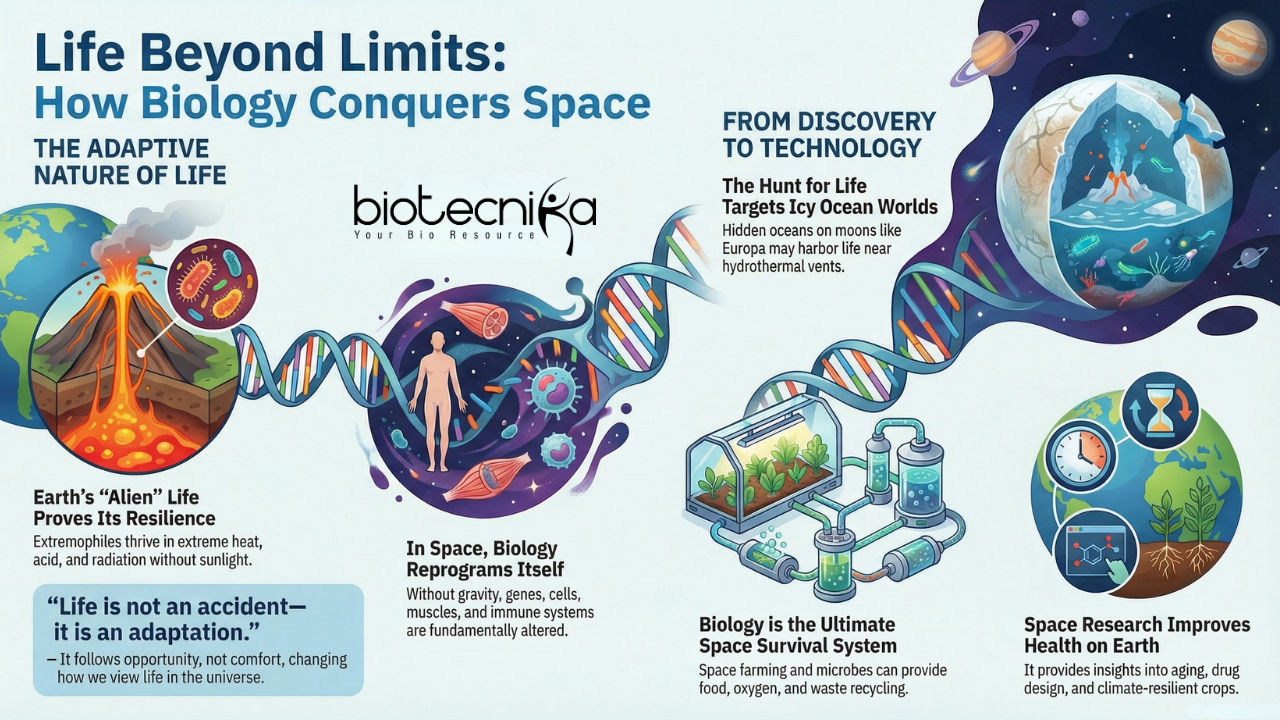
Research experiments in the International Space Station have revealed remarkable transformations in living systems, such as:
- Genes switch on or off unexpectedly
- Bones and muscles deteriorate without mechanical load
- Microbes grow differently, sometimes becoming more resilient
- Cells reorganize their internal structures
- Immune responses weaken or behave unpredictably
These changes are not failures; they demonstrate Biological plasticity. It implies that life is not rigid; it is ingeniously adaptable.
Extremophiles: Earth’s Proof That Life Can Endure Anything
If Space Biology teaches us one lesson, it is this: comfort is not required for life.
On our planet Earth, ‘Extremophiles’ flourish in environments once thought uninhabitable, deep-sea vents, frozen glaciers, radiation-soaked zones, as well as acidic caves. Some of these survive without even oxygen, while others thrive without sunlight. Some even endure vacuum-like conditions for years together.
These organisms are the living blueprints for Life Beyond Earth. They prove that Biology can run on Chemistry alone, powered by pressure, molecular reactions, or heat instead of sunlight.
If life can thrive in these extremes, it is plausible elsewhere in the Cosmos and beyond.
Ocean Worlds and the New Map of Habitability
Space Biology has expanded the concept of a “habitable world.” Scientists are now in search of life not only on Earth-like planets but also on icy moons with hidden oceans. Beneath Europa and Enceladus’ thick ice lies a vast, salty ocean, warmed by internal energy and hydrothermal vents, environments reminiscent of early Earth.
Key factors that make these ocean worlds promising are:
- Chemical energy replaces sunlight
- Organic molecules have been detected
- Liquid water exists beneath the ice
Life in these oceans might not resemble plants or animals but could thrive as microbial ecosystems powered purely by chemistry. Space Biology equips us to imagine, detect, and interpret these alien forms of life.
Space Biotechnology: Engineering Survival Beyond Earth
Understanding life in Space is only part of the story. Space biotechnology transforms Biology into an infrastructure to support human survival beyond Earth.
Long-duration missions cannot rely on Earth for resupply. Instead, life itself must become part of the system.
|
Biological System |
Purpose |
|
Space Agriculture |
Produces food, oxygen, and Psychological support |
|
Microbial systems |
Recycle waste and regenerate nutrients |
| Bioregenerative Life Support Systems (BLSS) |
Enable closed-loop survival without Earth resupply |
| Protein crystallization |
Improves Drug Development on Earth |
In Space, Biology is not just studied; it is engineered to sustain life.
Why Space Biology Matters on Earth
The lessons of Biology in Space extend far beyond Space missions.
- Muscle and bone studies inform treatments for aging and osteoporosis
- Microgravity-grown protein crystals accelerate Drug Discovery
- Immune response studies deepen understanding of stress-related diseases
- Research on plant growth aids climate-resilient Agriculture
The Universe becomes a Research laboratory, and Earth receives the extraordinary rewards.
Are We Alone, or Just Early?
Life appeared on Earth remarkably quickly, suggesting that it may emerge wherever conditions allow growth.
Space Biology reframes the question: it doesn’t just ask why we haven’t found life yet, but how life endures once it begins.
The answer is clear: life is remarkably persistent, tenacious, as well as opportunistic. Simple life can be common, while intelligent life could be a rarity. Either way, Biology demonstrates that life is not fragile; it thrives wherever it can and evolves.
The Future Of Space Biology
In the coming years, missions will drill alien ice, test permanent human habitats, as well as sample distant atmospheres beyond Earth.
Space Biology, Astrobiology, and Space Biotechnology will guide every step in the future.
For Life Sciences students and aspiring Scientists, this field is where curiosity meets purpose. This is the field where Biology, Engineering, and exploration converge. Careers in these areas will shape humanity’s journey into the Cosmos.
From toxic caves to orbiting laboratories, from resilient microorganisms to engineered ecosystems, Biology continues to adapt in ways that challenge imagination. As we explore Life Beyond Earth, we also discover that life on Earth is not an exception, but part of a vast, enduring cosmic story.
Space Biology and Space Biotechnology are more than Scientific disciplines; they are humanity’s passport to the Cosmos. They teach us that life does not need perfection; it needs opportunity, adaptability, and ingenuity. Every discovery, every experiment, every microscopic organism surviving the impossible brings us closer to understanding Life Beyond Earth and our place in the Universe.
For students, young Scientists, and dreamers, the message is clear: the frontier of life is vast, the opportunities endless, and the adventure just beginning. Wherever conditions allow, even briefly, life finds a way. And while exploring the Cosmos, we can discover not just alien worlds but also the extraordinary potential of life itself.
FAQs: Space Biology & Life Beyond Earth
-
What is Space Biology?
The study of how living organisms survive and adapt in Space conditions like microgravity and radiation.
-
How is it different from Astrobiology?
Astrobiology searches for life beyond Earth; Space Biology studies how known life behaves in Space.
-
Why is Biology in Space essential for humans?
It helps design life support systems, grow food, recycle resources, and protect astronaut health.
-
What is Space Biotechnology?
The application of Biological systems to support human survival, including Sustainable Ecosystems and Drug Research.
-
Could life exist on other planets?
Yes. Extremophiles on Earth show life can survive harsh conditions, suggesting alien life is possible wherever water and energy exist.