









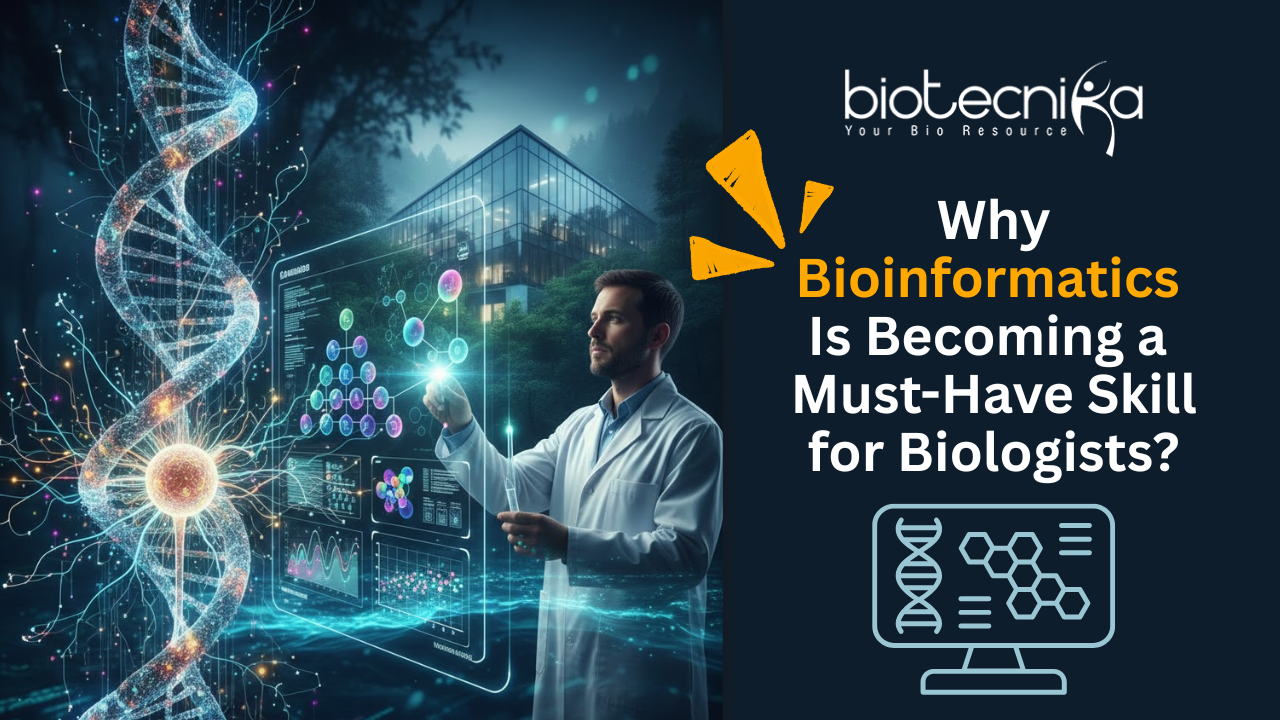
Why Bioinformatics Is Becoming a Must-Have Skill for Biologists
Biology and Life Sciences are standing at an exceptional turning point. Now, some of the most important innovations are emerging not just from microscopes, fermenters, or wet laboratories. But they’re also emerging from Datasets, the ever-growing, enormous, and complex Biological data. Various challenges, such as designing drugs, sequencing Genomes, predicting cell behavior, tracking infections, and understanding Biological ecosystems, each depend on Computational analyses and interpretation. Hence, Bioinformatics and Computational Biology have shifted from a niche interest to a non-negotiable skillset for today’s Biologists and Scientists.
This advanced transformation in the current industrial scenario represents a more profound shift in how Biology careers grow, how global challenges are solved, and how Science and Technology work in practice.
Biologists and Scientists who embrace this revolutionary change with open arms are stepping into a future filled with scientific innovation, opportunity, and impact for better days ahead.
Biology Has Become a Data-Driven Science
Earlier, Biologists and Researchers used to work with small Biological datasets, a few proteins, or a few genes, and got a handful of results and analyses.
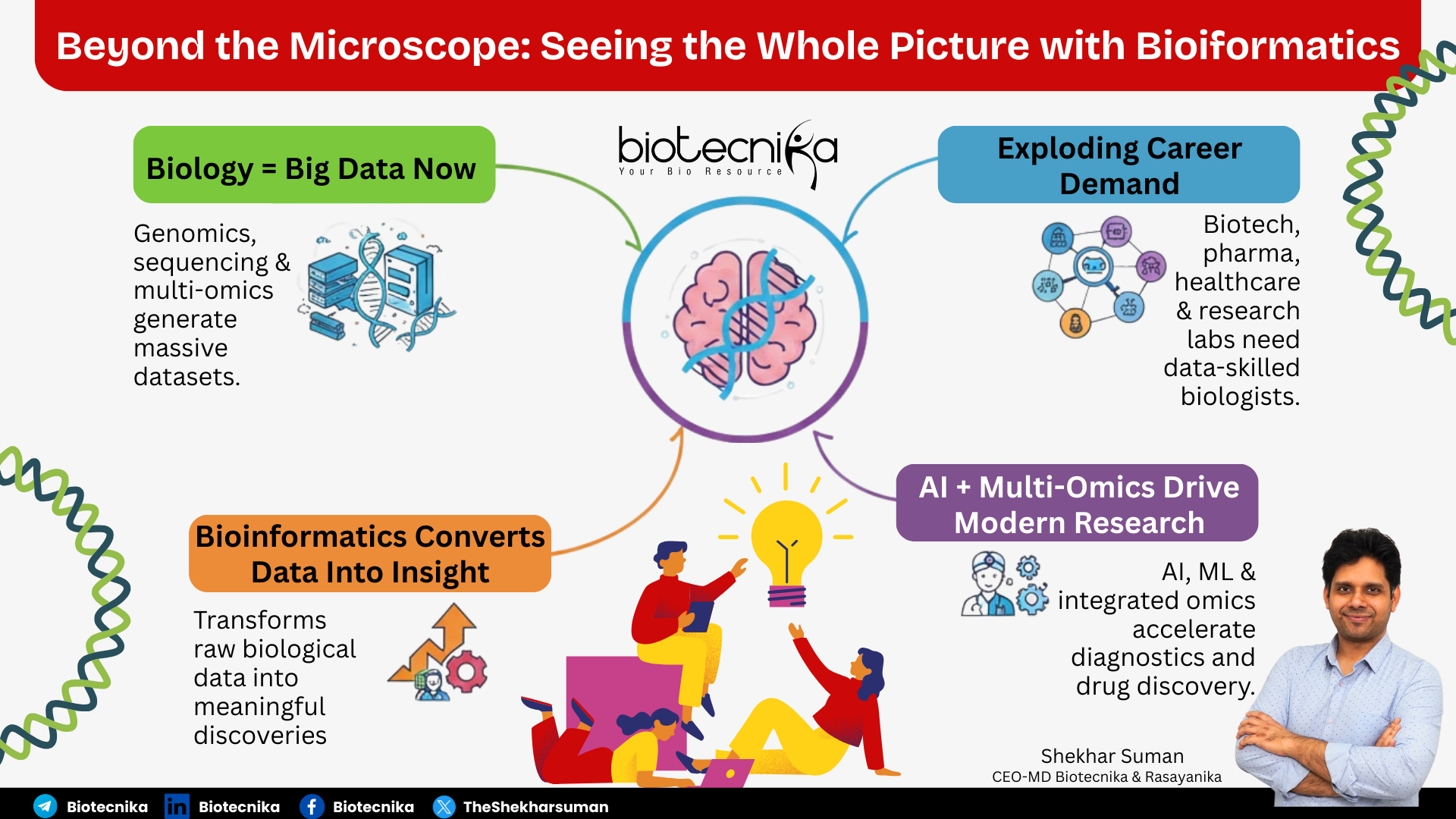
But today, with technological advancements, a single tiny experiment or specimen can generate millions and millions of data points across multiple layers. These layers could be Transcriptomics, Genomics, Metabolomics, Proteomics, or Imaging.
Advanced and futuristic Technologies have shaped and turned Biology into a constant stream of Biological blends with Digital information, which includes:
- High-throughput screening
- NGS (Next-Generation Sequencing)
- Single-cell analysis
- Spatial omics
- Cryo-electron microscopy
This transformative shift has built a new reality in today’s world. Now, if you can’t analyze or understand the data you generate while researching, you can’t fully understand the Biology you study and know about.
Bioinformatics is what revolutionizes this vast amount of raw Biological information into clear insights. It helps us gain an understanding of the Research and identify which metabolic pathways shift, which genes or proteins matter, which organisms shape an environment, and which mutations drive diseases and disorders.
Bioinformatics Is at the Center Where Biology Meets Innovations
Every scientific advancement in modern Life Sciences now depends on Computational analysis of biological data. The areas where Bioinformatics is most needed and helpful are:
Infectious Disease Surveillance
From mapping Antibiotic resistance to tracking SARS-CoV-2 (COVID-19) variants, Bioinformatics aids in detecting Biological threats early and prepares to respond intelligently when faced with such situations. It has become a central pillar of global Healthcare.
Precision & Personalized Medicines
Whether it’s rare-disease diagnoses or cancer therapy selection, Healthcare professionals and Clinicians are now using bioinformatics and Genomics to customize treatments, identify potential mutations, and predict drug responses. Without Bioinformatics or Computational tools, Personalized Medicine wouldn’t even exist.
AI & ML (Artificial Intelligence & Machine Learning) in Biology
Artificial Intelligence, Machine Learning, and Big Data are no longer technologies of the future. But it is now widely utilized by Biologists for discovering drug targets, actively predicting molecular structures (for example, AlphaFold), accelerating Research, and classifying cells. Understanding how these models work begins with understanding the data behind them. Computational Biology is the engine running modern Scientific discovery.
Multi-Omics & Systems Biology
Today’s Researchers and Biologists don’t study genes in isolation. They study networks: how RNA, DNA, metabolites, proteins, and microbes interact with organisms or the environment. Bioinformatics and Computational Biology make these complex relationships meaningful and provide detailed insights.
Why Biologists Need Bioinformatics Skillsets?
There was a time when Biologists depended entirely on the rare Bioinformatics professional. Today’s Biological Research environment is interdisciplinary, fast-paced, and competitive. Today, Biologists thrive who can move fluidly between the lab. Here’s why:
- Rapid Results: No more waiting for weeks or months or for someone to analyze your Biological data. With foundational Bioinformatics skills, Biological Research moves faster with enhanced accuracy, thereby increasing your impact.
- Smarter Experimental Design: When you understand how data will be analyzed, you design experiments that are cleaner, more efficient, and more statistically sound.
- Future-Proof Expertise: CRISPR screens, spatial omics, microbiome analytics, and large-scale imaging all rely on Computational interpretation. Bioinformatics is the foundation of tomorrow’s Biology.
- Higher Employability in Every Sector: Pharma, Biotechnology, hospitals, agriculture, environmental Science, Diagnostics, and even space Biology now demand hybrid talent. A biologist with coding skills stands out instantly.
- Stronger Collaboration and Leadership: Teams today expect Biologists to communicate across disciplines. Being “bilingual” in wet-lab and Computational Science makes you essential.
Bioinformatics doesn’t replace Biologists. It empowers them to understand life at a deeper, more complete level.
The Global Demand for Bioinformatics Skillsets
Across your reference articles, one theme was loud and clear: the world needs far more Bioinformatics-skilled professionals than it currently has.
Research institutes, Biotechnology companies, Clinical laboratories, and Health organizations are all struggling to hire enough people who can handle:
- Data cleaning and visualization
- Programming in Python or R
- NGS analysis
- Clinical variant interpretation
- Multi-omics workflows
- Machine learning for biological datasets
- Genome annotation
- Cloud computing
This demand is only increasing as technologies advance and global challenges grow more complex. For Biologists, this is not a threat; it is a massive opportunity.
The Future Belongs to Hybrid Biologists
Biology’s future will be shaped by professionals who can generate data, interpret it, as well as analyse it. Professionals who can understand both algorithms and experiments will be highly valued. Professionals who are ready to grow, curious, as well as adaptable will thrive immensely in the future. These are the Biologists who will solve the world’s biggest Scientific challenges, lead futuristic discoveries, and shape innovations.
If you’re a student, Researcher, or professional wondering whether to learn Bioinformatics, the answer is this article.
Because in the new age of Biology, Bioinformatics isn’t just an added advantage or additional skill set; it’s the key to understanding life itself. Yes. Start now. Your future self will thank you.
Key Takeaways
- Biology has become data-heavy, and Bioinformatics is now essential for interpreting massive Genomic, Proteomic, and Clinical datasets.
- Bioinformatics connects experiments to real insights, helping Biologists validate results, design better studies, and speed up discoveries.
- AI, multi-omics, and advanced analytics are shaping the future of Research, and Biologists with Computational skills have a significant advantage.
- Industry demand is booming across Biotechnology, Pharmaceuticals, Healthcare, Diagnostics, and Research laboratories.
- Even basic Bioinformatics skills boost careers, making Biologists more independent, collaborative, and future-ready.
Top 5 FAQs
- Why should Biologists learn Bioinformatics?
-> Because modern Biology runs on data, and analyzing that data is essential for meaningful Research and innovation.
- Do I need coding to get started?
-> Not immediately. You can begin with user-friendly tools and slowly learn Python or R as you progress.
- What careers open up with Bioinformatics skills?
-> Roles in Genomics, Drug Discovery, Diagnostics, Computational Biology, Biomedical Data Science, and more.
- Is Bioinformatics difficult to learn?
-> It’s manageable with structured learning. Starting small, using real datasets and guided tools, makes the journey easier.
- Will Bioinformatics remain relevant in the future?
-> Absolutely. As AI-driven Biology and multi-omics continue to expand, Bioinformatics will remain one of the most in-demand skills in the Life Sciences.