





















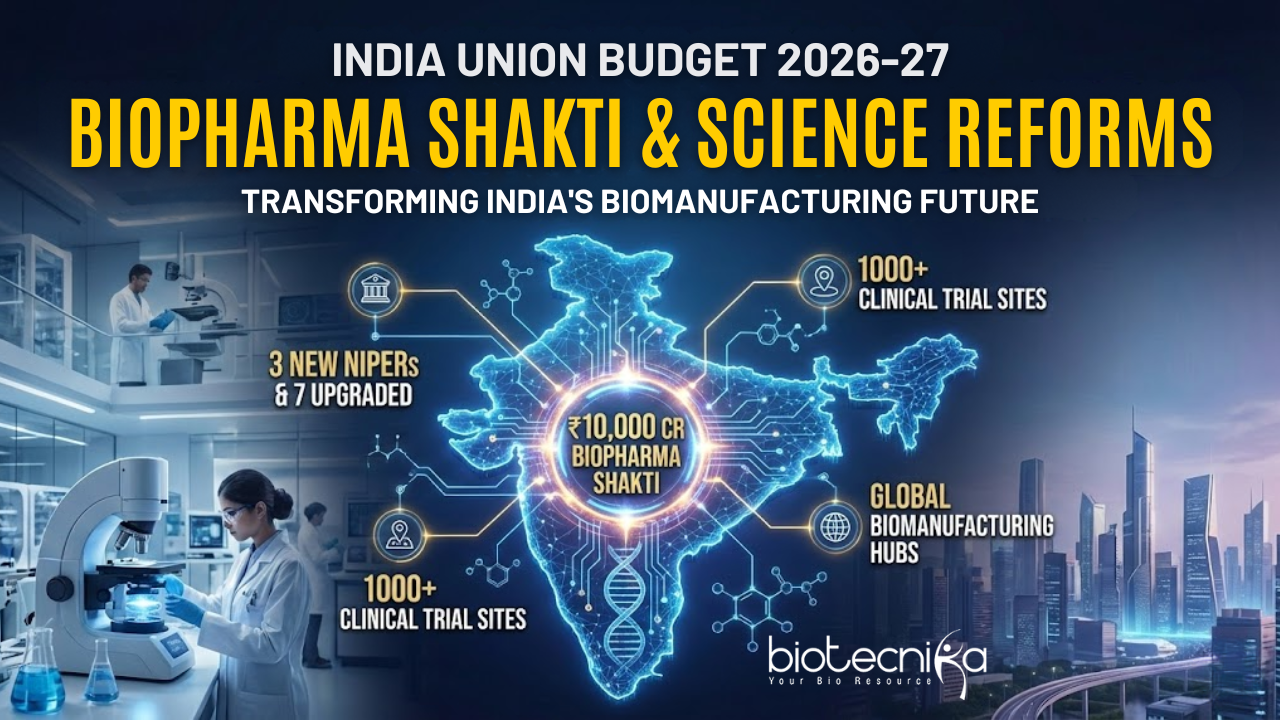
India Union Budget 2026–27: Biopharma Shakti and Science Reforms Set to Transform India’s Biomanufacturing Future
“This Budget lays the foundation for India’s role in the next industrial revolution,” said Union Minister Dr. Jitendra Singh, at the India Union Budget 2026–27.
The India Union Budget 2026–27 includes Science and Technology-led initiatives to strengthen India’s strategic position in the global industrial and innovation landscape.
This incredible initiative reflects a strategic approach to expand advanced Biopharma manufacturing. This would eventually position India as a competitive force in high-tech sectors worldwide, with the main goal of making India a global Biomanufacturing hub, as stated by the Union Minister.
The Minister emphasized that the Union Budget of 2026-27 showcases a coordinated approach that connects Research, deployment, and manufacturing in India.
With targeted, strategic investments in Nuclear Energy, Geospatial Systems, Mega-Science Infrastructure, and clean Technologies, these initiatives signal a deliberate shift in India’s industrial strategy.
The thoughtful strategy promises to quietly revolutionize how India innovates, competes, and produces on the global stage and eventually lead the world.
Union Budget 2026–27: ₹10,000-Crore Biopharma Shakti to Expand India’s Bioeconomy
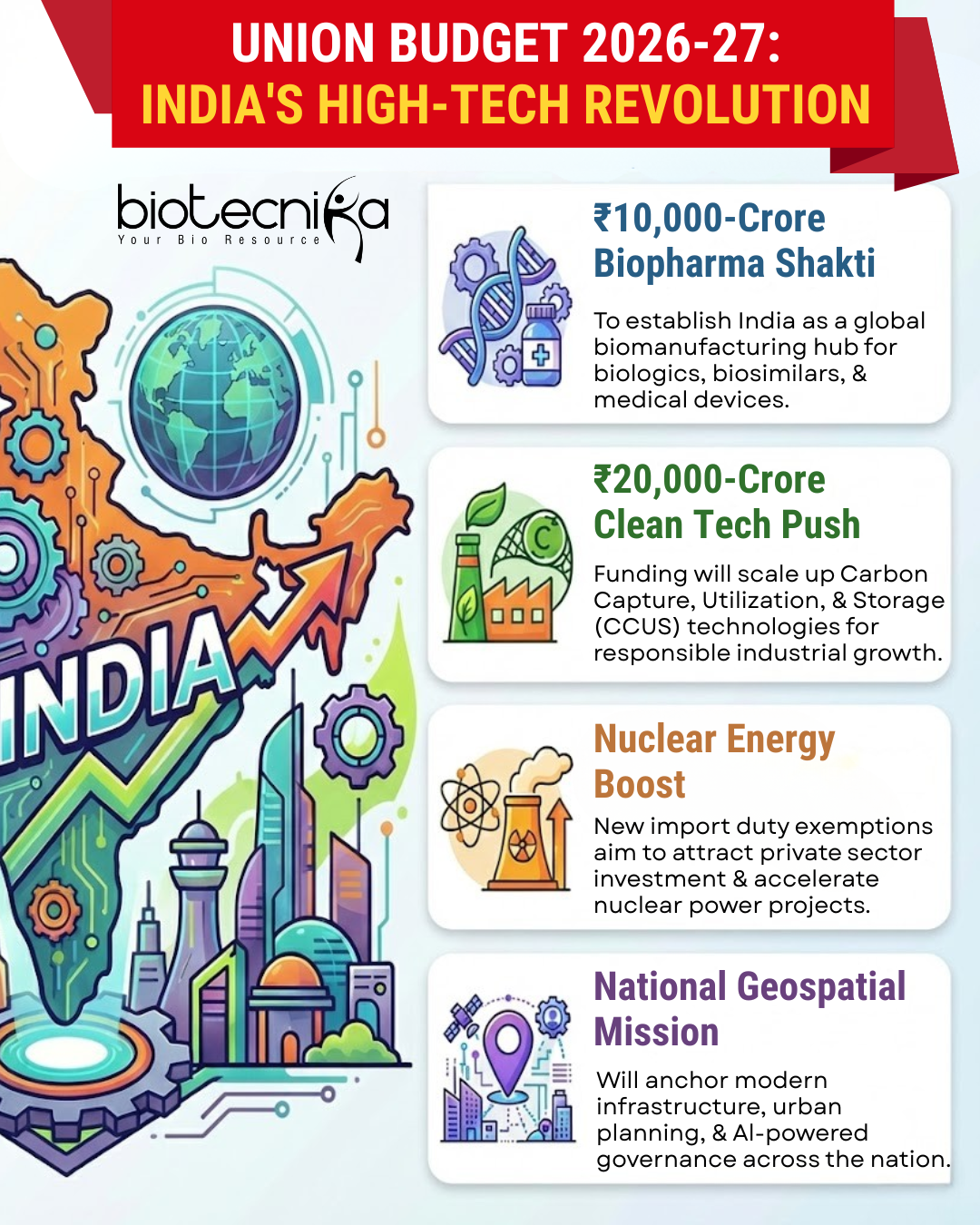
The Union Minister of State for Science and Technology, Dr. Jitendra Singh, stated that Biopharma Shakti, with an allocation of ₹10,000 crore, marks a decisive step in expanding India’s Bioeconomy beyond conventional Pharmaceutical products.
This futuristic and strategic initiative in the India Union Budget 2026–27 aims to accelerate the development and Manufacturing of advanced Biologics, Medical Devices, as well as Biosimilars, covering both Medical devices and Drugs within a unified framework.
Explaining the significance of this incredible move, Dr. Singh stated that the emphasis on cost-effective and indigenously developed Technologies would enable India to move up the global value chain while preserving affordability.
He highlighted that the initiative is designed to scale manufacturing and innovation simultaneously, strengthening India’s position as a competitive and reliable Biopharma manufacturing destination.
Strengthening Gains Under the National Biopharma Mission
Dr. Singh stated that Biopharma Shakti builds on the ongoing work under the DBT (Department of Biotechnology) National Biopharma Mission. The Mission has supported indigenous diagnostics, Biologics, vaccine development, as well as Biosimilars by creating a network of Technology transfer offices, Clinical Trial sites, and manufacturing facilities.
He emphasized that our country already ranks among the top 3 in the Asia-Pacific region and the top 10 Bioeconomies globally. Biopharma Shakti will help consolidate this standing by scaling innovation, value addition, as well as manufacturing capacity together. He further added that this futuristic initiative’s focus on efficient resource use aligns the Biopharma push with circular economy principles.
India Union Budget 2026–27 Boosts Mega-Science Infrastructure with New Telescope Projects
Dr. Singh also highlighted the Budget’s emphasis on strengthening India’s Scientific infrastructure. He highlighted the Yuva Shakti-driven Budget to set up or upgrade four major telescope facilities in India. These are the National Large Solar Telescope, Cosmos-2 Planetarium, National Large Optical Infrared Telescope, and the Himalayan Chandra Telescope.
These advanced and futuristic facilities will enhance India’s capabilities in Astronomy and Space Sciences, while nurturing future Scientific talent and supporting advanced Research ecosystems.
₹20,000 crore For Nuclear Energy Reforms and Clean Technology Support
Addressing the Nuclear sector, the Union Minister stated that the India Union Budget provides customs duty exemptions on imports of equipment and components required for nuclear power plants.
He emphasized that these measures align with reforms under the SHANTI Act, which envisions expanding private-sector participation in Nuclear Energy. Access to globally competitive Technologies, he said, is essential to improve efficiency and accelerate capacity creation.
Addressing Clean Technologies, the Minister stated that ₹20,000 crore has been allocated over five years for CCUS (Carbon Capture, Utilisation and Storage). He said the funding would support improvements in technology readiness levels and the scaling up of carbon capture projects, with Biotechnology-enabled carbon utilisation pathways becoming increasingly relevant.
National Geospatial Mission for Planning and Governance
Dr. Singh stated the National Geospatial Mission as a foundational reform with cross-sectoral impact, while addressing Digital and infrastructure planning. It will be implemented through the PM Gati Shakti platform, and the Mission will develop core Geospatial datasets and infrastructure to support urban planning, infrastructure project design, as well as land record modernisation. He further added that reliable Geospatial data would also help integrate AI (Artificial Intelligence) into governance and Infrastructure planning.
India Union Budget 2026–27 Signals Mission-Oriented, Technology-Led Growth
Dr. Jitendra Singh emphasized that the Science-linked measures in the India Union Budget 2026–27 reflect a strategic and advanced shift towards mission-oriented policymaking, where deployment, Research, and manufacturing advance together and aid India’s Technological growth.
This India Union Budget 2026–27 and combined focus on Biopharma, Geospatial systems, Clean Energy, mega-Science infrastructure, as well as nuclear Technology. This strongly showcases India’s strategic readiness to compete in Technology-intensive sectors that will shape global growth in the coming years.
Altogether, these futuristic and advancing initiatives reflect a deliberate national shift from steady advancement and leadership in Science and Technology.