





















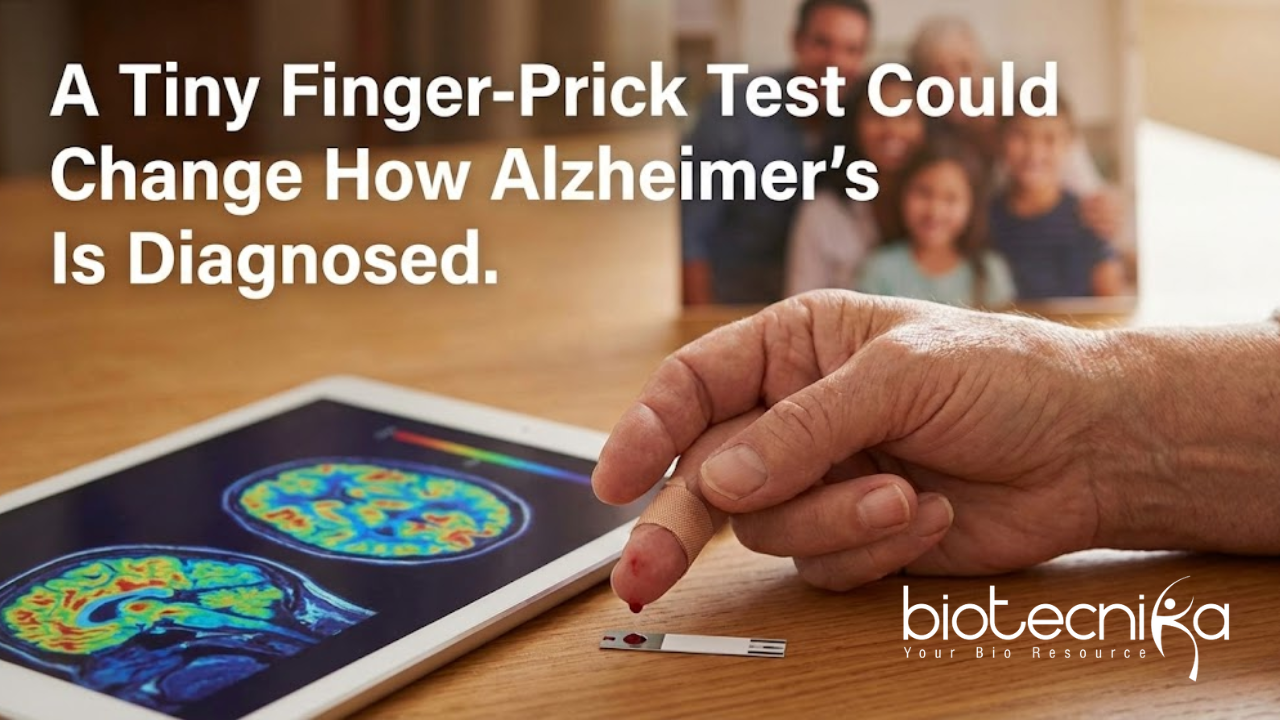
A Tiny Finger-Prick Test Could Change How Alzheimer’s Is Diagnosed
Alzheimer’s, which is one of the most common brain disorders and also the most alarming age-related disease, is supposedly going to be diagnosed with just a small finger-prick test. Alzheimer’s, which used to require expensive tests and scans, can be easily spotted without any complicated procedures.
The current study, ongoing in the UK, the US, and Canada, is examining how a simple blood test can help identify biological markers related to Alzheimer’s. This will lead to a more accurate diagnosis, which will ultimately help thousands of people.
A Simple Test for a Complex Disease:
This research has a personal connection to Dr. Michael Sandberg, a London GP who’s a part of this study. Dr. Michael Sandberg has already seen his mother, who was a patient of Alzheimer’s, slowly lose her memories and her freedom to this disease. It was an experience that stayed with him long after her diagnosis. He didn’t hesitate for a second when he was first approached to join this study.
He commented that he believes that knowledge is power, and if with this study, he can help people to avoid what his family has to go through, then it’s worth doing.”
Dr. Sandberg underwent both the standard brain scan and the experimental finger-prick test. Once the result came back negative, he further described his huge sense of relief mixed with the hope that this research would help a lot of people in the future.
Why Early Detection of Alzheimer’s Matters:
This study is being conducted by the medical research charity Life Arc alongside the global alzheimer’s Platform Foundation, which is being supported by the uk dementia research institute. The study is named Bio-Hermes-002. The scientists are working on locating the biomarkers, or, to say, specific proteins, which are associated with alzheimer.
Currently, what we know is that proteins such as amyloid and tau are the ones that start their deposition in the brain more than 10 years before their symptoms, like memory loss or confusion, start to appear. The goal has always been to find an easy way to detect those changes early on.
Currently, the study still requires diagnosis through PET scans or lumbar punctures and many more expensive and time-consuming procedures. Which is why only a small percentage of patients are able to utilize it. Patients have to wait for many years to get a diagnosis.
The experts have determined that the delay in treatment for Alzheimer’s can lead to severe results, especially as the new treatments are emerging. Early detection will allow patients to determine and access their care early on and help to plan ahead and take part in clinical trials.
Hope, With Caution:
Till now, 883 volunteers have joined the study out of the planned 1000 volunteers. This number includes your patients with zero symptoms, mild cognitive issues, and a few early staged alzheimer. This trial is also looking to make an effort to include volunteers from the underprivileged classes and communities to join the study. The expected date to finish this study has been determined to be in 2028.
Scientists stress that it’s too early to draw firm conclusions. All the data still needs to be analyzed. But if the results are positive, a simple finger-prick test, potentially even done at home, could transform how alzheimer is detected, offering hope to millions of families facing the disease.