











Drug Discovery Meets AI as Takeda Unveils a $1.7 Billion High-Stakes Partnership
Drug Discovery has always been a race against time, with years of trial and error standing between a Scientific innovation and a drug that actually reaches patients worldwide. That reality is beginning to shift, not by replacing Researchers, but by equipping them with smarter, faster tools and Technologies.
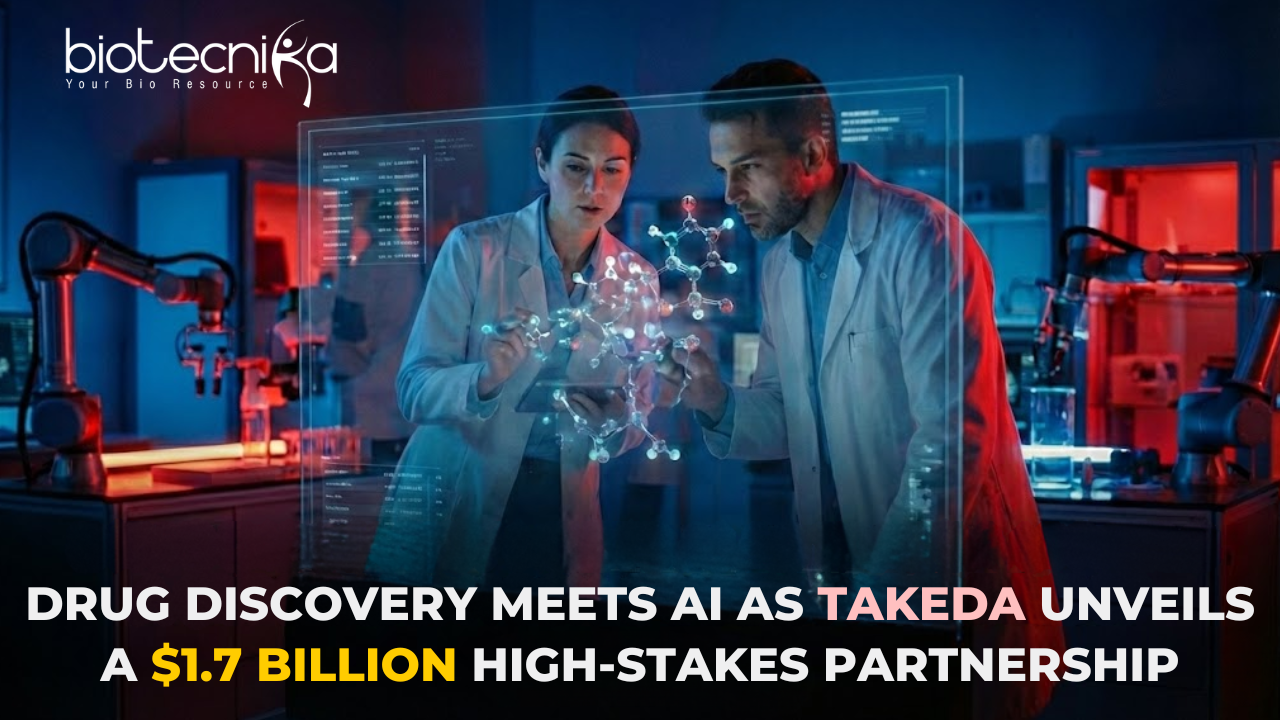
Takeda Pharmaceutical’s newly announced partnership with San Diego–based “Iambic Therapeutics” reflects that shift. The multi-year Technology and Drug Discovery partnership brings AI (Artificial Intelligence) and automated laboratory Science directly into small-molecule drug development. The primary focus for now is on Inflammatory and Gastrointestinal Diseases and Cancer. The collaboration signals how AI-driven platforms are being integrated into early Drug Discovery workflows to shorten timelines and improve decision-making.
It is valued at more than $1.7 billion in potential payments, the agreement showcases the growing confidence major Pharmaceutical companies are placing in AI-driven Research and Discovery.
Under the partnership, Takeda will apply Iambic’s AI-based platforms to advance a group of high-priority small-molecule programs. Takeda’s broader research vision spans Vaccines, Plasma-derived Therapies, Neuroscience, and Rare Diseases.
Iambic’s Chief Corporate Development Officer and CFO, Michael Secora, in comments to GEN, stated that “Iambic has shown success in cancer and other domains and believes that our computational and experimental approaches are widely applicable across therapeutic domains and even therapeutic modality.”
Applying AI Models to Early Drug Discovery and Pharma R&D
As part of the official agreement, Takeda will gain access to Iambic Therapeutics‘ wet-lab capabilities and AI Technologies, such as “Enchant,” to develop and design small-molecule drugs.
Enchant is a multimodal transformer model trained on dozens of data types across Drug Discovery and Development. It is designed to support Clinical & Preclinical endpoint prediction by providing Clinical datasets with laboratory-generated data. The primary goal is to predict human Pharmacokinetics and other critical Clinical properties from the earliest stages of Drug Discovery, improving candidate selection before costly late-stage development.
Iambic Therapeutics expanded these Technical capabilities earlier with “Enchant v2,” an upgraded version engineered to deliver accurate predictions across a wide range of Biological, Pharmacokinetic, Physicochemical, safety-related, and metabolic properties, which are critical for Clinical Research success.
Takeda will also use “NeuralPLexer,” Iambic Therapeutics’ Computational platform for predicting protein–ligand complex structures directly from ligand molecular graphs and protein sequences. Utilizing deep generative modeling, NeuralPLexer samples 3D (Three-Dimensional) binding conformational and structural changes at atomistic resolution. It provides accurate structural information that aids Medicinal Chemistry decisions.
To support the complexity and scale of its futuristic AI models, Iambic Therapeutics has also expanded its Computational infrastructure. In June, the company selected Lambda, an AI infrastructure and GPU cloud provider, to deploy an NVIDIA HGX B200 cluster for training Enchant. Since then, the companies have collaborated on model training across both Enchant and NeuralPLexer, strengthening Iambic’s ability to develop larger and more capable AI systems. “Watch for new and bigger versions of these models in the near-term,” Secora said.
Integrating Computation and Wet-Lab Validation in AI Drug Discovery
According to Secora, Iambic Therapeutic’s advantage lies in the perfect integration of experimentation and Computation, as explained in a statement, “Iambic’s Computational and experimental Technologies work in concert with each other using ideas like uncertainty quantification (UQ) and active learning within the context of fast DMTA (design-make-test-analyze) cycles. It is not enough to make a prediction. One needs to understand the certainty of the prediction and if there are biases that are skewing what may be an accurate prediction.”
Supporting this concept is Iambic Therapeutics’ automated laboratory, which can perform more than 95% of standard Medicinal Chemistry transformations and routinely generate more than 1,000 molecules per week. This enables rapid optimization and iteration.
Validation of NeuralPLexer’s Capabilities
NeuralPLexer’s performance has been validated in peer-reviewed Research. In 2024, a Research study published in Nature Machine Intelligence reported that researchers from Iambic Therapeutics, NVIDIA, and the California Institute of Technology found that the model consistently outperformed AlphaFold2 in predicting global protein structures. The Research study demonstrated a particular strength in systems involving ligand binding and large conformational changes, reflecting NeuralPLexer’s ability to sample both ligand-bound and ligand-free states.
Secora stated that, “Takeda will have access to our industry-leading Technology NeuralPLexer to fine-tune a model and direct it to Computational applications of their choosing,” highlighting that the access is non-exclusive.
Iambic Therapeutics’ Expanding Footprint Across Big Pharma and the Clinic
Takeda is not the only major Pharmaceutical company betting on Iambic Therapeutics’ AI-driven methodology. In recent years, the San Diego–based Biotechnology Company has built a growing network of collaborations with established Biopharmaceutical giants, emphasizing broader industry confidence in its incredible platform.
Among these renowned partners are Revolution Medicines and Lundbeck, which entered a strategic Research partnership with Iambic in September 2024. The Lundbeck agreement focuses on discovering a small-molecule therapeutic for Migraine, furthershowcasing the applicability of Iambic Therapeutics’ AI models beyond Oncology.
Recently, Jazz Pharmaceuticals also collaborated with Iambic through a Research partnership and drug supply agreement. Under this strategic arrangement, Jazz Pharmaceuticals offered Ziihera® (zanidatamab), a HER2-targeted Bispecific antibody, at no cost. It is to support combination studies with IAM1363, Iambic Therapeutics’ brain-penetrant HER2 small-molecule tyrosine kinase inhibitor. The combination is being evaluated in patients with HER2-positive breast cancer who were previously treated with Enhertu® (fam-trastuzumab deruxtecan-nxki, T-DXd).
This partnership followed the presentation of positive Phase I/Ib Clinical datasets for IAM1363 at the 2024 ESMO (European Society for Medical Oncology) Congress. Results from the trial demonstrated anti-tumor activity and a favorable safety profile across HER2-wild-type and HER2-mutated cancers. This further spans multiple disease indications, providing important validation of Iambic’s AI-to-Clinic pipeline.
Financial Terms and Strategic Fit in AI-Driven Drug Discovery
Under the official agreement, Takeda will be paying Iambic Therapeutics, along with Research Funding and Technology access fees. Iambic Therapeutics is also eligible to receive more than over $1.7 billion in milestone-based payments, as well as royalties on net sales of any products that emerge from the incredible and powerful partnership.
Reflecting on how the partnership came together, Secora highlighted a shared ambition between the two leading giants to rethink Drug Discovery through advanced, AI-enabled Technological approaches.
The Takeda-Iambic Therapeutics partnership highlights how Drug Discovery is moving toward more futuristic, data-driven, and integrated models that connect AI prediction with real-world laboratory validation. By combining AI-based prediction with hands-on laboratory validation, the collaboration aims to improve the design and evaluation of early drug candidates.
For Takeda, the alliance supports its focus on advancing small-molecule programs in key disease areas. For Iambic Therapeutics, this collaboration represents another step in scaling its Technology within large Pharmaceutical Research. This partnership will bring experimentation and Computation closer together to pursue better drugs and Healthcare across the globe.