














Table of Contents
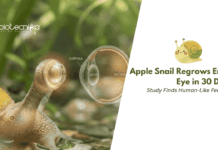
Study Reveals Apple Snail Can Fully Regrow an Eye in One Month
Imagine losing your eyesight and then growing it back in just a month. It sounds like science fiction. But for one small freshwater apple snail, it’s reality, reports the research published in Nature.
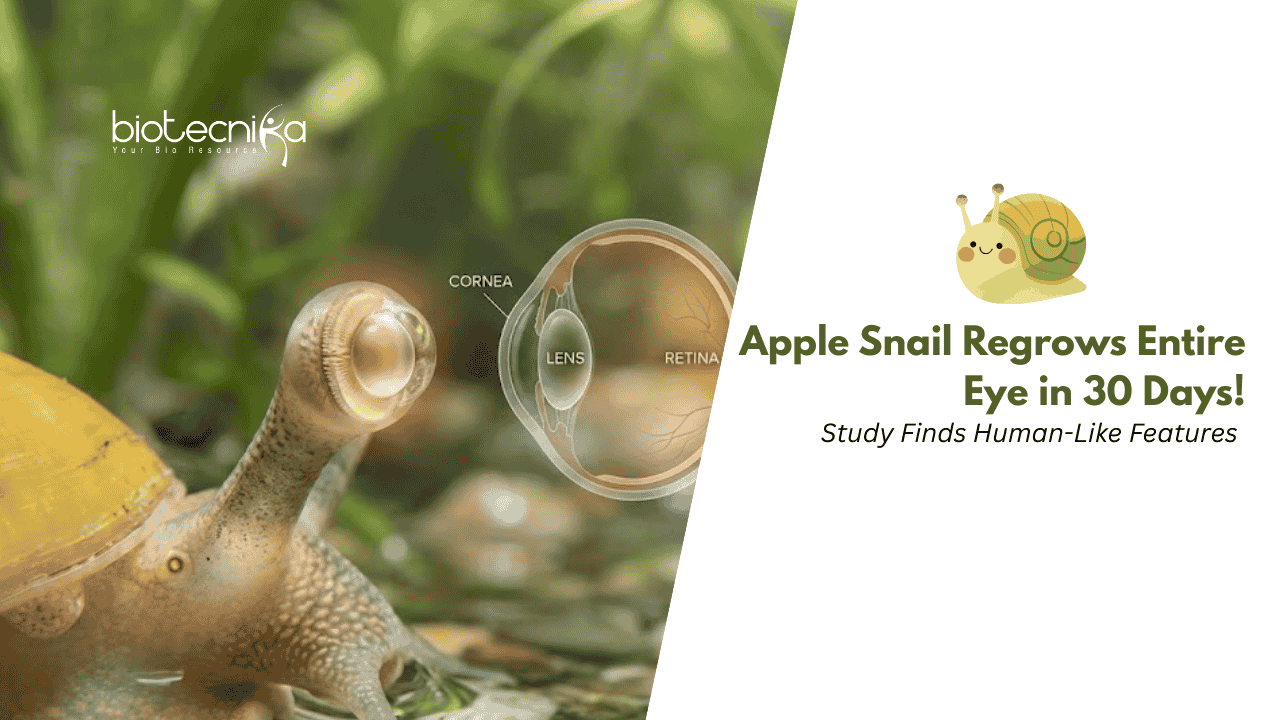
Alice Accorsi, an assistant professor of molecular and cellular biology at the University of California, Davis, who studies the golden apple snail (Pomacea canaliculata), has discovered that it can completely regrow a lost eye in about 30 days. And what’s turning heads in the scientific community isn’t just the regeneration itself, but it’s how similar that rebuilt eye is to our own.
A Surprising Match to the Human Eye
Human eyes are delicate, highly specialized organs. Once damaged by trauma or disease, they cannot naturally regenerate. That’s why conditions involving retinal damage or optic nerve injury are so difficult and often impossible to reverse.
The golden apple snail, however, has what scientists call a “camera-type” eye, the same general design found in humans and other vertebrates. That means it has a cornea to protect the eye, a lens to focus light, and a retina packed with light-sensitive cells.
When researchers examined the tissue more closely using advanced microscopy and genetic analysis, they found striking similarities not only in anatomy but also in gene activity. Many of the genes involved in building a human eye are also present and active in this apple snail species.
That overlap is what makes this discovery especially promising.
How the Apple Snail Rebuilds an Eye?
The regeneration process in the apple snail unfolds in clear stages.
Within the first 24 hours after losing an eye, the snail rapidly seals the wound to prevent infection and fluid loss. Then, undifferentiated cells, cells that haven’t yet specialized, migrate to the injured area and begin multiplying.
Over the next week and a half, those cells begin to differentiate into specific eye structures. By approximately day 15, the major components are reestablished, including the lens, retina, and optic nerve. By the one-month mark, the eye appears fully restored, though researchers believe molecular fine-tuning may continue beyond that.
During this process, thousands of genes switch on and off. Immediately after injury, roughly 9,000 genes show changes in activity. Even after 28 days, more than 1,000 genes are still expressed at different levels compared to a normal adult eye. That suggests that regeneration is not merely structural; it’s deeply genetic and highly coordinated.
The Gene That Builds Eyes
To better understand the mechanisms driving regeneration in the apple snail, Accorsi used CRISPR gene-editing technology. They focused on a gene called pax6, often described as a “master control” gene for eye development.
Pax6 plays a critical role in the development of the eye and brain regions in humans, mice, and fruit flies. When researchers edited the snail’s DNA to disable both copies of the pax6 gene in embryos, the snails developed without eyes.
That result confirmed something remarkable: across vastly different species, the same gene helps organize eye formation. The next phase of research aims to determine whether pax6 is also necessary for regeneration in adult apple snails, not only for initial development.
Why This Apple Snail Makes a Powerful Research Model?
The golden apple snail isn’t just biologically interesting; it’s also practical for research.
It reproduces rapidly, produces large numbers of offspring, and adapts readily to laboratory environments. Unlike many other snail species, it doesn’t go through a complex metamorphosis, which simplifies experimental studies. Its resilience and short generation time make it ideal for genetic work.
Scientists have known for centuries that some snails can regrow lost body parts. Historical records from the 1700s even describe snails regenerating entire heads. But until now, no one had fully harnessed that ability to study complete eye regeneration with modern molecular tools.
What This Could Mean for Humans
Researchers are careful not to overpromise. There is still no evidence that the regenerated apple snail eye restores vision exactly as it functioned before, and translating findings from snails to humans is a long, uncertain journey. But the implications are compelling.
If scientists can identify the precise set of genes and molecular pathways that allow these snails to regrow a complex sensory organ, and if those same genes exist in humans, it raises a fascinating possibility: perhaps the genetic instructions for regeneration are still present in us, just dormant. Reactivating those pathways could one day change how we treat traumatic eye injuries, retinal degeneration, or optic nerve damage.
It’s early research. There are many steps between a regenerating snail and the restoration of human sight. But for the first time, scientists have a workable model of a fully regenerating, camera-type eye that closely resembles our own.
“If we find a set of genes that are important for eye regeneration, and these genes are also present in vertebrates, in theory, we could activate them to enable eye regeneration in humans,” said Accorsi.
And sometimes, the most significant medical breakthroughs begin in the smallest, most unexpected places, even in a quiet freshwater apple snail, slowly rebuilding its vision.