



















What Are the Benefits of Biotechnology in Human Life?
Understanding the Benefits of Biotechnology in Shaping Healthier, Smarter, and Sustainable Lives
What if the solution to some of humanity’s most significant problems was already alive, evolving, quietly working, and growing around us? Have you ever thought about what if the clean water you drink, the food on your plate, and the Vaccine in your arm all shared a common Scientific thread? Biotechnology is often misunderstood as a complex lab Science reserved for experts, but in reality, it is one of the most potent forces shaping modern human life.
From saving lives and feeding billions to healing the planet itself, Biotechnology operates behind the scenes, subtle, precise, and revolutionary. Once you begin to see it, you realize it’s not the Science of the future; it’s the Science already transforming your present. Understanding the benefits of Biotechnology is not just about Science; it is about the invisible force redefining human life in the 21st century.
You may not see it. You may not hear it. Yet, every day, Biotechnology is quietly deciding how healthy you are, how safe your food is, and how long you might live. From the moment a Vaccine enters your bloodstream to the instant a farmer harvests a pest-resistant crop, Biotechnology is at work, often invisibly, but powerfully. In a world facing rising diseases, climate uncertainty, and food scarcity, this Science is no longer confined to laboratories. These everyday impacts reveal the real benefits of Biotechnology, often unnoticed but deeply influential. It has stepped into human life itself, shaping our present and redefining our future in ways few Technologies ever have.
Biotechnology often feels like something that belongs inside high-tech laboratories or advanced Research journals. Yet, in reality, it quietly influences our lives every single day, from the food on our plates and the Medicines we take to the way industries function and environments are protected.
At its heart, Biotechnology is about using living systems wisely to improve human life. This growing influence highlights the importance of Biotechnology in addressing modern human challenges. As the world faces growing health challenges, food shortages, environmental stress, and sustainability concerns, Biotechnology has moved from being a niche Science to a global necessity.
Understanding Biotechnology in Simple Terms
Biotechnology is a vast field in which the knowledge of Biological Sciences is applied to develop products and solutions that improve human well-being. It combines Biology, Technology, Chemistry, and Engineering to solve real-world problems using scalable, practical methods.
Human beings have used Biological processes for centuries, such as improving crop yields, fermenting food, and preserving dairy. What distinguishes modern Biotechnology is the accuracy and the effects.
Today, Scientists can work at the Molecular and Genetic levels, enabling resilient crops, environmentally friendly industrial processes, and targeted Medical treatments.
Hence, Biotechnology utilizes Science, Technology, and living systems together to support food and nutrition, Healthcare, environmental protection, public welfare, and industry.
The Major Benefits of Biotechnology in Human Life
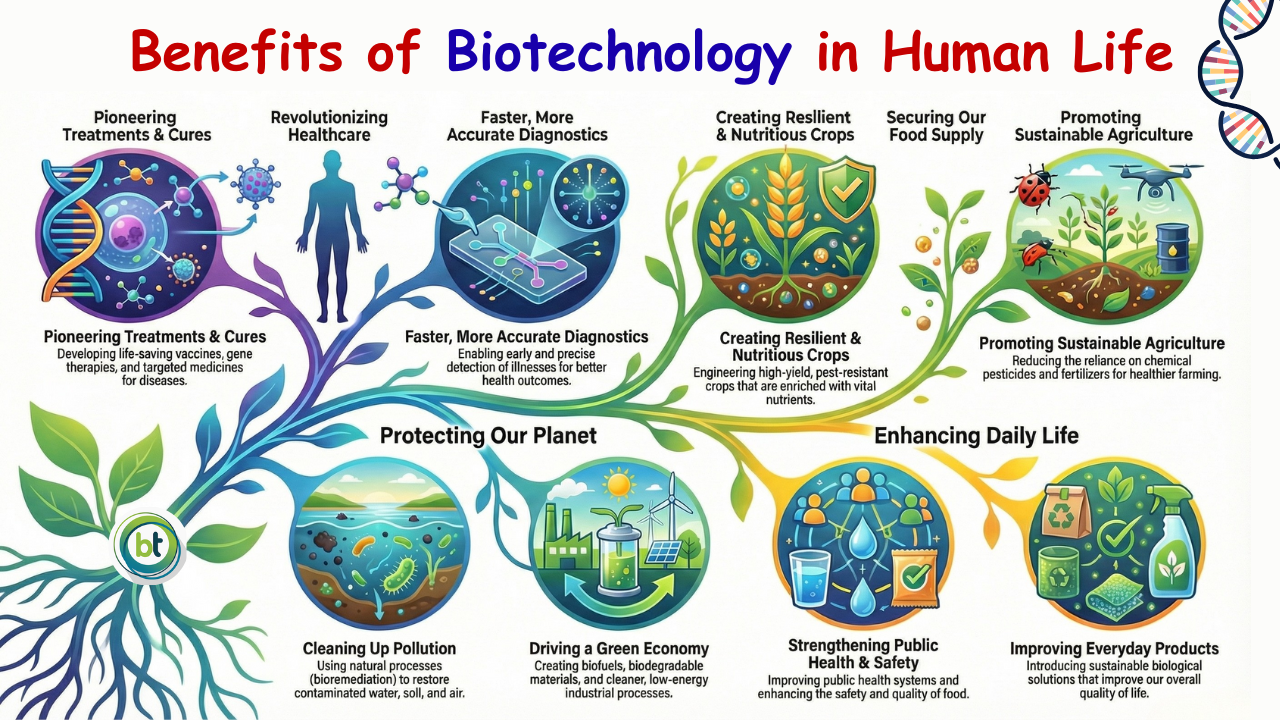
The benefits of Biotechnology extend across multiple sectors, directly shaping human Health, Food Systems, Environmental Sustainability, and Public Welfare. By merging Science with living organisms and their products, Biotechnology supports five major sectors that directly affect human well-being and society:
- Food and nutrition
- Healthcare and Medicine
- Social welfare and Public health
- Industrial sustainability
- Environmental protection
Each of these areas contributes in unique ways to improving the quality of life worldwide.
-
Advancing Healthcare & Improving Quality of Life
One of the most impactful contributions of Biotechnology is in the Healthcare sector. Many of today’s life-saving Medications are Biotechnology-driven. Vaccines, recombinant Insulin, Gene-based therapies, Biologic Drugs, as well as Monoclonal Antibodies have transformed how diseases and disorders are diagnosed as well as treated globally. Biotechnology in Healthcare has revolutionized how diseases are diagnosed, treated, and prevented.
Biotechnology has been advantageous, such as:
- Targeted therapies with fewer side effects
- Efficient, accurate, and faster disease diagnosis using molecular tools and techniques
- Rapid Vaccine development during health emergencies worldwide
- Improved management of Genetic as well as chronic diseases and disorders
Advances in Biotechnology in Healthcare have enabled faster vaccine development and the development of personalized therapies. Today, numerous Biotechnology-based Vaccines and Medications are already in use worldwide, treating conditions ranging from Cancer and Diabetes to the rarest of rare Genetic Disorders.
Among the most visible benefits of Biotechnology is its ability to transform disease treatment and healthcare outcomes. Beyond extending life expectancy, the Biotechnology field focuses on improving and enhancing the quality of life, allowing people to live more productive and healthier lives. These outcomes clearly demonstrate the advantages of Biotechnology in improving patient care and survival rates.
-
Ensuring Better Nutrition & Food Security
Feeding a growing global population is one of humanity’s biggest challenges, and Biotechnology plays a vital role in meeting this demand sustainably.
One of the most impactful benefits of Biotechnology lies in strengthening food security while improving nutritional quality. Agricultural Biotechnology improves nutritional value, resistance to environmental stressors, pests, and diseases, and crop productivity. It reduces the usage of Chemical pesticides and fertilizers, making farming both more environmentally responsible and safer.
|
Challenge |
Biotechnology Contribution |
|
Low crop yield |
High-yield and stress-resistant crops |
|
Pest damage |
Pest-resistant plant varieties |
| Malnutrition |
Nutrient-enriched foods |
| Chemical overuse |
Biofertilizers and biopesticides |
For consumers, this results in more nutritious and safer food and its products. For farmers, it implies improved livelihoods, stable yields, and reduced agricultural losses.
-
Protecting the Environment Through Biological Solutions
Biotechnology offers nature-based answers to environmental problems. Instead of relying primarily on Mechanical or Chemical cleanup methods and techniques, Biological systems are used to restore and enhance the polluted environment. These innovations highlight the environmental benefits of Biotechnology, offering sustainable alternatives to traditional chemical-based solutions. Through processes like Bioremediation, microbes break down industrial pollutants, oil spills, as well as toxic waste. Biotechnology supports water purification, waste treatment, and waste recycling.
The main environmental benefits are:
- Biofuels as alternatives to fossil fuels or non-renewable resources
- Cleaner water, air, and soil using Biological methods and Technologies
- Lower carbon emissions from industrial processes
- Biodegradable materials that reduce plastic pollution
These advantageous innovations enable the world’s development without sacrificing ecological balance, thereby signifying Biotechnology’s essential role in sustainable growth and development.
-
Making Industries More Sustainable, Cleaner, & Safer
Industrial Biotechnology, often called white Biotechnology, has changed how products are manufactured. Instead of energy-intensive Chemical processes, industries now use microorganisms and enzymes to produce detergents, food ingredients, Pharmaceutical products, bio-based plastics, and textiles.
|
Area |
Traditional Approach | Biotechnology Advantage |
|
Manufacturing |
High energy & Chemicals | Enzyme-based, low-energy |
| Waste generation | High waste output |
Minimal waste |
| Environmental impact | Polluting |
Eco-friendly |
Such transformations reflect the industrial advantages of Biotechnology, including efficiency, safety, and sustainability. This shift creates safer workplaces, reduces energy consumption, and lowers emissions while supporting a circular economy.
-
Improving Public Health and Everyday Human Life
Biotechnology doesn’t operate only in farms or hospitals; it supports daily human life in subtle but powerful ways.
From nutritional enhancement and disease surveillance to food quality testing and safe drinking water, Biotechnology & Life Sciences strengthens public health systems. Even everyday household products, such as fermented food products and detergents, depend on Biological methods.
The Biotechnology field works quietly in the background, ensuring that daily life is more sustainable, healthier, as well as safer.
Why Biotechnology Matters More Than Ever Today
The importance of Biotechnology has never been greater in a world facing health, climate, and resource crises. The success of Biotechnology in Healthcare demonstrates how science can respond rapidly to global emergencies. Modern challenges, including antibiotic resistance, climate change, population growth, depletion of natural resources, and emerging deadly diseases, call for solutions that are sustainable, efficient, and scalable. In today’s world, the long-term benefits of Biotechnology are critical for addressing global challenges such as climate change and antibiotic resistance. Biotechnology meets these demands by providing environmentally responsible and scientifically precise alternatives to the burning issues.
Emerging Life Sciences trends, such as Personalized Medicine, Gene Editing, Biologically derived materials, and Sustainable Bio-Manufacturing, are expected to expand further Biotechnology’s role in our lives over the coming years.
Responsible Innovation and Ethical Balance
As a famous dialogue quotes “With great power comes Great responsibility,” Biotechnology is therefore a field with numerous responsibilities, which is governed by safety protocols, strict Ethical guidelines, as well as Regulatory frameworks. These ensure that Scientific progress benefits society without harming it or the environment.
Informed Lawmaking, responsible Research, and transparent testing are critical to maintaining public trust globally.
The ultimate goal is not to replace Mother Nature, but to enhance and work alongside it responsibly and with utmost care. Responsible innovation ensures the long-term importance of Biotechnology for society and future generations.
Biotechnology is One of The Pillars of Human Progress
Biotechnology stands at a crossroads, where humanity meets innovation, and Science meets responsibility. It is helping us heal faster, eat better, think more sustainably, as well as live longer in the world we share. The wide-ranging benefits of Biotechnology make it one of the most powerful scientific tools shaping modern human progress. At a time when global challenges feel overwhelming, such as food shortages, climate stress, or rising diseases, Biotechnology offers something powerful: practical hope backed by Science & Technology.
For Biotechnology graduates and young professionals, this field represents more than career opportunities; it represents purpose and motivation for the betterment of the world. Working in the Biotechnology field means working on issues that matter, contributing to safer food systems, healthier lives, and a more resilient Earth.
When viewed together, the scientific, environmental, and social advantages of Biotechnology outweigh traditional approaches. As Science continues to evolve, Biotechnology will not only support human life; it will help redefine how we think and responsibly live.
Also, the next innovation, the next life-saving solution, could come from minds that are just beginning to ask curious questions today, i.e., YOU.