












Table of Contents
NVIDIA and Eli Lilly Build $1B AI Lab Powering Drug Discovery
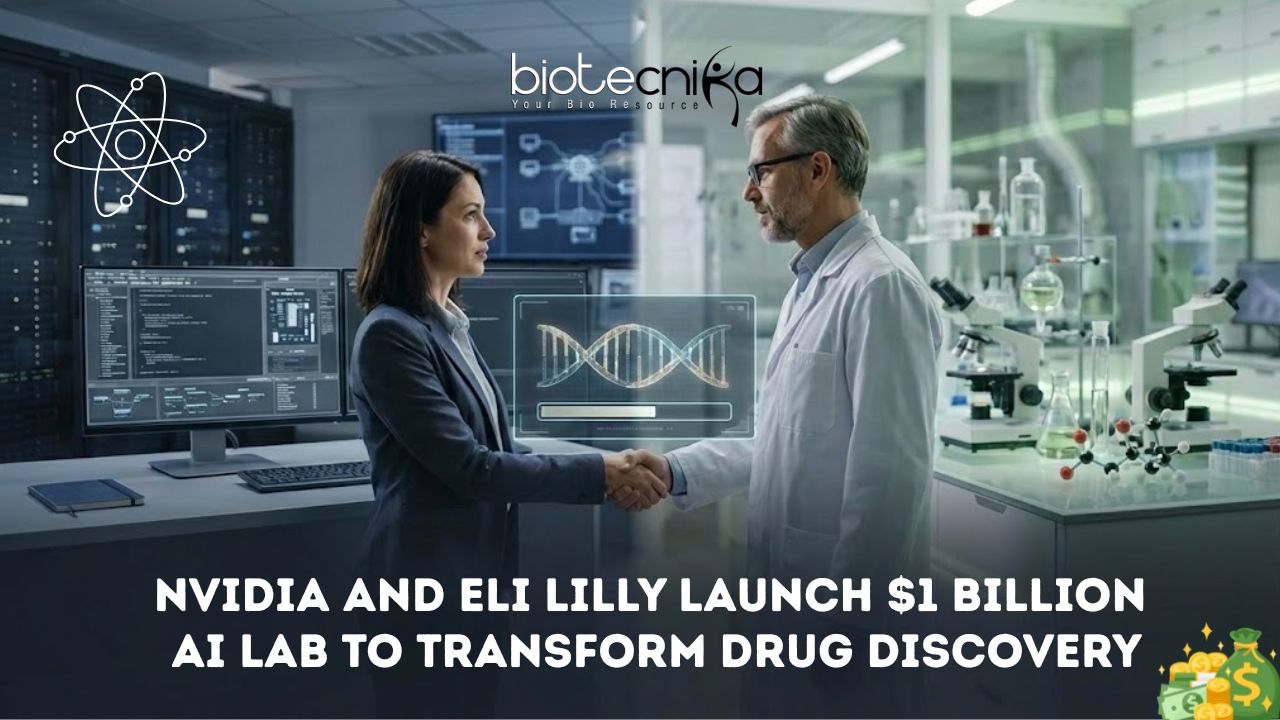
The leading tech company and pharmaceutical giant come together to mark a significant collaboration focused on reshaping the future of medicine. NVIDIA and Eli Lilly announced a $1 billion partnership to build an AI-powered drug discovery laboratory in the San Francisco Bay Area. This decision was unveiled in January 2026 at a major healthcare and finance conference.
Over the next 5 years, both companies have targeted investments of up to $1 billion, including talent acquisition, high-end computing software, hardware, and infrastructure required for research and development. The core purpose of this joint venture is to accelerate the drug discovery process, which traditionally takes years and is not very cost-friendly. The AI co-innovation lab brings together Nvidia’s cutting-edge computing technology with Lilly’s decades of experience in drug discovery and development.
The AI and Biology Amalgamation to Accelerate Medicine Development
NVIDIA’s BioNeMo, a machine learning platform built specifically for biological and chemical applications, is the heart of this collab. Along with Nvidia’s next-generation Vera Rubin AI computing architecture, the lab aims to develop powerful AI models that can understand and predict complex biomolecular interactions (DNA, RNA, and protein interactions). These models, by generating and analysing large datasets, join hands with researchers in identifying promising drug candidates (lead molecules) faster compared to the regular old methods.
Unlike conventional research, which works in isolated teams, this co-located lab comprises Lilly’s biologists, chemists, and medical scientists and Nvidia’s AI engineers. They work side by side, connecting wet labs and computational dry labs. Together, the team’s goal is to create a 24/7 continuous learning system that supports AI-assisted experimentation and feeds the real-time data from physical lab tests. This approach helps refine and improve the computational models.
Eli Lilly’s CEO, David Ricks, stated that combining Lilly’s deep scientific knowledge with Nvidia’s computational power can cut-short the timeline of drug discovery. Adding to this, Jensen Huang, founder and CEO of Nvidia, said that this partnership strengthens the landscape of “in silico” research, even before the real molecules are made. Overall, the idea is to set a new blueprint for drug discovery and medicine development.
Drug Discovery and Beyond
While the first step of this lab is to accelerate drug discovery, especially in the early stages, the focus may extend to other developments as well. NVIDIA and Lilly have signed plans to go beyond and explore how AI, robotics, and automation can improve the far stages of pharmaceutical research. The team has eyed areas such as clinical development, manufacturing, and supply chain management. On the whole, the partners hope to create efficiencies that benefit researchers, patients, and the entire pharma sector by merging cutting-edge technologies like AI and robotics, multimodal models, and digital twins.
The ultimate agenda is to innovate a system that bridges computational dry labs and physical wet labs. In such a setup, AI can design potential molecules while the well-orchestrated robotics runs the experiments around the clock, with scientists monitoring the databases and learning systems. This interlinked cycle could reduce the time from plan to action, eventually.
A Light in the Pharma Innovation
Artificial intelligence is gaining momentum across industries, but its role in drug discovery could be truly game-changing. With traditional drug development taking years and massive investment, the Nvidia–Eli Lilly partnership aims to break these barriers by combining powerful AI computing with deep pharmaceutical expertise. Experts believe this joint lab could set a new model for collaboration between technology and life sciences, opening the door to faster discoveries and a future where AI actively drives medical breakthroughs that reach patients sooner.