














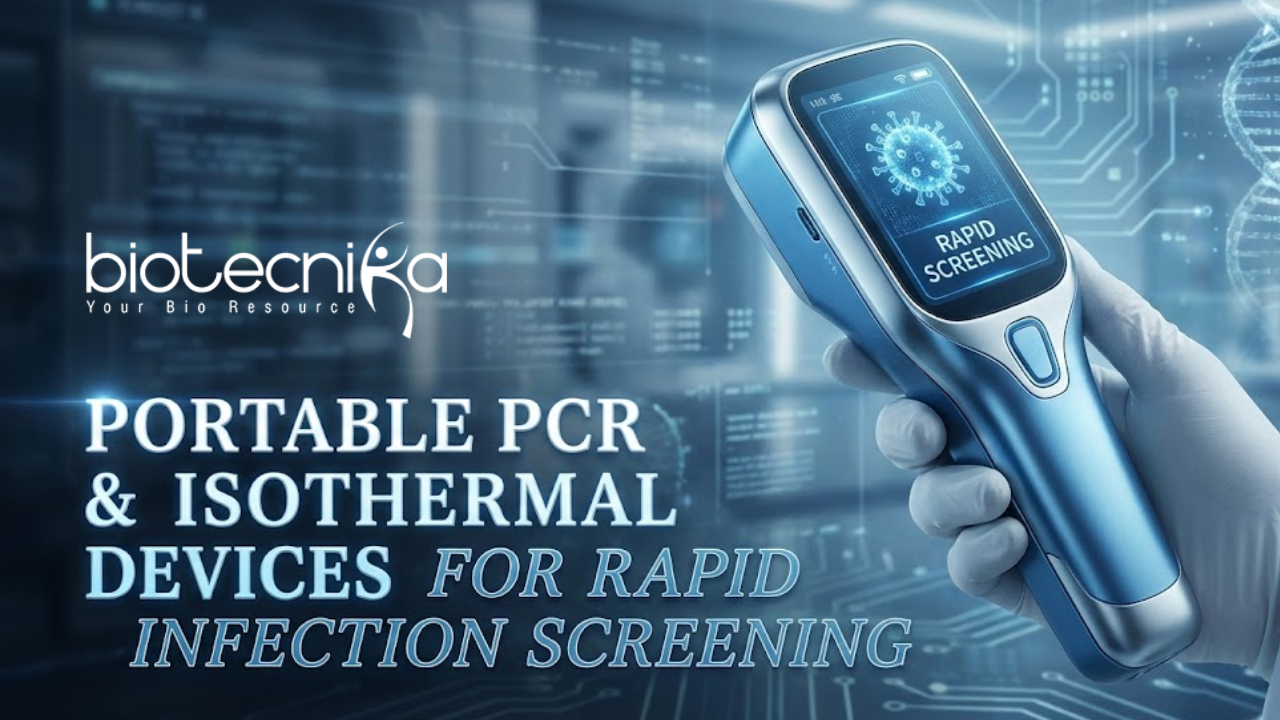
Portable PCR & Isothermal Amplification Devices for Rapid Infection Screening
Isothermal Amplification is changing infection testing by delivering lab-grade results without the laboratory.
Visualize being able to accurately detect a viral or bacterial infection within minutes, right in a field setting or at a local clinic, without the need to send test samples to laboratories. Don’t you think that would be wonderful?
This is the promise of Isothermal Amplification Devices and portable PCR (Polymerase Chain Reaction). These devices are highly accurate, compact, and rapid tools that are reshaping Healthcare and Diagnostics, thereby changing the way we screen for infectious diseases worldwide. From Influenza to COVID-19 (Corona), Tuberculosis, and Zika, these laboratory Technologies are bringing advanced Molecular Diagnostics directly to the point of care and enhancing Public Health.
For Life Sciences professionals, students, and early-career researchers, learning and having a profound understanding of these devices is not just exciting but essential. It will aid in keeping pace with the world’s industrial trends and the future of Diagnostics, where innovation, speed, as well as accessibility make a real difference in saving lives and enhancing well-being.
When the world faced coronavirus’ wrath and dealt with COVID-19, one lesson became crystal clear to the world; i.e., rapid Diagnostics save lives globally and is quite essential to take into serious consideration.
Waiting for test results for countless hours, or even days, is inconvenient and patience-testing. But during serious health situations or disease outbreaks, these delayed reports result in slow contact tracing and treatment, as well as allow infections to spread silently throughout the whole crowd.
That’s why a new advanced era of Isothermal Amplification Devices and portable PCR is revolutionizing how we detect infectious diseases and treat them on time.
Today’s battery-operated and compact Genetic testing tools deliver lab-quality results even in a small field clinic, run in a tea-cup-sized heater, as well as can fit in our hands.
For young Life Sciences graduates entering the fields of Biotechnology, Public Health, Diagnostics, or Pharmaceuticals, knowledge of these tools is no longer optional. It’s absolutely and incredibly essential.
Why Do These Portable & Rapid Testing Matter Today?
Infectious diseases, ranging from Tuberculosis and Hepatitis to Dengue and Influenza, and emerging viral threats, continue to pose serious Public Health challenges.
Conventional PCRs remain the gold standard and leading method for detecting pathogens with high accuracy and precision. But traditional PCR Devices are bulky, rely on sophisticated laboratory setups, and require electricity to function. Due to this, there’s a significant Diagnostic gap, especially in:
- Disaster zones
- Rural hospitals
- Community hotspots, Airports, and country borders
- Low-resource countries across the world
- Mobile testing camps and treatment camps
Hence, Isothermal Amplification Devices and Portable PCR bridge this critical gap by offering rapid on-site test results with minimal equipment requirements.
Insights on Understanding the Technologies: PCR vs. Isothermal Amplification
Both these testing Technologies amplify Genetic material, but they approach the process very differently.
Portable PCR
Portable PCRs minimize the functionality of conventional thermal cyclers into small, handheld (mainly) instruments for rapid testing. Their core strengths are:
- Smart Design: Modern portable PCR Devices integrate:
- Fluorescent detectors
- Smartphone applications for accessible analyses
- Micro-thermal cyclers
- Simplified sample preparation cartridges
- Innovative heating methods, such as magnetic induction or thin-film heaters. These have helped miniaturize the devices and drastically reduce energy consumption.
- Speed: Portable PCR units generate results on-site in just 5 to 30 minutes, depending on the system and the type of PCR.
- High Accuracy: Since even the portable PCR devices depend on thermal cycling, portable PCR units maintain the precision of traditional laboratory PCR systems. This makes them suitable for rapid Clinical Diagnostics and analyses.
- Applications: Influenza testing, Forensic DNA analysis, Environmental Monitoring, food safety checks, and even recently in SARS-CoV-2 screening.
Isothermal Amplification
Instead of cycling through temperatures like PCR machines, Isothermal Amplification performs the entire reaction at a single constant temperature throughout the process. This makes the equipment easier to use, simpler, as well as cost-effective.
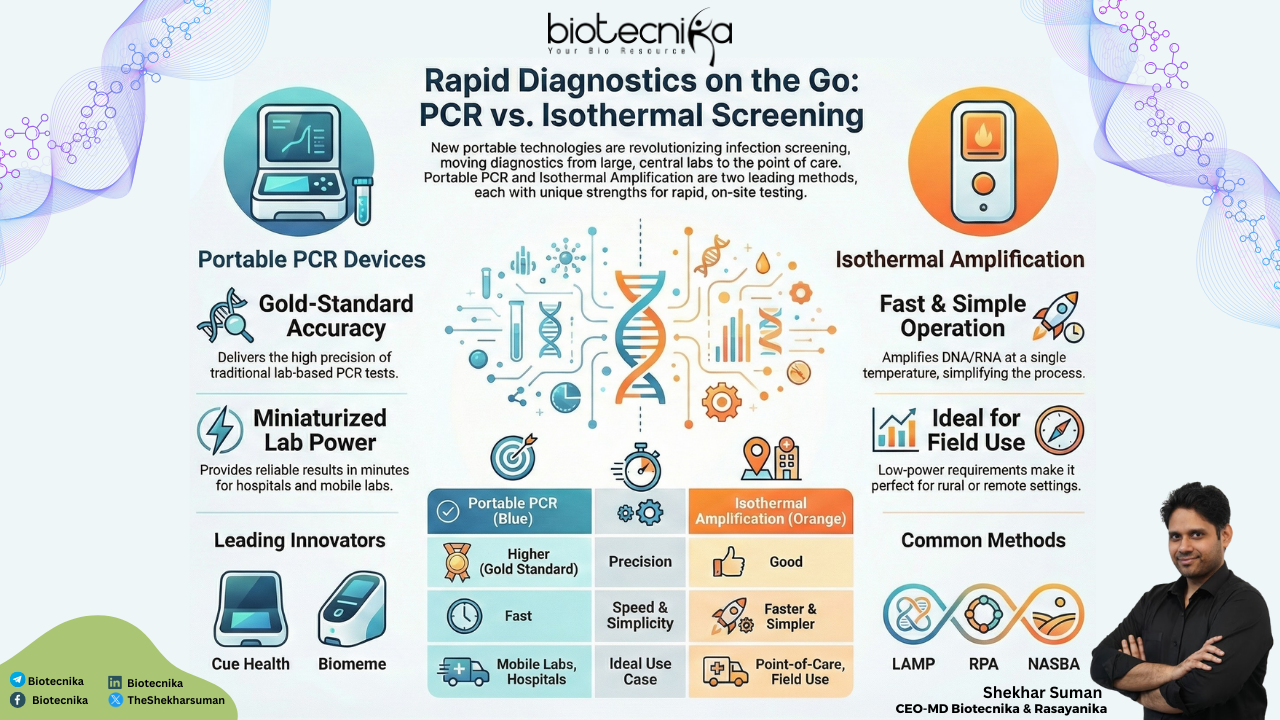
Why Is Isothermal Amplification Trending Worldwide in the Life Sciences & Healthcare Sector?
- Test Reactions finish in 15 to 30 minutes.
- Results can be viewed by turbidity, colour change, lateral-flow strips, or even fluorescence.
- Works on low-cost or battery-powered devices.
- No thermal cycler needed for the test.
Numerous types of Isothermal Amplification have emerged to address various Diagnostic needs, such as:
Recombinase Polymerase Amplification (RPA)
- Operates at around 37°C
- Ultra-fast: results are ready in 20 minutes of total time
- RPA is ideal for field paper-based tests, Diagnostics, as well as wearable biosensors.
CRISPR-Integrated Systems (such as DETECTR & SHERLOCK)
This is one of the fastest-evolving areas in the Life Sciences worldwide. Combining Isothermal Amplification with CRISPR-based detection boosts:
- Single-molecule detection
- Specificity
- Sensitivity
Loop-Mediated Isothermal Amplification (LAMP)
- Produces visible colour change or turbidity.
- Uses 4 to 6 primers, which target 6 to 8 regions, and is highly specific in nature.
- Suitable for multi-pathogen detection, such as RSV, SARS-CoV-2, or Influenza A/B
- Constant temperature: 60 to 65°C
- Increasing usage in microfluidic “lab-on-chip” devices for automatic sample-to-answer testing across the world.
Helicase-Dependent Amplification (HDA)
- Great for DNA-based bacterial detection
- Mimics natural DNA replication
Nucleic Acid Sequence-Based Amplification (NASBA)
- Highly suited for RNA virus detection
- Constant temperature: 41°C
- Has been utilized for respiratory viruses, HCV, HIV, and Zika
- These are leading the way for next-generation portable Molecular Diagnostics.
Portable PCR vs. Isothermal Amplification: A Quick Comparison
|
Feature |
Portable PCR | Isothermal Amplification (LAMP / RPA / NASBA / HDA) |
|
Temperature Requirement |
Thermal cycling (multi-step) | Single constant temperature |
|
Speed |
5 to 30 minutes |
15 to 30 minutes (fastest: RPA ~20 min) |
|
Accuracy |
Very high (gold standard) | High, varies by method and primer design |
|
Equipment Complexity |
Moderate (miniaturized cycler + optics) |
Low (simple heater/block or chip) |
| Power Requirement | Higher |
Very low |
| Ease of Use | Simple but needs some training |
Extremely simple, ideal for field users |
| Cost | Higher |
Lower |
| Detection Readout | Fluorescence, real-time curves |
Color change, turbidity, fluorescence, and lateral-flow |
|
Best For |
Clinical Diagnostics, high-precision tests |
Rural Diagnostics, POC testing, outbreak response |
| Pathogen Types | DNA and RNA (after RT) |
DNA, RNA, depending on the method (LAMP/RT-LAMP/NASBA) |
The Rise of Smartphone Diagnostics & Lab-on-Chip
One of the most advanced and exciting trends is the shift toward fully integrated microfluidic systems, and these newer devices can further:
- Run multi-step amplification
- Automate sample prep
- Visualize results with the help of smartphone cameras
- Capture amplicons on lateral flow strips
This means that what once required a full laboratory now fits into:
- A cost-effective paper device
- A pocket-sized reader
- A handheld cartridge
For aspiring students entering the field of Biotechnology, this represents a significant career break and opportunity in areas such as Biomedical Engineering, Bioinstrumentation, as well as Molecular Diagnostics.
Why Young Biotechnology & Life Sciences Graduates Should Care?
Portable Biological Testing Devices and Molecular Diagnostics are becoming the strength of Healthcare across the world. Skills in this domain open doors in fields such as:
- Infectious disease laboratories
- Diagnostics R&D (Research & Development)
- Point-of-care device companies
- Biotechnology and Life Sciences startups
- Field Epidemiology programs
- Public Health Surveillance teams
A clear and strong understanding of modern devices such as LAMP, PCR, CRISPR Diagnostics, as well as lab-on-chip systems, can enhance your future-readiness for roles in applied Biotechnology, Molecular Biology, and Biomedical Engineering innovations.
The Future of Rapid Infection Screening
Isothermal Amplification Devices and Portable PCR devices are no longer just emerging Technologies, but they are becoming standard tools in routine infection screening worldwide.
The next Technological wave will include:
- Smart cartridges with built-in biosensors.
- Multi-pathogen panels for vector-borne, respiratory, as well as waterborne diseases.
- AI-enabled test interpretations.
- Solar-powered and ultra-portable devices
- CRISPR-based at-home Diagnostic kits and tests
As infectious diseases continue to evolve and spread, accurate as well as quick detection will remain our strongest frontline defense for every country and especially for India.
Portable Isothermal Amplification and PCR devices are redefining what rapid Diagnostics can achieve. They combine practical accessibility with Scientific precision, making molecular testing available far beyond laboratory walls.
For Life Sciences young professionals and students, this incredible and futuristic field offers an inspiring blend of opportunity, innovation, as well as impact.
The world needs new Biologists, innovative thinkers, Coders, as well as Engineers who can design the next generation of Diagnostic tools.
Your journey can start right here, by understanding the Technologies powering rapid infection detection today.