


















How to Become a Food Microbiologist: Education, Courses, and Career Path
Behind every safe meal is a Food Microbiologist you never see
One tiny microorganism. That’s it. That’s all it takes to shut down a leading Food factory, make tomorrow’s headlines for the wrong reasons, or even trigger a nationwide food recall.
While we casually pick up packaged foods from supermarket shelves, a high-stakes process has already played out behind the scenes. Inside food testing laboratories, Scientists work quietly under pressure, deciding whether a product is at risk of never leaving the facility or is safe to eat. This invisible yet important responsibility belongs to Food Microbiologists, and their work often matters more than anyone realizes.
Today, more people consume food products, travel farther across nations, as well as stay on shelves longer than ever before. With that convenience and large-scale production comes risk to humans. Every dairy product, ready-to-eat meal, quick snack, or beverage must survive an unseen battle against harmful microbes before it reaches your home.
If you’re a Life Science student who loves the subject Microbiology and wants a fruitful career that goes beyond routine laboratory work and textbooks, Food Microbiology offers something rare: Science with immediate, real-world impact. This article walks you through what a Food Microbiologist really does, the education and courses you need, and how the career grows, from student days to becoming a trusted professional safeguarding what the world eats.
What Does a Food Microbiologist Actually Do?
A Food Microbiologist studies microorganisms present in food, both harmful and beneficial, to ensure products are safe, high-quality, and compliant with food safety regulations. Their work goes far beyond a microscope.
Core Responsibilities
- Developing Food Safety Systems like HACCP (Hazard Analysis and Critical Control Points)
- Testing the raw materials, in-process food samples, as well as the finished and final food products for pathogens such as E. coli, Salmonella, as well as Listeria.
- Investigating foodborne illness outbreaks and contamination sources.
- Preparing culture and nutrient media, microbial counting, incubation, sterilization, and microbial isolation.
- Working with R&D (Research & Development), QA (Quality Assurance), as well as production teams.
- Supporting Regulatory inspections and Audits.
- Conducting stability and shelf-life studies
Where Do Food Microbiologists Actually Work?
- Beverage, dairy, seafood, meat, as well as bakery industries
- Food manufacturing & food processing companies
- Research Universities and Institutions
- QA & QC (Quality Control) laboratories
- Contract Testing and Food Safety Consulting companies
- Regulatory Agencies and Government bodies
Why Food Microbiology Is a High-Impact Career Today?
With the rise of ready-to-eat products, global supply chains, stricter regulations, and food exports, food safety has become non-negotiable and of utmost importance. Antimicrobial Resistance (AMR), Climate change, and emerging pathogens have further increased the demand for skilled Food Microbiologists. The bottom line is that safe food is no longer optional, and neither is this profession. Both food and the profession are essential and a social necessity.
Education Pathway to Become a Food Microbiologist
Becoming a Food Microbiologist follows a structured but flexible academic route.
-
Bachelor’s Degree (Foundation Stage)
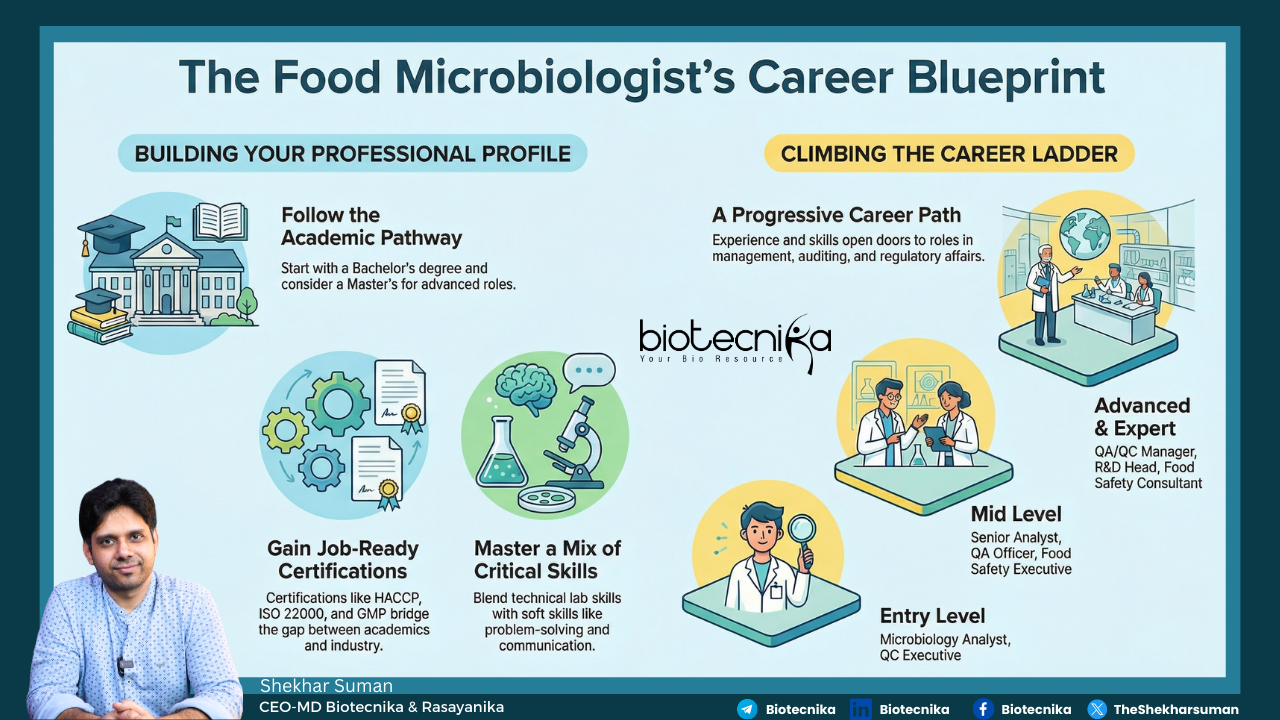
A Bachelor’s degree is the minimum requirement to become a Food Microbiologist.
Relevant degrees include BSc/BTech in:
- Food Science / Food Technology
- Microbiology
- Life Sciences
- Biotechnology
Key subjects to focus on:
- Food Safety and Hygiene
- General & Applied Microbiology
- Basic Statistics and Laboratory Techniques
- Microbial Physiology
- Biochemistry
-
Master’s Degree (Career-Defining Stage)
While some entry-level roles accept Bachelor’s graduates, a master’s degree significantly improves salary, job prospects, as well as responsibility.
Recommended programs include MSc/MTech in:
- Food Microbiology
- Microbiology (with Food Safety specialization)
- Food Science & Technology
At this stage, students gain exposure to:
- Pathogen detection methods
- Advanced Food Microbiology
- Research projects and dissertations
- Quality Management Systems
-
PhD (Optional, Not Mandatory)
A PhD (Doctor of Philosophy) is mainly required if you want to:
- Lead R&D teams and facilities
- Work in Academic Research
- Drive innovation in Food Safety Technologies
- Teach at Universities & Institutes
Essential Courses & Certifications That Add Real Value
Formal Academic degrees alone are not enough in today’s industry-driven environment. Hence, appropriate specialized certifications and short courses make your profile job-ready and help you stand out.
Must-Have Certifications for Food Microbiologists
|
Course / Certification |
Why It Matters |
|
HACCP |
Global food safety requirements |
|
Food Safety & Standards (FSSAI) |
Critical for the Indian food industry |
|
GMP & GHP |
Industry compliance standards |
| ISO 22000 / ISO 9001 |
Quality Management Systems |
| Food Microbiology Laboratory Techniques |
Practical skill enhancement |
| Computer Basics & ERP |
Industry Documentation & reporting |
These important certifications bridge the gap between industry expectations as well as academic learning.
Skills Every Food Microbiologist Must Develop
Technical knowledge alone won’t sustain your career.
Technical Skills
- Aseptic Techniques & Culture Handling
- Microbiological Testing & Documentation
- Data Reporting & Interpretation
- Hazard Analysis and Risk Assessment
Soft & Professional Skills
- Problem-solving and troubleshooting under pressure
- Attention to detail (critical for food safety)
- Team collaboration across various departments
- Clear communication with non-scientists and cross-functional teams
Food Microbiology Career & Growth: What Does the Ladder Look Like?
|
Career Stage |
Typical Roles |
|
Entry Level |
Microbiology Analyst, QC Executive |
|
Mid Level |
Senior Analyst, QA Officer, Food Safety Executive |
| Advanced |
QA/QC Manager, HACCP Lead, Regulatory Specialist |
| Expert Level |
Food Safety Consultant, R&D Head, Audit Lead |
With experience and acquired skill sets, Food Microbiologists often move into roles in Audits, Regulatory Affairs, Management, or Consulting.
Challenges You Should Be Prepared For
- High responsibility, errors can impact public health across nations
- Audit pressure & Strict deadlines
- Exposure to microorganisms (with proper safety protocols)
- Continuous updates in Regulations and standards
Yet, for those passionate about Food Safety and the Food Industry, these challenges are also career-shaping experiences.
Is Food Microbiology a Good Career Choice?
Absolutely, especially for professionals or aspirants who:
- Prefer industry exposure over purely academic roles
- Want applied Science career roles, not just laboratory R&D
- Seek long-term and stable career growth across industries
- Are interested in public health, safety, as well as quality
Food Microbiologists don’t just test food; they safeguard public health, protect consumers, and support industries.
A Food Microbiology career is one of those rare career paths where your Science actually leaves the laboratory and touches everyday life forms.
The reports you sign, the decisions you make, and the tests you run can protect millions of people you will never meet.
With the proper education, real laboratory experience, and practical certifications, this path offers not just respect and stability but also the satisfaction of knowing your work truly matters.
If you like the idea of being the reason a food product is safe to eat, and if you want a career where your knowledge makes a visible difference, Food Microbiology could be your calling.
It’s where curiosity turns into confidence, learning turns into responsibility, and your passion for Science finally finds a purpose that feeds the world safely.