
















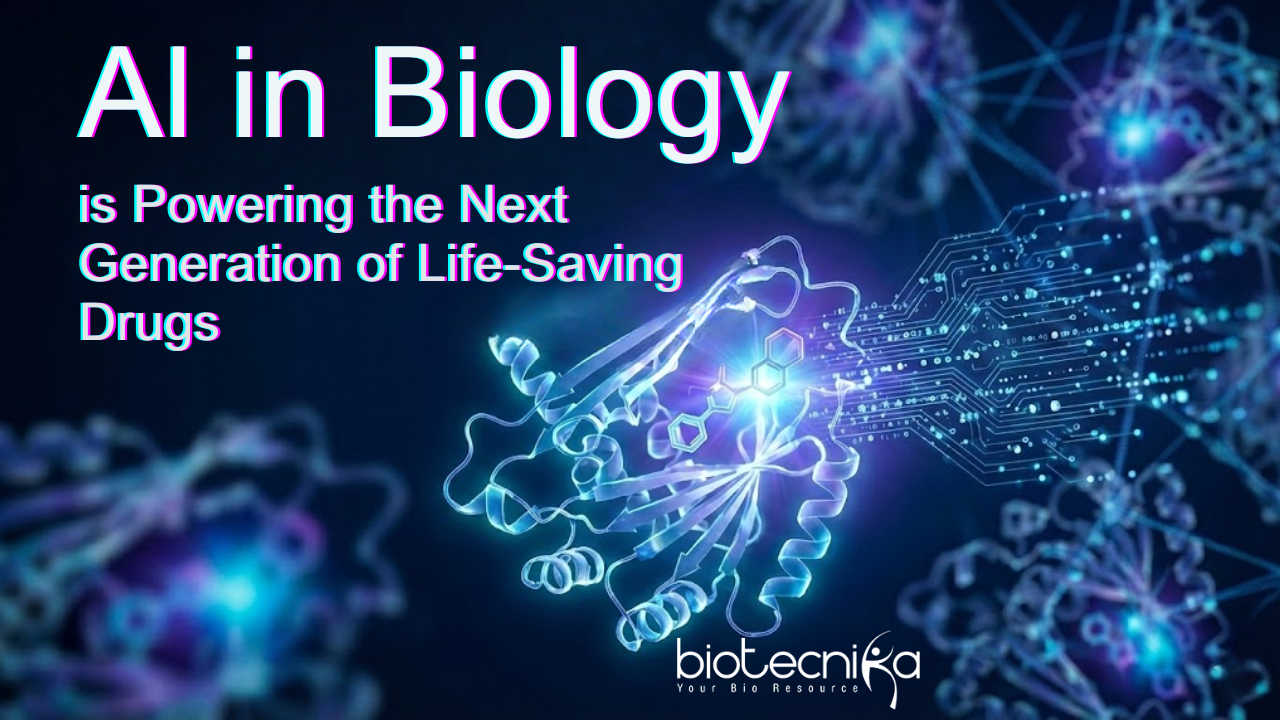
AI in Biology Is Powering the Next Generation of Life-Saving Drugs
AI in Biology is transforming Drug Discovery by replacing years of Trial-and-Error with High-Speed Intelligence.
What if discovering or innovating a novel drug didn’t take years of trial and error methods, but something way better and far faster than before?
Well, some esteemed Researchers in China have introduced an unexpected approach that is starting to change how Researchers and Scientists discover and look for novel medications.
Developing novel drugs has always been a technically demanding, slow, and expensive process, in a nutshell. AI in Biology is now emerging as a powerful solution to overcome these long-standing barriers.
A Research team in China has developed an AI (Artificial Intelligence) tool to the rescue. This AI tool can significantly accelerate this critical and early stage of Drug Development processes with enhanced efficiency.
This AI in Biology system is known as “DrugCLIP.” It can rapidly screen millions and billions of potential drug compounds against thousands of protein targets, completing the process in a few hours rather than the years it would conventionally take.
Yanyan Lan at Tsinghua University led the Research work, and the Research article was published in the popular journal “Science.” According to the Researchers’ team, “DrugCLIP” operates at a scale nearly ten million times faster than traditional virtual drug screening methodologies, without depending on physics-based and slow simulations.
Rethinking Drug Discovery Before AI in Biology
In the era before AI in Biology, traditional Drug Discovery methodologies usually use advanced Computational models to simulate how a 3D drug molecule fits into a protein’s binding pocket on a screen.
A good drug-protein fit implies that the molecule might interact with the protein molecules and influence its Biological function in the body. Even though this conventional strategy has been widely used worldwide, it comes with a few challenges. They could be like that; it is costly, difficult to scale, and computationally intensive. This is particularly applicable when millions of drug compounds must be tested against thousands of protein targets to identify the ideal drug compound.
These challenges sparked the inspiration in the Research team to explore an alternative and better Drug Discovery approach that would eventually bypass the conventional time-consuming physical simulations.
How DrugCLIP Works?
Instead of conducting modeling of molecular interactions directly, “DrugCLIP” functions more like a high-speed search engine for Drug Discovery. This system utilizes two neural networks. One of them is trained on protein-binding pockets, while the other one is trained on drug-like molecules altogether. Each molecule and protein is converted into a Mathematical vector. This approach reflects a broader shift in AI in Biology, where pattern recognition and data representation are replacing slow, physics-based simulations.
If a drug molecule is likely to bind to a protein and interact with it, then its vectors appear close together in a shared digital space. “DrugCLIP” identifies promising matches by measuring the distance between drug-protein vectors, enabling it to evaluate millions and billions of potential interactions extremely fast and with enhanced efficiency.
Building Accurate Protein Targets Using AI in Biology
For large-scale screening of the drug molecules, the Researchers & Scientists relied on “AlphaFold 2” to predict the 3-D structures of approximately 10,000 human proteins. These Computational predictions reveal and showcase how proteins fold into shapes that allow them to function on a molecular level.
However, the Researchers of this study found out that even though AlphaFold-generated 3-D structures are generally dependable & accurate, the details of the same drug-binding pockets are often insufficient for further Research and exploration.
Hence, to overcome this limitation, the Researchers developed “GenPack,” an advanced tool specifically designed to refine protein pockets and make them accurate enough for DrugCLIP to analyze effectively and produce the best results.
Trillion-Scale Screening and Key Results
“DrugCLIP” screened protein targets representing roughly half of the human protein-coding Genome, in the testing phase. This advanced system matched approximately 500 million potential drug molecules against 10,000 protein targets, completing nearly 10 trillion screening operations in a single day. Just wow, right!
Among its Research insights, “DrugCLIP” identified a suitable drug candidate molecule for the TRIP12 protein (which is associated with Autism and Cancer). TRIP12 had been challenging to study earlier due to its limited molecular structural information, showcasing this system’s ability to work with less-understood targets efficiently.
The Researchers stated in their Research article, “DrugCLIP is an ultrafast virtual screening method that we rigorously validated through in silico benchmark evaluation and wet-lab experiments.”
They highlighted that its high speed enables screening at a scale that covers the human druggable proteome, thereby laying a foundation for future Drug Discovery innovations worldwide.
Open Access for the Global Research Community Through AI in Biology
Both DrugCLIP and its massive Database of 10,000 protein structures are available for free, enabling Scientists & Researchers worldwide to utilize and explore the platform in their own Research. By making the system openly accessible, the Researchers hope to accelerate Drug Discovery innovations, especially for diseases linked to proteins that remain poorly understood worldwide.
This Research demonstrates how AI in Biology is not just accelerating Research timelines but also expanding what is scientifically possible. Together, these advances suggest that AI-driven screening tools like DrugCLIP could play a crucial role in shaping the next generation of Medicine Discovery.
