











Table of Contents
New Study Shows Ants May Help Solve the
Superbug Crisis
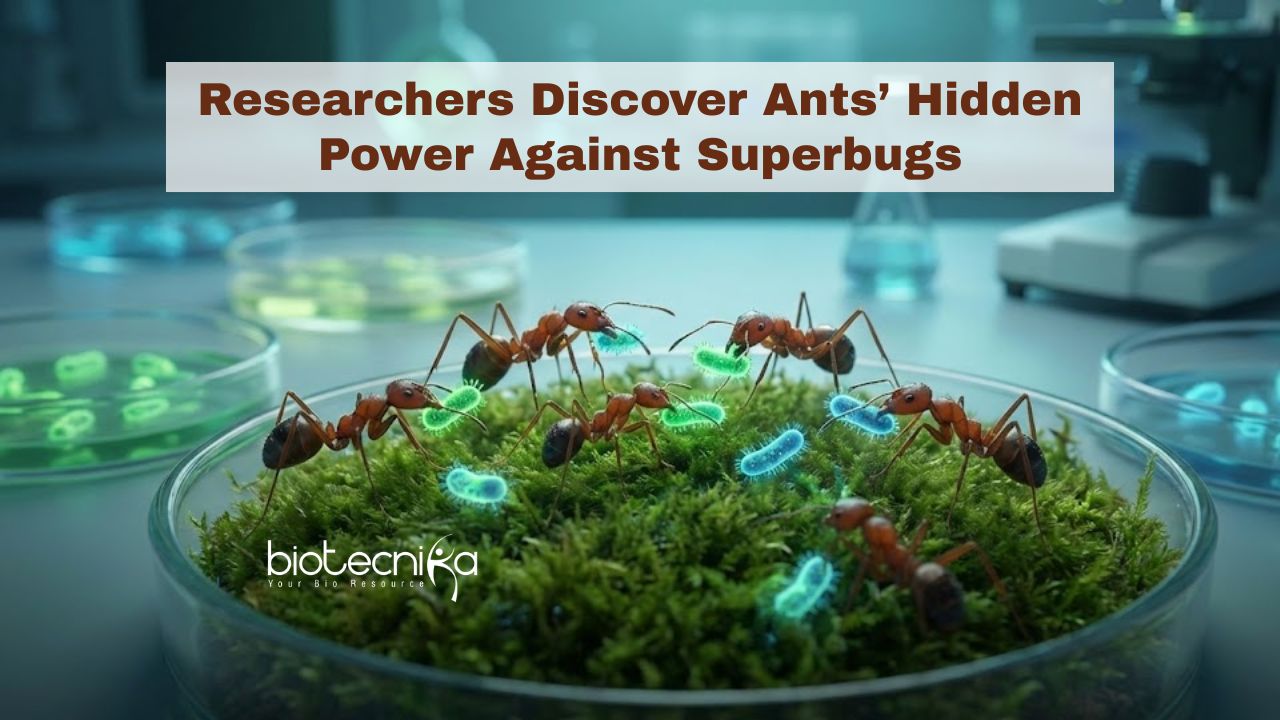
Would you believe the tiny pests crawling here and there, from garden to kitchen, can actually help fight “superbugs”? Yes, new research suggests that ants could help in developing antibiotics against pathogens.
A group of researchers at Auburn University in the US has found that ants are way ahead of humans in antibiotic resistance. The study focused on how antibiotic components are used against pathogens in ants and how their defence system remains effective over evolutionary time.
Superbugs are microbes (bacteria and fungi) that have become resistant to even the strongest antibiotics. This is raising concerns among the doctors as the infections are becoming harder to treat and sometimes impossible. Scientists have discovered that ants can produce certain natural components that kill harmful microbes, including superbugs. These could offer fresh perspectives in developing new medicines to overcome the growing problem of antibiotic resistance.
Humans have been dependent on antibiotics for less than a century, and have already developed resistance against many infections. Surprisingly, ants have been producing antimicrobial chemicals for over tens of millions of years and have evolved ways to keep the infections away. “Ants might teach us how to use powerful antimicrobial compounds more wisely,” said Dr. Penick, assistant professor of entomology and lead author of the study.
Tiny Ants, Big Antibiotic Warehouse
For the study, the team considered six different ant species that commonly inhabit college backyards and campuses. These are found in the Southeastern United States. The ants that run underfoot have the potential to produce the most powerful antibiotics to tackle superbugs.
The recently published study in the Biological Journal of the Linnean Society has proposed two hypotheses as to how ants handle germs without promoting antibiotic resistance. The first one goes like these tiny creatures produce different classes of antimicrobial compounds from different chemical components. When one antibiotic doesn’t work, they try a new combination to kill the germs ultimately. Penick explains just like how humans try new antibiotic medicines if one doesn’t work, the same way ants have multiple classes of chemicals or antimicrobials. The team tested this using the solvents extracted from ants and found the evidence.
The second proposed hypothesis is that ants can produce specific antibiotics to target a particular microbe. Targeting one particular microbe at a time has become a challenge in the case of humans. While taking antibiotics for one condition, we not only kill the pathogen but also harmless ones. This way, the microbes have developed drug resistance over time, raising the issue of superbugs.
The study shows that the ants can produce specific compounds against different pathogens, some target gram-negative bacteria, while some attack the fungi, and a few that can act on gram-positive bacteria. The team used all the ant extracts to test against the drug-resistant superbug Candida auris, a fungus that has been spreading in hospitals and posing a threat to treatment. The result was astonishing! All the extracts were highly effective, almost killing the superbug. This suggests ants may be producing chemicals with real therapeutic potential.
“The next step is to identify exactly what these compounds are and how they work,” said Penick. “It could help inform our own practices, or even lead to new compounds with medical importance.” The team included Katy Chon, a Kennesaw State University graduate student, and Darmon Kahvazadeh, an Auburn entomology and plant pathology graduate research assistant.